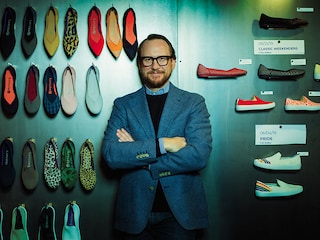
In 2018, Rothy’s sold over 1 million pairs of shoes. It will likely sell closer to 2 million this year. Today its lineup includes round-toe and point-toe flats, loafers and sneakers in a variety of colours and patterns (priced from $125 to $165), plus kids’ loafers and sneakers ($65). The China factory now fills six floors with 140 knitting machines and some 500 workers.
While traditional fashion brands work more than a year in advance, Rothy’s is immersed in its lineup for this coming fall and winter. It learns from its customers’ online purchases what to make more of, and what to cut, and holds contests on its website to determine what discontinued styles to sell again. Some shoes (like a pink camo) are duds with its customers, but others (such as a marigold point toe) become unexpected winners. “If we ever make a mistake, we might have two weeks’ stock rather than four days,” Martin says. The result: No excess and no discounting—ever.
The downside of speed is that if something doesn’t work, there may not be time to fix it. Earlier this year, Martin was excited about a summertime slide with a vegan leather sole. But as the new sandal went from prototype to production, there were quality problems. Days before the slated May launch, Rothy’s pulled the product, a decision that Rothy’s president Kerry Cooper called “heartbreaking”. A new sandal will debut in 2020. The decision will not meaningfully impact Rothy’s revenue this year, according to Cooper, and the company will recycle the small quantity of sandals it had produced for launch.
Rothy’s will open stores in a handful of cities, including Washington, DC, New York and Los Angeles this fall. It soft-launched sales in Shanghai earlier this year with a shop within the WeChat messaging app, a popular way to sell in China. Rothy’s is the rare American brand to choose China for its first international foray. Why? Its manufacturing is there, and distribution is easy. “It’s measured growth,” Martin says. “We try to do things in a disciplined way, but that doesn’t mean we’re afraid to try something new.”
Hawthornthwaite’s departure is a blow. Any founder’s exit is a demarcation point for a startup. But over the past year and a half, Rothy’s has built out an experienced, mostly female executive team, led by Cooper. She joined as president and chief operating officer after stints at Levi’s, Walmart and online fashion retailer ModCloth (as well as a two-and-a-half-year run as CEO of Choose Energy, a retail energy marketplace). This spring, Rothy’s added Dayna Quanbeck, former chief financial officer at Charlotte Russe, a now defunct clothing retailer for young women, as its first full-time CFO. The new execs have experience scaling businesses, an operational skillset that creative founders often lack and that Rothy’s will need on its way to an expected $280 million in sales this year. “Where we are now is different because I am here,” Cooper says. “They’ve never built companies.”
Read More
Longer term, Martin is thinking about new products that build off Rothy’s sustainable ethos. What exactly, he won’t say. But as look-alikes crop up—like Everlane’s $98 knitted flat—staying ahead of the competition is key. Of the imitators, Martin says: “Is it annoying? Yes. Is it somewhat flattering? Yes.”
His mind, though, is already racing ahead. “Innovation,” he says, “is the ultimate trump card.”