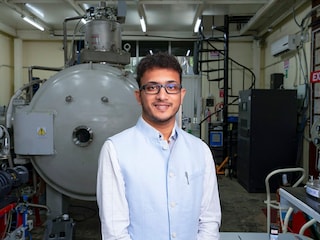
On March 30, Bengaluru-based space mobility company Bellatrix Aerospace announced it had raised $20 million in a pre-Series B round—led by Cactus Partners and including Hero Enterprise and other investors—to transition from flight-proven propulsion systems to large scale commercial manufacturing. The company has so far raised $31 million and is valued at $100-105 million. As the company focuses on cutting lead times and integrating with international supply chains, Co-founder and CEO Rohan Ganapathy speaks to Forbes India about Bellatrix’s journey from an academic experiment to a space qualified propulsion player. Edited excerpts:
The biggest shift is from proving that the technology works to proving that it can be built repeatedly, reliably, and at volume. We completed design development earlier, but a large part of the last few years has gone into qualification—ground and space—and tuning systems for long-duration performance.
Now the focus is on manufacturing readiness: High throughput production lines, predictable lead times, and consistent quality. Space hardware has no margin for error, so scaling isn’t just about capacity—it’s about building repeatability into every step of the process.
It’s fully end-to-end. We design the propulsion system, qualify it on the ground, fly it in space, and analyse its in-orbit performance. Ground qualification alone takes years: Engines have to operate for over 5,000 hours across different parameters so that we understand how they behave at end-of-life.
Subsystems like pressure vessels, valves, and electronics must survive extreme pressures, vacuum conditions, and operate reliably for 15 years or more, which is the typical lifespan of a satellite. Because very little of this data is publicly available, you also have to build your own datasets. Only after ground qualification and flight validation does a product become market ready.
Q. With satellites becoming more diverse, how has Bellatrix’s product strategy evolved?
One solution doesn’t fit all. Our original water-based electric propulsion works well for large satellites that can generate significant onboard power. But the market has clearly moved towards smaller satellites and constellations. So today we work across both electric and chemical propulsions and offer hybrid solutions. Our goal is to become a propulsion supplier to satellite manufacturers in the same way engine makers supply automotive OEMs. The platform shouldn’t matter; if you build a satellite, Bellatrix engines should be an option.
Q. You’ve spoken about qualification and reliability. How exacting is spacecraft propulsion engineering in practice?
Spacecraft propulsion engineering is extremely unforgiving; there’s no margin for error. You’re not just testing whether something works today, but whether it will work reliably for 15 to 20 years in orbit, without the possibility of repair.
In that sense, propulsion is like Swiss watchmaking: extremely small, extremely precise. Rockets get attention because of the noise and spectacle, but their job is over in a few minutes. After that, the satellite has to survive and operate flawlessly for decades. That’s why qualification standards are so stringent.
Isro played a key role in handholding us through this process, and we’ve also benefited from retired Isro experts who helped identify potential failure points early on. In deep tech, the gestation period is long, but there are no shortcuts.
Q. Space hardware is expensive. How much has India’s supply chain maturity affected costs?
When we started, our engine was more expensive than Boeing’s. Around 80 percent of the content had to be imported because India didn’t have a space subsystem vendor ecosystem. Isro builds components for its own missions but doesn’t sell them commercially, so even a single valve could cost several crores.
We made a conscious decision to be late to market and vertically integrate. Today, about 84 percent of our systems are indigenised. Some electronic components, like chips, will always need to be imported, but everything mechanical, coatings, and electronic design is now done in-house. That shift has dramatically improved both cost and control.
Q. How have regulatory changes altered the operating environment for private space companies?
Space has always been treated as a dual-use industry, especially propulsion. That hasn’t changed overnight, but the regulatory environment has become far more predictable. India becoming a signatory to the Missile Technology Control Regime was a major unlock for international collaboration. More recently, technologies like electric propulsions, which have no atmospheric or weaponised application, were removed from restricted categories, making exports easier.
On the investment side, the move to allow 100 percent FDI in space is a major step forward. Earlier, regulatory uncertainty was a bigger deterrent than technology risk. That uncertainty has reduced significantly, which makes long-term manufacturing and customer commitments far easier.
Q. You have an unusual role—CEO and CTO. How is it managing both?
Challenging. When we started Bellatrix, we thought technology would be the hardest part and managing people would be easy. I take that back. I can handle tech, but managing people is a nightmare. Everyone is different. Our team is extremely talented, but understanding and navigating personalities is tough. That’s something I’m still learning.
Q. Finally, what does success look like at this stage of Bellatrix’s journey?
Success now is about execution at scale. We’ve moved from flight proven to factory ready. That means shorter lead times, predictable deliveries, and propulsion systems that customers can rely on mission after mission. The opportunity in space today isn’t just about innovation, it’s about building industrial infrastructure. That’s what we’re focussed on.