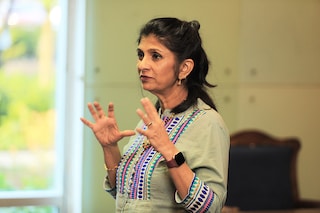
Vani Kola, one of the pioneers of venture capital (VC) in India, decided to return to the country in the mid-2000s to set up one of its first homebred VC funds, Kalaari Capital, to invest in early-stage tech startups. It was an unconventional bet, but more than 16 years later it ranks in the top quartile of the world, and has managed to consistently give 3x to 5x returns to its investors. “You can call it a leap of faith or a deep conviction, but we started taking early bets on e-commerce. The early stage is where maximum failures, setbacks, and value creation happen," says Kola, founder and managing director of Kalaari Capital, in a rare and exclusive conversation on Forbes India Pathbreakers.
In Part 1 of the conversation, Kola, by far one of the most authoritative voices in India’s burgeoning start-up ecosystem, shares life lessons from her journey to debunk what it takes to be a trailblazing entrepreneur and investor in times of mind-boggling valuations, rapid disruption, and intense competition. “I have seen five bubbles so far in my life. So, the ‘up’ doesn’t excite me and the ‘down’ doesn’t depress me," she says. Edited excerpts:
Being Vani Kola
Vani Kola is one of the most powerful women in business. She has financed and mentored some of the country’s best startup founders. Her influence and credibility in the industry is the result of decades of hard work and conviction. “I approach everything with the question, ‘Will I find meaning in the context and horizon of time that truly matters to me?’ Ultimately, everything you do is for yourself. This might sound narcissistic, but that is how I look at the choices I make. I think that if you are not fulfilled with your work, then you cannot bring your best self, and you will not be happy. I derive this ‘best self’ of mine from the structure in my life—my morning meditation, my focus on living a healthy life that goes beyond simply focusing on fitness, and engaging in doing things outside of work. All these things give me a sense of purpose and joy. ‘Being Vani Kola’ is about all these things and more that help me in being my better self every day," says the venture capitalist.
The trailblazer
Kola grew up in a family that encouraged her to follow her passion and chart her own path. “I was very good at maths," she says, “I was encouraged to dream, to pursue a career in a male-dominated world. I had a nurturing home and school environment that was always encouraging me to be my best self. Why not? You can do unconventional things. You can be what you aspire to be. So, I am grateful for that. The willingness, the capacity, the confidence to be one of the few among many, to be the minority, to make choices that are right for you, even if they are not conventional was not difficult for me. Also, some may say that unconventional means risky, but that type of risk-taking and taking challenges felt normal. But different people have a different sense of normal. I think, my normal was always to be a ‘trailblazer’, if I can use that word."
This offers clues on Kola’s readiness to take the unbeaten road. She elaborates, “I think the same journey led me as a young mother to not think that hard about jumping into starting a new company. I did that at the age of 30. Around 41, I moved back to India, which also for a lot of people sounds like a risky decision. But the fact is that I did not see it as a risky decision. I saw it as an adventure, a learning experience, and a motivating challenge that could test me in a fulfilling way. So, I think the principle of pushing yourself for challenges without worrying about calculating the risk, but instead looking at the upside, looking at the positives was imbibed in me. I think it was the confidence, perseverance and conviction to listen to my intuition and accept setbacks to pursue my dreams. These can be qualities that are once nurtured and continue to bear fruit for you year after year."
The entrepreneur
As most entrepreneurs, Kola had a steep learning curve when she donned the hat of an entrepreneur in the US. She says she started out with the vision of a product, and a challenge to herself to prove her mettle and break out of self-limiting beliefs. “I think the entrepreneurial journey can have so many analogies, like drinking from a fire hose or being an extreme athlete, because it is intense," she explains. “But the most important part of my journey was realising how many walls are inside us. We almost have an unlimited capacity to underestimate ourselves. I think we don’t put ourselves in situations where we can pull from our reserves and find out what we are truly capable of. It is a journey of self-discovery and in that sense, it is a spiritual journey for me. Of course, the companies were successful, the investors made money, and I made money. That’s all incidental, but the learnings and the way they fuel your life are important."
More importantly, entrepreneurship is a test of character. “It is also a test of your values. There are many temptations on the path of entrepreneurship, but you have to keep your feet on the ground and have common sense. I have seen five bubbles so far in my life. So, the ‘up’ doesn’t excite me and the ‘down’ doesn’t depress me. I remember people saying, ‘You could be a $5 billion company.’ I wondered if we really could we had $50 million in revenue! So, when we had an opportunity to sell the company for $1.2 billion, which had a different magnitude and aura in the 2000s than today, I decided it was a good deal. People told me we could get more. But my common sense as a founder and CEO told me, ‘Well, that’s just a bubble’. We were very fortunate that we made the right decisions. There were some companies that were down 90 percent and 80 percent in value, and nothing changed."
The investor
After Kola sold her second company, she chose to take a break and catch her breath to decide what she wanted to do next. She gave herself six months to pause and reflect. Incidentally, she travelled to India at this point in her life, after being away for over two decades. The country had changed and how. “It was like a new country to me," she says, “It was like a magical draw. I hadn’t expected it. I went back and told my husband that I think we should move to India. I thought, ‘This is a very different India and if I don’t participate in it, India will be fine, but I will miss out.’ My entrepreneurial fervour or my entrepreneurial bone drove me here."
Within a couple of months, in 2006, Kola relocated to India with her family and set up Kalaari Capital, which is now one of the country’s leading homebred VC firms. “The name ‘Kalaari’ itself comes from ‘Kalaripayattu’, a martial arts form which to me represents many of the entrepreneurial traits that I value, like commitment, strength, perseverance, and so forth," she reminisces. “Raising the fund was relatively easy because we raised it in North America and had established credibility and reputation. Relationships are also big assets in your bank. These help you navigate your highs but more importantly, they help navigate your lows."
What transpired in the following months was an interesting lesson in how to unlock opportunities. “Coming to India, and what to invest in India, would be a lot of unlearning for me. I knew I was new in India and that I should not bring in so many assumptions of what works and what doesn’t work from just my experience. They are important, but only as they are relevant. I knew that I had few unfair advantages to gain access, at least. There were a lot of people that were willing to give their input and ideas or encourage me," she says.
Read More
The unlearning process wasn’t simple: Kola, an engineer, had just returned from Silicon Valley, and was impatient to make India global. But in 2006, India’s tech infrastructure was not ready and the market was yet to evolve. “So, everything I had in terms of my US network and experience was useless because Indian companies weren’t rapidly going global at that point," she recounts, “My technology knowledge and experience also proved to be useless because there weren’t many deep tech companies at that time." This opened new windows as Kola explored the market for new areas of disruption.
She continues: “Somewhere we started picking up new things, whether it was e-commerce or gaming, which were not getting early air cover from more traditional investment firms that were in India, and you can call it a leap of faith or a deep conviction but we started taking early bets on that. I enjoy working with early-stage companies and knowing the founders at the beginning of their journeys and all the possibilities that it represents. I think that we are good mentors at that phase of a company’s life. The early stage is where maximum failures happen, maximum setbacks happen, and also maximum value creation happens."
The joy of reimagining what’s next is also a risky gamble, because investors do not have a crystal ball to accurately predict the outcome of an early-stage venture. There is potential, undoubtedly, but there’s also a lot that can go awry, unexpectedly, as the business scales up. This means investors must be open-mined, alert, and agile to pick changing trends and red flags in a fast-changing landscape.
“We were early investors in Snapdeal, Myntra, Dream11 via Simplilearn and many companies that fortunately have created great returns for our funds. That is another thing that has always been important to me. Coming from a very conservative middle-class family, the sense of money and its value is very intimate to me. Money is a means to an end it is not the end itself. But money brings responsibilities and obligations. We have always wanted to create par returns globally and have been able to consistently return 3x to 5x of our funds. This puts us in the top quartile in the world," Kola says.