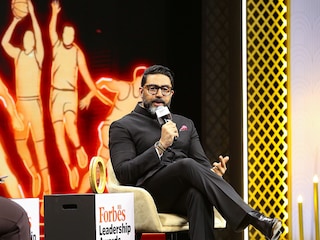
At the Forbes India Leadership Awards 2026, Abhishek Bachchan wore his latest award title 'Icon of Excellence' lightly. “It’s a bit embarrassing,” he admitted on stage, looking out at a room filled with business leaders and entrepreneurs. “Seeing the luminaries in this room today, I feel I don’t think I’ve really earned any of it. We’ll work in reverse...I’ve got the award, and I’ll try and live up to it.”
That self-effacing note set the tone for a conversation that moved seamlessly across cinema, OTT platforms, investing and sports entrepreneurship. Yet, repeatedly, Bachchan returned to one central idea: Decisions that last are driven by conviction, not just calculation.
Why He Refuses to Be ‘Unidimensional’
Reflecting on a career that has spanned more than two decades, Bachchan spoke about his resistance to getting boxed in. “I probably get very bored being unidimensional,” he said. “I like the challenge. I enjoy variety. I like to push boundaries. I like to take risks.”
For him, those risks are not driven by spreadsheets alone. “It all starts from: Does your heart lie in what you want to do?” he said. “If your heart isn’t in it, then what’s the point of doing it?”
That belief, Bachchan explained, comes from growing up around cinema--where decisions were often guided as much by emotion as ambition. Films, he said, were not just entertainment but lessons in instinct and audacity.
Lessons From Cinema
One of the most formative influences, Bachchan said, came from watching his father Amitabh Bachchan on screen. He recalled a scene from Deewar that left “an indelible mark” on him.
“The character buys this building and the seller tells him, ‘You’re a very bad businessman, you’ve paid several lakhs above what I would have sold it for,’” Bachchan recounted. “And my dad’s reaction was: ‘Actually, you’re the bad businessman. Had you asked for Rs 10 lakh more, I would have paid it.’”
The reasoning behind that decision, Bachchan said, stayed with him. “There was an emotional connect. My mother helped build this building,” he explained. “What that taught me was that there was emotion behind the business. It wasn’t just about the balance sheet, and that really formed an integral part of my decision-making.”
Taking the OTT Leap
That same thinking informed Bachchan’s early move into OTT content—at a time when few mainstream Hindi film actors were willing to experiment with the format. “I was one of the first film actors that went on to do a series on OTT,” he said, referring to Breathe. “Creatively, it was exciting.”
Read More
What drew him to OTT was the luxury of time. “You have twelve hours to tell a story as opposed to two-and-a-half hours in a film,” he explained. “You can really deep-dive into the nuances of a character. That’s what excited me about OTT.”
It wasn’t about chasing a trend. “It didn’t really make a difference that others weren’t doing it,” he said. “It was just something that excited me.”
Investing With Instinct
That preference for instinct over convention is also visible in Bachchan’s approach to investing. Asked about his early bets on Swiggy and Zepto—long before quick commerce became mainstream—he laughed at the simplicity of his reasoning.
“You’re not going to like my answer,” he said, smiling. “But the truth is… they got my food to me on time.”
Behind that casual line, however, lay a clear logic. “I enjoyed using the product. It benefitted me in my day-to-day life and made my life a lot easier,” he said. “So I said, ‘Hey guys, can I be involved in some way?’”
By his own admission, Bachchan is not driven by spreadsheets alone. “If your heart isn’t into it, then it doesn’t matter if the balance sheet and spreadsheets are great,” he said. “I’m not able to alienate myself and just be very cut-throat business about it. For me, it’s always been my gut.”
Betting on Indian Sport
If films shaped his emotional approach to business, sport, Bachchan said, taught him the importance of infrastructure and long-term belief. His investments in teams such as Jaipur Pink Panthers in the Pro Kabaddi League and Chennaiyin FC made him one of the earliest celebrity backers of those sports.
“I always wanted to do something with sports in India,” he said, recalling his years at a European boarding school where organised sport was a way of life. The turning point came, however, during a conversation with then FIFA president Sepp Blatter at the World Cup in Rio in 2014.
“He said, ‘You have 1.2 billion people. You can’t put eleven boys on a pitch,’” Bachchan recalled. “It was harsh, but it was true.”
For Bachchan, the solution lay in infrastructure. Quoting Field of Dreams—the Hollywood film centred on building opportunity before expecting results—he said, “If you build it, they will come.”
At the time, sport in India was not seen as a viable career option. “I wanted to change that thought process,” he said.
The potential became clear, he said, when he watched a local kabaddi tournament near his home. Played on mud, it drew nearly 10,000 spectators. “That just blew me away,” he said. “Here’s a sport that just doesn’t have the spotlight on it.”
The growth since then has been stark—from Rs 11 lakh auction prices in the league’s earliest season to players selling for close to Rs 3 crore today. “That’s the scale these guys went up,” Bachchan said. “They’re huge celebrities. They have fan clubs now.”
When asked why he never invested in the IPL, Bachchan was characteristically candid. “When it started, it was just too expensive,” he said. More importantly, “I didn’t know what I could contribute. I’m not somebody who’s happy sitting in the stands and waving.”
Instead of dispensing advice as the conversation drew to a close, Bachchan turned reflective. The question that occupies him most, he said, is: “What keeps you motivated every day?”
“The euphoria kind of dies down,” he added. “How do you keep going?”
And in that uncertainty, he offered one hard-earned truth: “You’re never going to know success if you’ve never been through failure. Be comfortable falling, provided you’re willing to do what it takes to rise after that.”