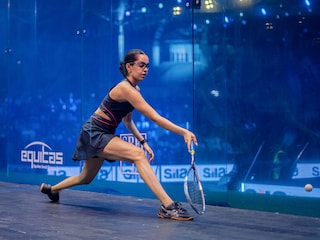
Like many students, Anahat Singh struggles with maths. Which is why she once chose to confront her fears in a way she knows best—in a glass court.
Two years ago, in the run-up to her Class 10 board exams, Singh chose a practice session of squash to run equations in her head. “Every time I’d hit a shot, I'd say one physics equation. But it didn’t work. I'm not going to use that technique again,” says the 18-year-old, breaking into a laugh.
Thankfully for Singh, when she steps on the court, there’s only one number she has to worry about—11, the number of points she needs to win a game. And judging by how often she gets there, one would say that’s one equation she’s mastered.
In the 2024-25 season, the Delhi teen was awarded the Women’s Challenger Player of the Year by the Professional Squash Association (PSA), after winning 9 of the 11 Challenger tournaments she played in. She was also jointly named the Women’s Young Player of the Season alongside Egypt’s Amina Orfi.
But Singh’s headline act came this February, at the elite level and in her first season on the senior tour, when she secured the biggest victory of her three-year professional career by winning her first bronze-level title. [Professional squash has a six-tier structure with the diamond level at the top, platinum, gold, silver and bronze in the middle, and copper at the base.] At the Squash On Fire Open in Washington, she beat Georgina Kennedy in straight games, avenging her defeat to the World No 10 at the Canadian Open in October. To put Singh’s feat in perspective, Kennedy was the first Englishwoman to win a squash gold in the Commonwealth Games, in Birmingham in 2022, where Singh was the youngest member of the Indian contingent at 14, and faced a second-round exit.
The victory catapulted her to No 20 in the world rankings, making Singh (who was just shy of 18 then) the youngest Asian player to break into the bracket. By climbing over 60 spots in a year—from outside the top 80 in mid-March last year—she has made rapid strides in a sport that is set to debut in the Los Angeles Olympic Games in 2028.
Soon after her successful US swing, Singh won her second world tour title, this time on home soil, by clinching the JSW Indian Open, a copper-level tournament in Mumbai in March. With it, her total title count has gone up to 16, from 18 finals and 26 tournament appearances.
Singh, though, wears her early successes lightly. She shrugs when asked how she managed to handle the pressure of playing at the elite level. “It’s easier for me to play higher-ranked players at the senior level since I have nothing to lose and no one expects me to win. There is zero pressure on me,” she says.
In fact, what’s perhaps weighing more heavily on her at the moment are her upcoming Class 12 board exams beginning April, and for which she will have to skip the World Championships being held in Egypt in May. At the JSW Indian Open, Singh spent as much of the day studying as she did preparing for matches. “My match today is at 8 pm,” she told Forbes India on the day of the quarterfinal, “so I spent the entire morning studying. If I am not studying enough, it stresses me out and that’s not what I want before a match,” she says.
A student of the British School in Delhi’s Chanakyapuri, Singh is articulate beyond her years; she grasps questions instantly and rarely stutters in her answers. But underneath all that poise is a fiercely competitive player, says Sourav Ghosal, former World No 10 who is mentoring Singh. “The only way to get Anahat to do something is to beat her to it. Losing is an absolute no-no with her. The fear of losing spurs her on,” he says.
Singh with her coach Gregory Gaultier, the former World No. 1 squash player. Photo courtesy JSW Indian Open
Quick rise
Singh started playing badminton at five and would accompany her parents to the Siri Fort in Delhi, where her sister Amira would play squash. In some time, she began to compete in both sports, but eventually gravitated towards the latter as it became easier for her parents to travel with both the siblings. When she was nine, she won the under-11 title at the British Junior Open, and at 10, she won in the under-13 category. “I realised squash was going to work out pretty well and maybe I should focus on it,” says Singh, who grew up idolising veteran Joshna Chinappa. In December, the two played as part of the national team that won India's first ever World Cup title, with a whitewash against Hong Kong.
As Singh graduated to the senior circuit this season, her mental switch took place during the Canadian Open, a PSA Silver event in October, where, for the first time, she took down a player each from the top 20 and top 10—Melissa Alves of France (then World No 20) in the pre-quarters and Tinne Gilis (then No 7) of Belgium in the quarters—before losing to Kennedy in the semis. It gave her the belief that she belonged.
“Initially, I would feel that maybe I could win one or two games against top players, but won’t be able to convert that into winning a match. This was the tournament that changed my perspective; it was here that I felt that not only could I give top players a good fight but I could win those matches as well,” says Singh.
In her victory against Kennedy, this confidence saw her through a phase in the first game when Singh was trailing 8-10, and then won four consecutive points to seal the game. “Against a player of her stature, you have to win the first 10 minutes. That’s what I kept telling myself when I was behind. If you give her an edge in the first game, she won’t let you come back,” says Singh.
When Ghosal first saw Singh in 2022, she was “all skin and bones but had some serious ability to return balls”. “Now her game has a lot more layers,” he says. At the JSW Indian Open, she proved equally adept at powering through drives as well as executing deft drop shots. From a time when she would just want to play—“and she will play 10 hours a day if you ask her to,”—Singh has now finally taken to the routines around it: Warming up, cooling down, training at the gym, “boring things she now realises will eventually strengthen her game”, says Ghosal.
“Credit to her that she takes the constant jabbering from me,” he laughs. “But, jokes apart, she is extremely receptive to feedback.” As a result, her game has developed a lot of nuances from the earlier unilinear attack-and-return mode. “She can produce a lot of variations. Although nowhere close to the level of [Egyptian World No 2] Nour Elsherbini, she has a semblance of it. And that’s very hard to deal with,” says Ghosal. “One of Anahat’s USPs is that she can pick the right shots, which is something innate to a player and tough to teach.”
The other thing Singh has gotten good at is bouncing back from losses. Her win against Kennedy in February came weeks after an unexpected defeat in the final of the British Junior Open, where she was the top seed in the under-19 category. “Losses should sting, so I can imagine why she couldn’t snap out of it,” says Ghosal. “But, earlier, she would visibly take a week to recover. Now, she turns around in 2-3 days.”
Road to the Olympics
For the last two years, Singh has been shuttling off to Prague from time to time to train with former World No 1 Gregory Gaultier, who is steering her with the maxim that ‘practice makes perfect’. “There are certain areas on the court Anahat still isn’t comfortable with and there are certain shots she doesn’t time well. She needs to iron out these things with repetition,” says Gaultier.
The Frenchman first saw Singh at a national camp in Chennai around 2022, and her tricky game caught his attention. “I went on court twice that week with her, and both times she took points out of nowhere. Even at that age, when she was 13 or 14, I had to be on guard against her,” he says. “She is stronger now, can stay in rallies against better players and her current world rank is proof of that,” adds Gaultier, who along with Ghosal and Stephane Galifi, former Italian international, comprise the coaching cohort that’s guiding Singh.
The good news is that Singh handled the pressure of being the top seed at the JSW Indian Open and went on to win it comfortably. But her toughest journey begins now. “The climb from No 20 to the top 10 will be most difficult as all top players are equally skilful and competitive,” says Gaultier.
The bird’s eye is the top eight who get automatic qualification to LA28. But, before that is the Asian Games in September, where a gold will earn her direct qualification to the Games as the continental champion. But Singh isn’t taking anything for granted. “The competition will be stiff, world Nos 6 and 7 will play in that event, and I don’t think anyone expects me to win gold. If I win, it will be a bonus,” she says. If that doesn’t happen, she is set on improving her rankings fast and reaching the top eight, so that “I don’t have to stress the last few months about qualification and train for the Games instead”.
As the highest-ranked Indian on the global list, Singh is the frontrunner from the Indian contingent to make it to the Olympics. “That doesn’t mean she’s a medal prospect if the Olympics were to happen today,” says Ghosal. But given her career trajectory, and that the Los Angeles Games are still two years away, she has enough time to fashion herself into one.
“If Anahat can get a medal, or even has a strong run, it will help squash capture national imagination,” Ghosal adds. In a country, where the sport remains niche, that will be no mean feat.