Modi unveils Manav vision at AI Summit, calls for AI as ‘global common good’
Modi, Macron and Guterres unite on child safety and warning against unregulated AI for minors
By
Prefer us on GoogleLast Updated: Feb 19, 2026, 19:33 IST3 min
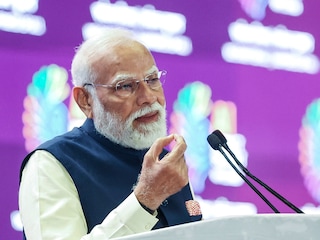
Prime Minister Narendra Modi on Thursday called on the world to resolve that AI be developed as a “global common good” and unveiled India’s new AI governance doctrine, the Manav Vision, at the India AI Impact Summit.
UN Secretary-General António Guterres, who also spoke at the event, offered a pointed endorsement of that framing. “The future of AI cannot be decided by a handful of countries or left to the whims of a few billionaires,” he said.
French President Emmanuel Macron, co-host of last year’s Paris AI Action Summit, hailed India’s technological evolution as a “civilisational story”. The India Stack, the country’s interlocking architecture of digital identity, payments and health records, was, he said, precisely the kind of open, interoperable and sovereign infrastructure the AI summit was convened to advance.
While tracing a line from the first spark struck from stone to the transcription of speech into script to the wireless transmission of signals, Modi said, “The fascinating part is that when we are living through such a transformation, we rarely grasp its true impact. Artificial Intelligence is such a transformation.” What distinguishes this moment, he said, is speed and scale, “Today, the journey from machine learning to learning machines is faster, deeper, and broader.”
He also drew a pointed analogy to the history of nuclear power when talking about the applicability of AI today: “If directionless, it leads to disruption; if guided rightly, it becomes a solution.” The summit’s guiding principle, he said, was drawn from ancient Indian thought, “welfare for all, happiness for all”.
The benchmark India has set for itself, Modi said, is that no human being should be reduced to a mere data point or a unit of raw material to be processed by systems built and owned elsewhere. AI, he said, must instead be democratised, transformed into an instrument of inclusion and empowerment, with the Global South at the centre of that ambition rather than at its margins.
Guterres echoed the point with a concrete ask. Calling for a $3 billion global fund to build AI capacity in developing nations, covering skills, data, affordable computing power and inclusive ecosystems. He noted the sum amounted to “less than 1 percent of the annual revenue of a single tech company”. He also announced the formal appointment of a 40-member independent international scientific panel on AI, mandated last year by the UN General Assembly, saying the panel’s message was unambiguous “AI must belong to everyone”.
Macron reinforced the argument through the lens of strategic sovereignty, contrasting India’s deliberate bet on small, task-specific language models with France’s investment in large-scale sovereign models. “India chose granular and smart. Europe chose sovereign and scaled. But both chose independence, and both were right,” while adding that no country was bound to serve only as a market where foreign companies sell their models and download citizen’s data.
Modi also called for content authenticity standards to be wired into AI systems from the outset adding that in the digital world content must carry authenticity labels so that people can distinguish what is AI generated.
Modi drew a distinction between those who see fear in AI and those who see fortune. “We have the talent, we have the energy and capacity, and we have policy clarity.” He announced that three Indian companies had launched their own AI models and applications at the summit, and concluded with an open invitation to the world: “Design and develop in India; deliver to the world; deliver to humanity.”
First Published: Feb 19, 2026, 20:05
Subscribe Now