TTK Prestige is looking for life beyond the kitchen
India's largest branded cookware firm is banking on a surge in rural demand and exports to keep the pot boiling
By
Prefer us on GoogleLast Updated: Dec 19, 2018, 10:26 IST9 min
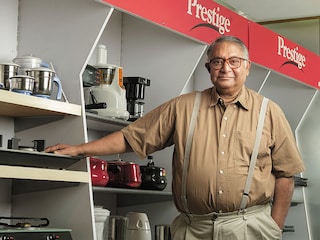
In terms of volume, the pressure cooker market in India is 15 million-strong, of which TTK Prestige has a 40 percent market share and rival Hawkins has a 27 percent share. The remaining share comprises largely the unorganised market. According to Jagannathan, “There are about 800 pressure cooker companies in India. But they make low-priced products which could burst in your face.”
In 1955, Jagannathan’s father TT Narasimhan started importing the Prestige brand of pressure cookers from the United Kingdom. It was a profitable business from day one, recalls Jagannathan, so much so that his father started manufacturing the products in Bengaluru (then Bangalore) by 1959. The parent UK company collected royalties for the use of their brand name.
From one factory in Bengaluru to six factories across India, TTK Prestige today manufactures pressure cookers for the Prestige brand, globally. “Every cooker they sell is made by me,” says Jagannathan with a smile. In 1997, UK’s Prestige cookware brand was bought by Hong Kong-based Meyer Group.
TTK Prestige was, in fact, the only profitable business that Jagannathan inherited from his father in 1972. Those days, the TTK Group, founded in 1928 by Jagannathan’s grandfather (former Union finance minister) TT Krishnamachari, had diverse business interests ranging from the manufacture of condoms, maps and atlases, innerwear, clocks, pens and pressure cookers. They even manufactured, and still do, the Woodward’s Gripe Water that is given to babies to aid digestion.
“I had got a nice job in America to teach operations research [now a defunct subject] and had decided to settle down there,” says Jagannathan. But when his father broke the news to him that the group was almost bankrupt, Jagannathan was forced to give up his American dream. “I had left my books and winter clothes in America thinking that I would be back in one year because I didn’t have it in me to run a business,” he says, matter-of-factly. “I was an academic… I didn’t know accounts, finance, HR and marketing.”
The biggest loss-making entity within the TTK Group was maps and atlases, which was a partnership firm with Bertelsmann of Germany. According to Jagannathan, Bertelsmann had estimated a demand for 8 million atlases and 30 million maps per year and had accordingly set up a printing press in Chennai, in 1965. But those estimates turned out to be far-fetched, as the partnership firm was reporting losses of ₹80 lakh a year by 1972.
Starting off as general manager of the maps and atlases business, Jagannathan, the self-proclaimed academic, actually got down to tightening the nuts and bolts in the company.
“We had printing machines that were lying idle, so I secured print jobs from advertising firms that helped us arrest losses to some extent,” Jagannathan recalls. Today, the maps and atlases business (formerly TTK Maps) is part of another listed group company, TTK Healthcare. Jagannathan says, “Only 1 million atlases are sold in India and almost no maps are sold because of Google.”
Then, in 1974, he relocated to Bengaluru to take charge as managing director of TTK Prestige, after the previous MD was sacked by his father on account of misbehaviour. Since then he has made Bengaluru his home. *****Till about 2001, TTK Prestige only made pressure cookers, having a range of about 12 models. Its target audience was solely the homemaker, so much so its ’90s tagline ‘Jo biwi se kare pyaar, woh Prestige se kaise kare inkaar’ (One who loves his wife, how can he say no to Prestige) became a household catchphrase. With the homemaker firmly behind the company, Jagannathan expanded the product portfolio to include cookware, mixer grinders, gas stoves, kettles and ovens, among other appliances. The diversification, however, was the result of pressure cookers being slapped with a 57 percent tax—a combination of sales tax and excise duty. Currently, 50 percent of TTK Prestige’s revenue comprises pressure cookers and cookware.
In Jagannathan’s defence, TTK Prestige’s profitable pressure cooker business gave him time to restructure and shut down all the non-profitable businesses of the TTK Group. “People say the TTK Group is so old and diversified, yet we are small with a valuation of $1.8 billion (which includes the group’s stake in the two listed entities, TTK Prestige and TTK Healthcare, as well as land assets and cash reserves),” Jagannathan says, adding, “They don’t realise that we [as a group] didn’t have much money till 2001.”
TTK Prestige achieved another key diversification over the past year. This time, Jagannathan admits to having tried to achieve this goal five years earlier. The company has tied up with top foreign retailers for the export of its cookware range. “These would be white label exports to all the big guys,” says Jagannathan, while refusing to name any of the retailers. The move would see TTK Prestige’s international business swell to 10 percent of its revenue next year from 5 percent at present.
Jagannathan’s role as executive chairman is not to run the company—that has been entrusted to the company’s MD since 2001. Interestingly, all three of Jagannathan’s sons–Mukund Thattai, 42, TT Lakshman, 40, and TT Venkatesh, 36–have not shown interest in taking up executive positions in the company.
So after Jagannathan, the family would function in the capacity of promoter-shareholders with board representation. “Standard wisdom is that the first generation starts the company, the second generation builds the company and third generation destroys the company. I’m the third generation, I haven’t destroyed it, but built it,” says Jagannathan, with a sense of pride and accomplishment.
First Published: Dec 19, 2018, 10:26
Subscribe Now