Dream11’s second innings: Betting big on India’s watch-party economy
Dream11 is betting on community, creators and polls to replace cash contests
Last Updated: Dec 29, 2025, 13:05 IST3 min
For more than a decade, Dream11 defined how India gamified sport. What began in 2008 as a niche fantasy cricket platform grew into a consumer internet giant, riding the country’s sporting obsession and smartphone boom. By 2024, Dream11 had crossed 250 million registered users, commanded an estimated 70 percent share of India’s fantasy sports market, and reached a valuation of about $8 billion, backed by investors, including Tiger Global, DST Global and TPG.
Then came 2025.
India’s new online gaming regulations—which effectively banned real-money gaming formats, including paid fantasy sports—struck at the heart of Dream11’s business. Entry fees and cash prizes, which accounted for an estimated 90 to 95 percent of revenues, were no longer permissible. For a company that generated `6,384 crore (FY23) revenue at its peak, the impact was swift and existential.
Importantly, Dream11 was no longer just a single-product company. Under its parent, Dream Sports, the group had been building a broader sports ecosystem. Its portfolio includes FanCode, the digital sports streaming platform with rights to hundreds of leagues; DreamSetGo, a premium sports experiences business offering access to global sporting events; and Dream Capital, an early-stage investment arm backing sports, fitness and gaming startups. Collectively, these businesses signalled Dream Sports’ ambition to be a full-stack sports company—not merely a fantasy gaming operator.
Instead of retreating, Dream11 chose to reinvent.
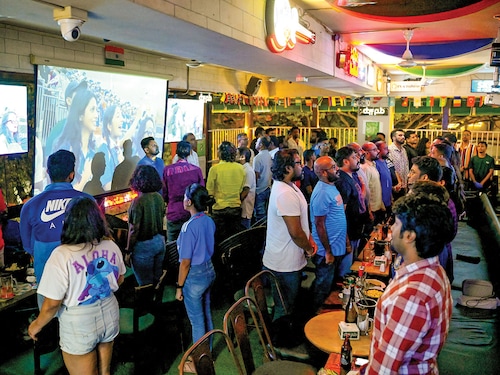
In late 2025, the company began rolling out a redesigned app focussed on India’s rapidly growing watch-party culture—a second screen, social way of consuming live sport. The idea is simple: If fans can no longer play for money, they can still play a role in the moment.
“We’ve always believed that sports is fundamentally a shared experience,” says Harsh Jain, co-founder and CEO of Dream11. “The regulation changed the format, not the fan behaviour. People don’t just watch matches anymore—they react, discuss and celebrate them together.”
The numbers support that insight. India today has more than 450 million online video viewers, and major sporting events routinely generate tens of millions of real-time social interactions. During the 2023 Cricket World Cup, digital engagement around live matches grew by over 30 percent year-on-year, driven by creator livestreams, memes and fan commentary layered on top of traditional broadcasts.
Dream11’s new app positions itself squarely in this second screen universe. Instead of drafting teams, users can join creator-led watch rooms during live matches, interact through chat and reactions, and take part in free-to-play predictions, polls and trivia. The product is designed to complement the live stream—not compete with it—turning passive viewing into a communal experience.
Monetisation, at least initially, will rely on advertising, brand integrations and premium fan features, rather than entry fees. Executives believe that even a fraction of Dream11’s historic user base—50 to 60 million monthly active users—could make the platform attractive to brands seeking scale during marquee sporting events.
The pivot mirrors global precedents. Platforms like Twitch, which generated more than $3 billion in revenue in 2024, have shown how live content combined with community interaction can become a durable business. But Dream11’s challenge is steeper: It must transition from a high-margin gaming model to an attention-led media play, while competing with YouTube, Instagram and X, where sports conversations already thrive.
Industry observers say the shift is less a pivot than a return to first principles. “Dream11 didn’t just build a gaming company; it built a habit,” says one digital media executive. “The question was how to preserve that daily engagement without real money.”
Still, the risks are substantial. Advertising-led models are notoriously volatile, creator ecosystems are competitive and attention spans are short. Dream11 is now competing not just with fantasy rivals, but also with social media platforms, streaming apps and influencer networks—many of which already dominate sports conversations.
Yet Dream11 has one key advantage: Its audience. Millions of users already associate the brand with live sports moments. Converting them from contestants into community members may be easier than starting from scratch.
For Jain, the transformation is as philosophical as it is commercial. “If regulation has made one thing clear,” he says, “ it’s that the future of sports engagement in India has to be participatory, inclusive and entertainment-first. People want to feel like they’re watching together—even when they’re miles apart.”
In an industry where regulatory shocks often kill companies, Dream11 is attempting something rarer: Reinventing itself mid-match. Whether India’s watch-party economy proves as lucrative as fantasy gaming once was remains uncertain. But one thing is clear—Dream11 isn’t ready to leave the stadium just yet.
First Published: Dec 29, 2025, 13:20
Subscribe Now(This story appears in the Dec 26, 2025 issue of Forbes India. To visit our Archives, Click here.)