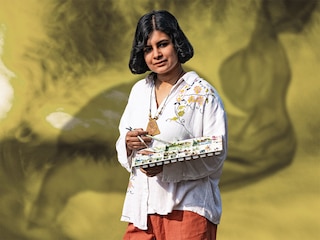
Moumita Basak (29) Artist
If you go through Moumita Basak’s CV, it will tell you that she completed her bachelor’s in Fine Arts (BFA) from Government College of Art and Craft, under University of Calcutta, followed by her master’s degree from the same institution. It will tell you she has received a host of scholarships and awards at the state, national and international levels, including a gold medal from the International Textile Triennial in Central Museum of Textile in Lodz, Poland (2022) and the Inlaks Fine Art Award (2026). It will tell you her works have been displayed at prestigious exhibitions in India and abroad, including the Kochi Students’ Biennale (2021) and Richard Saltoun Gallery in London (2024). And that she has been selected for residency programmes in cities as diverse as Kolkata and Salhus, Norway.
What her CV will not tell you is that a teenage Basak rebelled against her family, and applied for her BFA with help from her friends and without her family’s knowledge; that she would tell her family she is going for tuition classes, and, instead, go for her for admission interview—about 143 km from her home in Srirampur to Kolkata. And, finally, once she gained admission, she would simply land up in college, call her family and tell them she is not coming home anymore. This, not to pursue an ambition of becoming rich and famous, but to follow her passion of becoming an artist.
“I didn’t keep in touch with my family at all for about five years,” says Basak, who eventually reached a state of reluctant reconciliation after she fell gravely ill. “I survived on money that I had saved up from a state scholarship I had won because of my Class 12 results, and the pocket money I would get.” Even then, going hungry became par for the course, causing her to drastically lose weight. “I met my mother once, and she was in tears after seeing me,” recalls Basak.
Basak’s artwork reflects her experiences, where her mediums, too, are an extension of the lives around her. Kantha stitches—an intrinsic part of Bengal’s textile heritage, used in everyday mundane drapes as well as exquisitely embroidered garments—textiles, waste cloths, along with tea and coffee tints take on unique shapes and textures in her works.
Read More
Click here for Forbes India 30 Under 30 2026 list
“Moumita’s medium of Kantha stitch comes from her natural environment, where she has seen women around her use it to put together clothes and household upholstery,” says Soujit Das, former assistant professor, History of Art, Government College of Art and Craft, and currently an independent art historian.
“When I came home during Covid, I didn’t have the art material that I had while I was in college. However, I had to continue my practice. In earlier days, I would watch women make bangles, or other items for their households. My older sister would work as a tailor, from where I could access different kinds of textiles. I began to use those, along with other mediums, such as water colours,” explains Basak.
Initially, her works were about her own experiences, and that of other girls and young women around her. Now, she has a studio-based practice and a community-based practice. While the former is about her own experiences and conversations, the latter is based on shared experiences of other participants. Recently, she has been working on a FICA-backed project in her village, which explores the impact of social, political and economic factors on the health and education of young girls. “The world of young girls in villages is small. They depict their stories, which can involve violence as well, by stitching them onto dupattas,” Basak says. “They have almost never shared these stories with anyone, including their own sisters.”
“Moumita had experimented with different mediums, and kantha stitches came to her organically; for her, it was not a borrowed lingo,” says Das, who was Basak’s professor in college and has observed her work for about seven years. “Her works emerged from a place of introspection, where she was navigating the confines of her home during the pandemic lockdowns. Her medium of Kantha stitches helps in her community-based practice, because it is a medium that women around her understand and are able to express themselves in.”