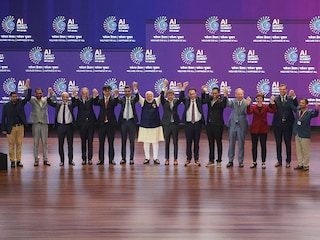
The AI Impact Summit in New Delhi this week has emerged as a defining geopolitical and technological moment for the Global South.
For the first time, the world’s most influential AI convening has shifted away from the traditional power centres of Europe and the US and into India, drawing leaders from over 100 countries and between 15 to 20 heads of government to the Bharat Mandapam venue in New Delhi.
The scale of attendance speaks not just of India’s growing role in AI, but also of the deepening recognition that AI’s future cannot be shaped solely by a few wealthy nations.
During his speech on February 19, 2026, at the Summit, Prime Minister Narendra Modi leaned into this positioning, describing the summit as a “historic moment” that represents “one-sixth of the global population”. He said it was a matter of pride for India and credited the country’s young population with driving this transformation. “India makes new tech fast and adopts it quickly,” he said, while praising the youth for adapting artificial intelligence “with finesse”.
At the same time, he struck a balanced note of ambition and caution: “We have to open the skies for AI but also have to make sure that we remain in control of it,” a sentiment that resonated deeply in a week where both optimism and anxiety defined the discussions.
To anchor India’s approach, Modi unveiled the MANAV vision — an ethical, sovereignty-conscious and inclusive framework for AI. MANAV, meaning “human”, doubles as an acronym for a Moral and Ethical System, Accountable Governance, National Sovereignty (the right to data), Accessible and Inclusive AI, and Valid and Legitimate systems. In a summit filled with announcements and demonstrations, this human-centric framing set the tone for how India wants the Global South to negotiate its AI future.
Key Announcements
India’s Big Policy Push
The Indian government outlined major updates to the IndiaAI Mission, including an investment of Rs 10,372 crore, the onboarding of 38,000 GPUs for shared compute access, the development of 12 indigenous foundation models, and the approval of over 30 India specific AI applications aimed at broad deployment across sectors. In a significant boost to domestic innovation, India also announced a $1.1 billion state backed venture capital fund designed to accelerate investment in AI and advanced manufacturing startups across the country—a move signalling the government’s intent to seed homegrown innovation at scale.
Sarvam AI: India’s Homegrown AI Steps Up
Sarvam AI also made one of the summit’s most anticipated moves with the launch of its first made in India foundational AI models, Sarvam 30B and Sarvam 105B—a major step in India’s ambition to build sovereign, homegrown AI systems. The models were unveiled at the summit as part of the company’s effort to compete with global platforms like ChatGPT, while addressing uniquely Indian needs around language, cost, and data privacy. The 30B model, trained on 16 trillion tokens, supports a 32,000 token context window and is optimised for real-time conversational tasks across Indian languages, whereas the larger 105B model, with a 128,000 token context window, is built for advanced reasoning, coding, research, and enterprise analytics. Sarvam demonstrated these capabilities through ‘Vikram’, its multilingual voice-first chatbot that operates even on feature phones, showing how AI can reach users far beyond urban smartphone ecosystems. Together the two models mark a significant milestone for India’s AI ecosystem, signalling that indigenous players are ready to build—and compete—at frontier scale.
Google’s Multiple Announcements
Google CEO Sundar Pichai made several major India-focused announcements on Wednesday. He reiterated Google’s commitment to an expansive AI skilling initiative, designed to accelerate India’s digital ambitions and prepare its workforce for AI driven opportunities. In a landmark infrastructure move, Pichai announced the India America Connect Initiative, a new strategic subsea cable project that will strengthen AI connectivity between India, the United States, and the Southern Hemisphere—part of Google’s broader push to build the world’s AI backbone. He also revealed that Google is establishing a full stack AI hub in Visakhapatnam, a centrepiece of the company’s $15 billion infrastructure investment in India, which will house gigawatt scale compute and a subsea cable gateway. In parallel, Google DeepMind announced new research and science partnerships with Indian institutions, offering access to frontier AI for science models and building innovation hubs using GenAI assistants.
OpenAI Expands Deeper Into India
OpenAI confirmed a major expansion, announcing that it will open new offices in Bengaluru and Mumbai later this year, adding to its existing New Delhi presence. This move aligns with India’s status as the second largest base of weekly active ChatGPT users globally, behind only the US. OpenAI CEO Sam Altman said: “India is already leading the way in AI adoption, and with its homegrown tech talent, optimism about what AI can do for the country, and strong government support, it is well placed to help shape its future and how democratic AI is adopted at scale. Through OpenAI for India, we’re working together to build the infrastructure, skills, and local partnerships needed to build AI with India, for India, and in India.”
Anthropic Deepens Its India Footprint
Anthropic announced the opening of its first India office in Bengaluru along with a wide slate of partnerships aimed at accelerating responsible AI adoption across the country. The company revealed that India has already become the second-largest global market for Claude, with nearly half of its usage coming from computer science and mathematical tasks, a sign of India’s unusually advanced developer base.
Alongside the office launch, Anthropic unveiled partnerships with Karya and the Collective Intelligence Project to develop evaluations for Claude’s performance on locally relevant tasks in domains such as agriculture and law, working in collaboration with non-profits like Digital Green and Adalat AI to better understand on ground needs.
These collaborations feed into a broader initiative the company started six months ago to improve Claude’s fluency in ten major Indic languages including Hindi, Bengali, Tamil, Telugu, Punjabi, Gujarati, Kannada, Malayalam and Urdu—an effort already yielding measurable improvements in model accuracy. Anthropic said its India team will focus on hiring local talent, expanding enterprise adoption, and deepening its work across education and agriculture, reflecting what it calls one of the “most promising opportunities in the world” to expand the impact of responsible AI.
Microsoft: Investing $50B to Bridge the Global AI Divide
Microsoft used the India AI Impact Summit to spotlight what it calls the world’s “growing AI divide”, announcing that it is on pace to invest $50 billion by the end of the decade to help expand AI access across the Global South. In a new blog post, Brad Smith and Natasha Crampton underline how AI usage in the Global North is already twice as high as in the Global South—a gap that is widening—and argue that unless addressed with urgency, this divide could replicate the century long inequality created by uneven access to electricity. The update also highlights India-specific progress, including efforts to strengthen AI safety benchmarks in Indic languages and the growing significance of India’s 24 million strong developer ecosystem, which Microsoft sees as pivotal to building multilingual, culturally grounded AI systems.
Indian AI Startups: A Funding Surge
The investment climate for Indian AI startups surged during the summit. Blackstone acquired a majority stake in the fast rising Indian AI startup Neysa as part of a $600 million equity raise, with the company planning an additional $600 million debt raise and a deployment of over 20,000 GPUs. Deep tech startup C2i, which builds power solutions for AI heavy data centres, announced a $15 million Series A round led by Peak XV with participation from Yali Deeptech and TDK Ventures.
Ground Reality
The energy on the ground, however, was not without friction. The summit drew approximately 2.5 lakh visitors and more than 840 exhibitors, making it one of the world’s largest AI expos. A quadruped robot dog capable of navigating rubble and diagnosing mechanical faults quickly became a crowd favourite and a symbol of India’s appetite for cutting-edge AI hardware.
But the opening day also drew criticism, with reports of overcrowding, long queues, poor signage, and exhibitors locked out during sudden security sweeps ahead of high-level arrivals. These organisational hiccups revealed the gap between India’s aspirations to lead the global AI conversation and the operational precision such a role demands.
Still, the narrative that persisted through the week was one of acceleration. With world leaders discussing governance frameworks, tech giants announcing expansions, startups raising capital at scale, and the government doubling down on compute infrastructure and skilling, the AI Impact Summit signalled India’s intent to shape—not merely respond to—the direction of global AI.