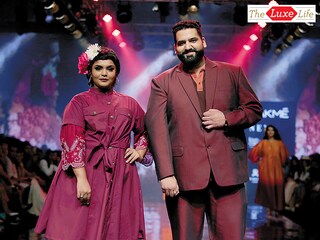
She might be getting somewhere with this tall ambition, given that her recent appearance was at the Lakme Fashion Week (LFW), one of the biggest, most glamorous events in India’s fashion calendar. Walking the ramp for designer Rina Dhaka, Navaneethan says she felt her efforts—which include training prospective ‘plus size’ models to flaunt their best versions for a niche, but growing market—have received a leap.
“This might sound like progress, but it is slow. There’s this ingrained mindset that fashion sells best only if it is represented by certain body types,” she says. “Why can’t designers be more diverse? Why can’t the top names doing a fashion show that is watched by many influencers have at least one bigger sized model in their lineup? Why aren’t ‘plus size’ women featured more prominently in their campaigns? These are some questions the industry has just started answering.”
Even three years ago, the idea of ‘plus size’ models strutting the ramp at LFW or other big fashion events would have been unheard of. Since then, however, not only has mass retail catering to this category of consumers grown, but even luxury brands and upscale designers are catching on to a trend that they are also viewing as a lucrative business opportunity.
According to statistics portal Statista, revenue in India’s fashion segment amounts to $12.54 billion in 2019 and is expected to grow at an annual rate of about 20.8 percent, resulting in a market volume of $26.72 billion by 2023. The largest segment of this market—which also includes leather goods, shoes and accessories—is apparel, with a market volume of about $10 billion in 2019. The ‘plus size’ category of customers becomes important here because about half of the total consumers in India are beyond the standard ‘size 0-12’ bracket. This trend rings true in the US too. According to Business Insider, ‘plus size’ consumers constitute about 67 percent of the population, generating around $21 billion in annual sales.[br]“Model sizing—the sizes showcased on the ramp—constitutes just 10 percent of sales. Nearly everything is a size beyond, usually between 4 and 16. Designers are also conceding to this fact,” says Jaspreet Chandok, vice president and head (fashion), IMG Reliance, which organises LFW. “Three years ago, inclusive sizing was seen as a risk, but today more and more designers and labels are seeing it as par for the course, something that needs to be ingrained in their work.”
Rini Phalgunan agrees. The Bengaluru-based designer says 60 percent of sales in her boutique Rini Couture are from the ‘plus sized’ clientele. Her bespoke and off-the-rack offerings include suits, tunics, skirts, gowns, kaftans and other Western wear. The price range starts from ₹5,000. “We have seen a 45 percent increase in sales in this category of customers in the last two years. Since 2017, for example, our collection of suit sets [about 110 pieces] has been a sell-out,” she says, explaining that while people of larger sizes were traditionally underserved by an industry that offered them limited options, this segment of consumers has started asserting itself and is experimenting with silhouettes and colours.
“Most ‘plus size’ women are treated to jump suits, fit and flare styles, form-fitting dresses and the sheath dress depending on their body type. These are the only silhouettes we have been recommending this size category for years,” she says. “But now the millennials are ready to experiment with shorter dresses, deeper necks, flary tunics, etc.”Nicobar’s latest ‘plus size’ collection, Core[br]Nicobar, a lifestyle design studio from the creators of Good Earth, has also joined the chorus with its Core collection, which was launched in September after seeing the “universal need for extended sizing’,” says Aparna Chandra, design head (clothing), Nicobar. “Our sizes start from an XS and go on to 3XL, but our endeavour is to extend that selection to everyone… we are producing them as we go, and more sizes keep getting added to the range.”
While Chandra says she cannot comment on the demand and revenue generating ability of the range, the brand is planning to offer extended sizes across all their collections. “We would like to do this as these collections are launched, and not as a gradual process,” she says.
Bigger Potential Another reason why designers and high-end boutiques—from Sabyasachi Mukherjee to the Half Full Store—are taking note of the business potential of the ‘plus size’ segment is because of mass retail outlets that are aggressively trying to tap this customer base.
Improving internet penetration helps India’s population—half of whom are under the age of 25 and nearly two-thirds under 35—access brands across the spectrum. A recent report on the country’s apparel market by Care Ratings indicates that while the top fashion brands focussed largely on metros, proliferation of ecommerce and popularity of the mall culture in tier II cities have helped retailers reach these untapped regions. Digitally connected shoppers aware of the latest fashion trends, adds the report, are providing a huge opportunity for brands and designers to reach a larger clientele.[br]“The Indian ‘plus size’ market is estimated to have a share of 12 percent of the overall fashion market and is expected to grow at 25 percent per annum for the next five years,” says Amar Nagaram, head, Myntra Jabong, which launched its brand Sztori in 2018, specifically for bigger sizes. “There is a large untapped market for plus sizes that needs to be catered to, with online platforms clearly having the potential and edge to penetrate deeper into these markets.”
Hetal Kotak, CEO of aLL, a chain of stores that is among the pioneers of ‘plus size’ retail in India, agrees that the internet is helping create awareness and a larger customer base. “Online accounted for 10 percent of our annual revenue of about ₹280 crore last year. We are seeing a year-on-year growth of about 20 percent,” he says. Currently, aLL has about 80 exclusive outlets, and nearly 40 as part of Central malls across India.
Wendell Rodricks, who was one of the first top designers in India to adopt inclusive sizing across his creations, believes that it was inevitable that the issue of size would trickle down among designers, who would have to address it to stay real, practical, profitable and relevant. “With experience and a keen eye on the balance sheet, more designers will realise the market potential of treating fashion in a democratic, embracing, and inclusive manner,” he says. “While doing so, we must also leave the West, or other countries like China out of the picture, since they are a different market with a vastly different aesthetic. For example, the West feels that bright colours are not for ‘plus size’, but Indians love colour. So we should celebrate our ethnicity.”Wendell Rodricks’s Primero Collection for aLL at the Lakme Fashion Week, 2017[br]This growing affinity for inclusive sizing in the industry is starting to reflect on high-fashion ramps, say industry experts, which means designers are becoming more diverse in their selection of models. Dhaka believes that including models of various sizes, skin tones and orientations should be the essence of fashion. “The ‘plus size’ consumer is here to stay and their confidence is incredible,” she says. “Some of the women who walked for me [at LFW] have been called by the Fashion Design Council of India (FDCI)to be part of their regular pool of models from which designers pick lineups for the India Fashion Week. This is the beginning of more size 18s representing fashion on a catwalk alongside a size 8 or a sample size.”
Bigger ProblemsThe reason why luxury inclusive sizing may not have fully gotten its moment in the sun yet could be two-fold: Cost concerns and limited understanding of the nuances of body positivity.
Phalgunan explains that producing larger-size garments can often cost more than smaller-sized items due to “production complexities like using more fabric for some items without charging more, grading patterns as sizes go up and down the scale, finding the right sewing staff that understand the silhouettes, and finding the right silhouettes themselves”. Plus, she says, “There is this long-standing industry belief that ‘plus size’ women won’t spend money on expensive clothes because they think they will lose weight.”
Chandra says since Nicobar is a small company, feasibility and cost have to be factored in at every step. “We have forayed into extended sizing with tried-and-tested basics that work on every body type, and clothes that people will buy time and again. The restriction comes from the business end of the brand. It’s just easier for a business to start with the more commonly-picked sizes,” she says.[br]“Do designers really care?” asks fashion commentator Prasad Bidapa. “They just want to move stock as fast as possible. Even overweight designers have to order clothes for themselves as there are no standard sizes set in [designer] clothing for the obese. Body positivity is all very well, but will it make them money?” Bidapa, whose model management agency has discovered and groomed celebrities like Deepika Padukone, Anushka Sharma and John Abraham, says many designers continue to feel that creating larger sizes would affect their brand image. “On the other hand, some feel they are encouraging unhealthy lifestyles by catering to overweight audiences.”
Navaneethan agrees that she has personally faced instances where excess body weight has been equated with unhealthiness. “They pass judgements even before considering if the weight is because of hormonal issues or simply genetics. Sometimes, I feel that designers rope in ‘plus size’ models just because someone else is doing it and they don’t want to be left out of the trend.”
Model Nancy Pathak believes that the bias is clearly visible in how designers organise separate shows for ‘plus size’ models but do not include them in their regular lineup because they don’t consider them ramp material. “Designers also think that thinner models look younger. In most auditions there is a silent understanding that models of larger sizes are not welcome. So while thinner models go for auditions almost every month, we get casting calls once in three to four months.”
The 31-year-old is disappointed even with the recent FDCI auditions, where she and about 15 other ‘plus size’ models were selected for its model pool, only to not receive callbacks. “When we questioned them, they said none of the designers has made clothes suited for larger sizes. Some models were even asked to lose weight. Where is the body positivity in all this? And if you did not intend to include us in your shows, why waste our time with auditions and publicise it on social media?”
Pathak, whose PhD from Jawaharlal Nehru University was a study in body politics and why fashion has body image issues, is now launching a content company that will offer to make portfolios and videos for ‘plus size’ models free of cost. “If the industry wants to be inclusive, it has to understand body positivity at the most basic level.”
Chandok of IMG Reliance agrees that not all designers are evolved to embrace inclusivity. “While high street retail has started creating sub-groups within their existing ranges to cater to larger sizes, a bulk of designer wear focusses on imagery [they use ‘plus size’ models in campaigns but do not always make clothes for them].”
In all, however, models, designers and commentators agree that luxe fashion is headed in the right direction. As Chandok puts it: “Inclusive sizing is becoming an industry-wide conversation. While not everyone has converted to the idea, it will certainly speed up in the next two-three years.”