Peyush Bansal: The somehow founder
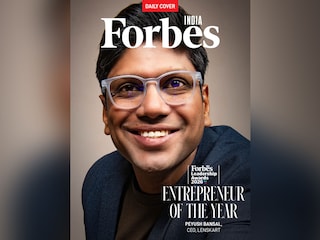
The Lenskart CEO did not know it was impossible to build a multinational, product-focussed startup based in India. So he went ahead and did it
By
Prefer us on GoogleLast Updated: Mar 30, 2026, 12:25 IST12 min
In 2007, while working as a programme manager with Microsoft on its Office team, Peyush Bansal found himself invited to dinner at Bill Gates’ home, not far from the company’s headquarters in Redmond.
“I don’t know what the criterion was, but somehow I got selected,” Bansal tells Forbes India on a Sunday morning at his home office in New Delhi’s tony Greater Kailash. It may have been because he had done well in his reviews and an Office feature he worked on became widely used.
“That got me thinking,” says Bansal. “Am I just adding another toolbar to Microsoft?” The next day he told his manager he was resigning.
The decision surprised many, especially since he was doing well. But Bansal’s mind was made up.
“There is a big gap between what exists in India and what should exist in India—and I needed to do something transformative,” he says. He wanted to create an impact.Bansal’s life so far had been a series of unexpected, often contrarian decisions, which he somehow pulled off.
The idea of his going abroad for undergraduate studies caused so much stress to his mother that she landed up in hospital with gut issues and hypertension. Still, he went. And he roughed it out in Canada.
Money was tight. And he did not get university accommodation because he had not applied on time. “I had never been abroad before,” he says. For the next four years, he focussed on work and academics, rarely sleeping more than four hours a night.
After leaving Microsoft, Bansal returned home to Greater Kailash, his joint family home. He came from a family of chartered accountants. But his cousin built a career as a salaried professional and rose to become the country manager for HP in India. Seeing how well he was doing shaped Bansal’s father’s view.
“My dad was clear that there was no point in doing entrepreneurship. It was just too much hassle, and you didn’t make that much money.”
But once again, Bansal wanted to do his own thing, this time to build something from scratch. His own struggles with finding a house in Canada led him to start SearchMyCampus.com, an online platform focussed on student accommodation. During this time, he read Subroto Bagchi’s The High-performance Entrepreneur. He says he might have read the book 200 times. It sparked in him the idea of building such a company that “the world would not be the same if it did not exist”.
That laid the foundation for Lenskart. Over the last 15 years, the company has reshaped the eyewear market in India. After its blockbuster initial public offer (IPO) in 2025, it now has a market capitalisation of ₹88,583 crore (as of March 19) and presence in 15 countries.
It is rare for an Indian startup, a non-fintech one, to be present in so many countries. But that is not all; Lenskart is also an example of an Indian startup to have developed its own model instead of adopting one that had already succeeded in the US. It is focussed on products rather than services. And it has successfully blended online and offline to work on a hybrid model.
Around this time, he came across an article stating that 40 percent of the world’s visually impaired population lived in India. To understand the category from the ground up, Bansal spent a year working part time at a spectacles shop in Delhi’s Laxmi Nagar.
One statistic stood out for him: 75 percent of the people who needed glasses were not wearing them. It was the problem he wanted to solve.
Starting a product-led company at that time was unusual—many thought it unwise—in India. Most tech startups did services. “I did not even care… I was clueless. I did not know any other entrepreneurs,” says Bansal. “There was no desire to build a large company—none of that. It was, I would say, just luck and destiny. We were not even chasing growth or revenue.”
Bansal and his co-founder Amit Chaudhary remained focussed on solving the problem they had identified, returning repeatedly to the same idea: “We wanted to make a company without which the world would not be the same; and it had to be through technology.”
In eyewear, most frames were made in China and lenses came from France, which made the product expensive. Lenskart made it its mission to make spectacles affordable. “If you can solve affordability, you can solve distribution,” says Bansal.
While speaking to someone in the early days, he asked why they did not get their eyes checked. The reply stayed with him: “I don’t want to be a patient.”
It changed the way Lenskart stores were designed. Customers are not called patients, optometrists do not wear lab coats, and the lighting is warm, avoiding the stark, clinical feel. “This was such a big insight. No Excel sheet would ever tell you that.” Even now, he says with a laugh, Lenskart optometrists chafe at not getting lab coats.
Another insight came from Japanese consumer giant Uniqlo. “We loved the fact that they had engineering in their products, with innovations like AIRism and HeatTech,” says Bansal. The thought of applying similar thinking to eyewear led them to experiment with materials, hinges, comfort and durability. Lenskart Air has become one of the company’s successes because of how light and durable the frames are.
However, despite being a category creator, Lenskart did not grow rapidly in the early years. During board meetings, investors would draw comparisons with other companies—their discounts, gross merchandise value (GMV) and pace of growth. Something needed to change.
Around 2011, Lenskart expanded into watches, jewellery, bags and more. Some investors felt the eyewear market was not large enough and wanted it to become the “online version of Titan”.
One Sunday, Bansal went to meet investor and upGrad founder Ronnie Screwvala at his home in Mumbai.
“What do we really want to be?” Screwvala asked Bansal. “We want to transform the way people see,” Bansal said. “Then why are you doing everything else?” Screwvala asked.
Bansal did not have an answer. Shutting the other verticals would mean losing nearly 80 percent of Lenskart’s revenue at the time, and he feared investors wouldn’t back such a move. But Screwvala offered to put his money where his mouth was and invest even if Lenskart withdrew from the non-eyewear segments. This soothed the nerves of the other investors, who now supported the idea.
“Having worked in rural India via our Swades Foundation, I could see how big a problem overall eyecare was in India. The TAM (total addressable market) was massive and beyond any consultant report on the same,” Screwvala says via email.
What appealed to him was Lenskart’s focus on affordability and accessibility. “That was a perfect formula for being both a market maker and the dominant player,” he says.
The decision to go deep and focus only on eyewear became a turning point. “Only then can you work on first principles problem solving,” says Bansal.
This was not about choosing between online and offline. “This is omni consumer,” he says, noting that the same person moves between channels depending on the moment. The teams that built the website also designed the stores. The pricing is the same everywhere, and differential offers are avoided. The approach means spending less on marketing.
“We have zero BTL (below the line) advertising,” Bansal says. Online browsers often end up purchasing in stores, and store customers spread the word. The same philosophy shaped Lenskart’s technology strategy, with the company choosing to build and own its stack end to end, including supply chain systems.
The first foray outside India took Lenskart to Singapore. As with many of Bansal’s initiatives, this was seen to be an unwise move. West Asia, the wise people said, would be a better bet given the familiarity of ethnicity and languages.
But Bansal interviewed a job candidate from Singapore who worked at Meta. She had two myopic children and spent $400 to $500 a year on their glasses. They discussed why spectacles for children must be so expensive. Bansal also found out that Singapore was the myopia capital of the world, with 83 percent of its people becoming myopic by the age of 18.
“We were like, the problem is bigger [in Singapore],” he says. “Today, one out of three people in Singapore wears our spectacles.”
In June 2022, Lenskart announced the acquisition of a majority stake in Japanese eyewear brand Owndays—a deal valued at roughly $400 million. This, too, was not a popular decision with the board.
“This was another thing Ronnie always told me—whenever you are taking a big decision, ensure that you believe in it yourself. Everybody will have a view—some for, some against,” recalls Bansal. A year later, what mattered was the outcome, not the debate. “I very well knew it was my neck on the line. But a year later, many of our board members came to me, saying, ‘You were right’.”
For Bansal, listing marks a shift in how the company sees itself. “We wanted rigorous scrutiny. From a company we had become an organisation. The organisation to institution journey happens post IPO, where an individual is not important; the institution is important,” he says.
Quarterly results, though demanding, bring discipline. “If you want to create the next ‘Amazon of Eyewear’, you have to go public,” Bansal explains. What matters is balancing short-term scrutiny with long-term direction.
The other thing that matters is density. Drawing on examples like Maruti, Asian Paints and Airtel, he says concentrating customers in a postal code creates both pressure and advantage. Once a brand becomes synonymous with a category, expectations rise, but word of mouth grows just as quickly.
This emerges when companies “keep densifying versus diversifying” and do work that is “worth talking about”. The only real moat, in his view, is raising the bar every year. “You cannot build a business on incrementally better stuff,” he says. New services soon turn into expectations. The secret lies in pushing standards rather than watching competitors and asking yourself, “Okay, what can I do better today?”
The technology has been built in house, including a dedicated app for recording meetings, look and tell features, and health and nutrition tools. With a tech team of around 700 and a goal that “50 percent of our company should be engineers”, Lenskart operates through multiple product pods, each with its own chief technology officer—spanning smart glasses, geo analytics for store selection, computer vision analytics and AI-led eye testing. “Our geo-analytics tool helps companies figure out the ideal locations for stores. In fact, we now license that tool to a lot of companies, including Bata and Starbucks,” says Bansal.
The first prototypes of B Glasses are being given to a few hundred people, mainly content creators. “We are not interested in commercialising it right now,” Bansal says. The glasses are currently being tested by Sony, Qualcomm and Google engineers.
Even when it comes to expansion, Bansal insists that the decision must be driven by the scale of the problem. “It has to be a large problem,” he says, noting that more than 500 million people still need glasses but are not wearing them. Lenskart currently serves around 25 million people, leaving significant room to grow.
Looking back, Bansal credits much of his approach to his time at Microsoft. “It taught me to focus on the consumer. Things have to be 10x better—they don’t have to be incrementally better. Think about the problem, don’t think about the money,” he says.
Don’t think about the money? That sounds like an unwise idea. So, Bansal will definitely follow it. And he might make it work—somehow.
First Published: Mar 30, 2026, 12:39
Subscribe Now