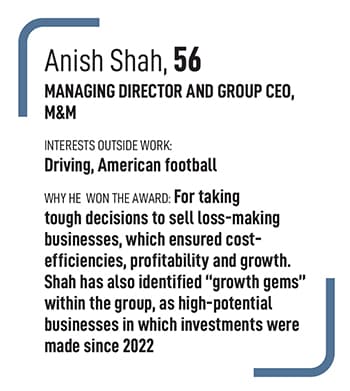
The acid test for Anish Shah came before he took charge as the group CEO and managing director at Mahindra & Mahindra (M&M). In April 2020, when he was the deputy managing director and group CFO, the pandemic forced the board of directors to scrap a support plan for the loss-making South Korean firm, SsangYong Motor, and signal its stance to sell its majority stake in the company.
The move was backed by data. In FY20, losses from the group’s international subsidiaries stood at more than ₹5,200 crore, wiping out most of the profits coming from other parts. Its market capitalisation had got eroded by about 70 percent between August 2018 and March 2020.
But few things in business, as in life, are driven purely by data. Emotions are invariably involved. As was the case here.
M&M acquired SsangYong, an embattled sports utility vehicles (SUV) maker, in 2011. The idea was to turn it around, bring its SUVs to India, make India a manufacturing base, and use SsangYong’s strong technology base and international dealer network to increase M&M’s presence in the global SUV market.
Anand Mahindra, part of the promoter family, who had been M&M’s managing director since 1991 and became the chairman and managing director in 2012, had himself driven the SsangYong purchase along with his lieutenant, Pawan Goenka. Now Anand Mahindra was giving up executive responsibilities and handing them over to Shah, who was poised to take charge as the first non-family CEO of the group in its 75-year history.
“This was an extremely difficult decision for Anand Mahindra and all of us. The issue was not about the present or the past. The question was, did we have the ability to turn this company around? We did not see it changing dramatically in the future. Even the best-case scenario was not very reassuring,” Shah tells Forbes India.
At that time, M&M, though a strong player in the SUV segment, still needed to keep pace with the evolving market. Further, it had announced its entry into the electric vehicles (EV) space, but the pace of EV adoption in India was still slow.
Also Watch: CEO of the Year: Anish Shah | FILA 2026
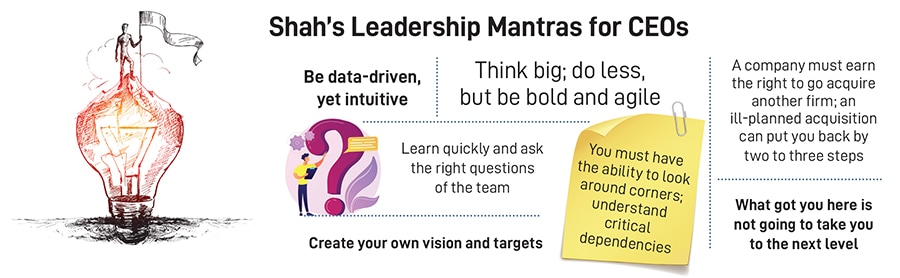
With this as the backdrop to Shah assuming leadership of the group, focusing on data was most critical. “A leader has to focus on what the situation requires. Given where we started this journey from, it was important to be data-driven at that time to drive a discipline around capital allocation, take calls fast and implement them,” Shah says.
He describes the early days of his leadership as “exhilarating” rather than daunting. “I had faith in my leaders. There was never a concern that we were in trouble.” In the following 15 to 17 months, M&M had exited 15 loss-making businesses.
“This capital allocation strategy helped M&M focus on its core strengths, such as SUVs, tractors and EVs, driving improved financial performance,” wrote Raamdeo Agrawal, veteran investor and co-founder of Motilal Oswal Financial Services, describing M&M as a “bruised blue-chip” in his thematic study as part of the 29th Annual Wealth Creation study in December 2024. “The fresh leadership perspective reinvigorated M&M’s focus on customer-centricity, operational efficiency and shareholder value, leading to a more streamlined and profitable organisation.”
![]()
Those were not empty words of praise. Investors cheered as the M&M stock rose nearly three-fold by April 2022 from a Covid low of ₹245 around March 2020. The stock surged to ₹3,059 as of March 19, 2026.
Shah, for his part, gives credit to Anand Mahindra. “All the credit goes to Anand,” he says. “It is difficult for anyone to step back and hand over the responsibilities, in this case in letter and spirit… he truly gave that empowerment.”
The management philosophy remains intact. As recently as March, Shah exited a loss-making agricultural machinery joint venture in Japan.
Think big, be bold
For the past 15 to 18 months, Shah’s internal conversations with his top leaders have not been about cutting costs or scaling up, but about their vision for the business or anticipated investments.
![]()
“In many meetings, I tell my leaders, I will not ask you questions on cutting costs anymore or scaling up. What I want to know is your vision for the business and what investments we need to make. Provide me with your vision and targets,” says Shah.
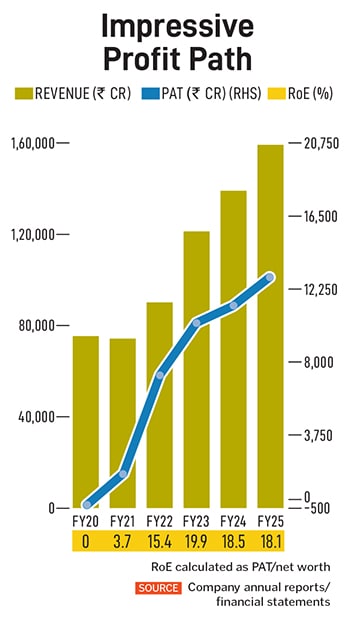
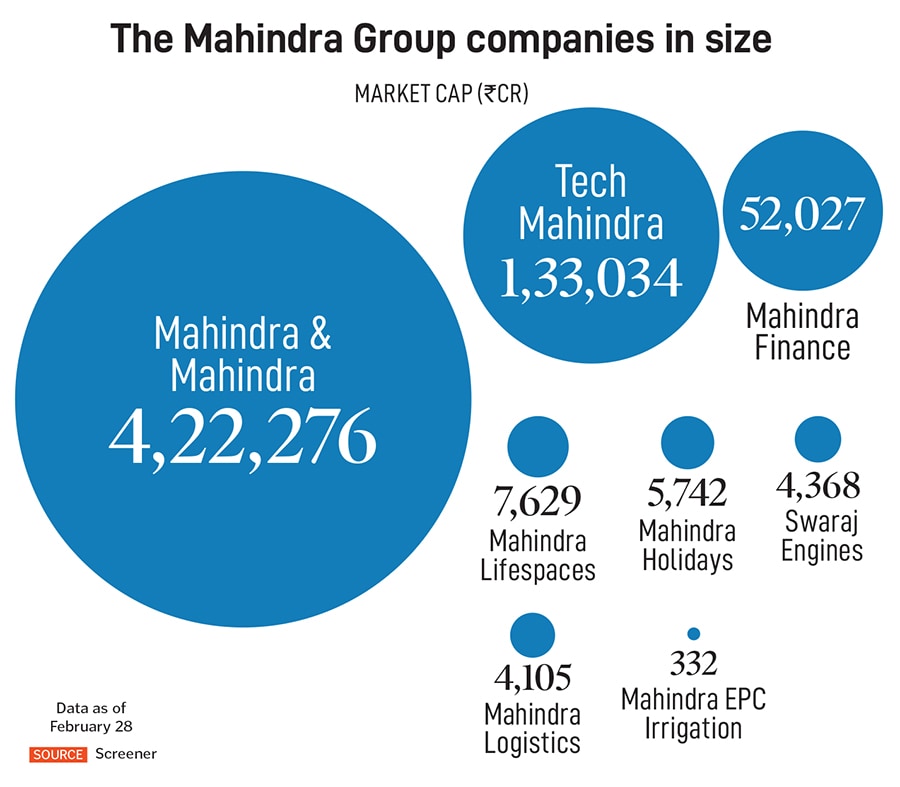
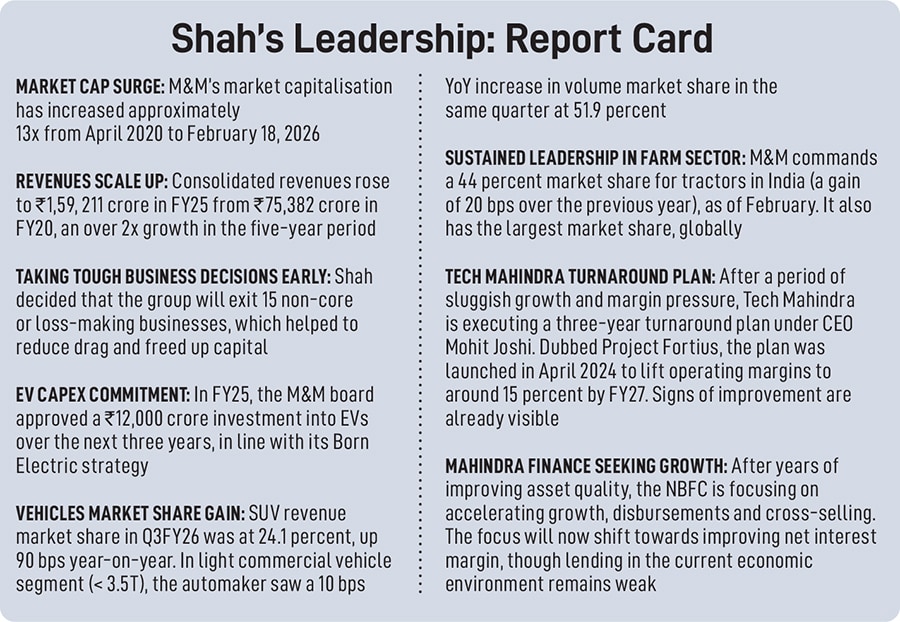
Business prudence dictates that cost efficiencies and gaining market share are always important. But, now as a leader, Shah’s focus has shifted to a broader landscape. Mahindra Group’s key businesses, from auto and farm to financial services, have all grown impressively under Shah’s leadership, which marks five years on April 2 (see Shah’s report card). Even some of their so-labelled “growth gems”—the real estate arm and the EV last-mile mobility businesses—have seen improved valuations, as profitability and sales rose.
One of Shah’s directions to the CEOs running various arms of the sprawling group is to think big and be bold.
In June 2020, when M&M’s top management met analysts, it disclosed its ambitious growth plan and that it will continue to invest in growth with at least 18 percent return on equity (RoE) in five years. In FY20, the company’s RoE was 6.4 percent, down from 14.9 percent in FY19. “We got to the RoE target in 18 months rather than five years,” Shah says.
The core business of automobiles set the bar high.
![]()
Rajesh Jejurikar, a Mahindra group veteran of more than 22 years, who took charge as executive director and CEO of the auto and farm equipment sector on April 1, 2020, was among those leaders who raised the benchmark. For SUVs, Mahindra Auto formalised a strategy called ‘Brand Purpose’, which was about creating authentic SUVs that are adventure-ready and sustainable, but with sophistication and technology.
This meant differentiating its core SUV positioning in the market, as the XUV700, variants of the Thar, and the best-selling Scorpio became aspirational products for people to own, rather than just being cheaper. Today, M&M is the leader in SUVs by revenue market share, at 24.1 percent, as of the third quarter of FY26.
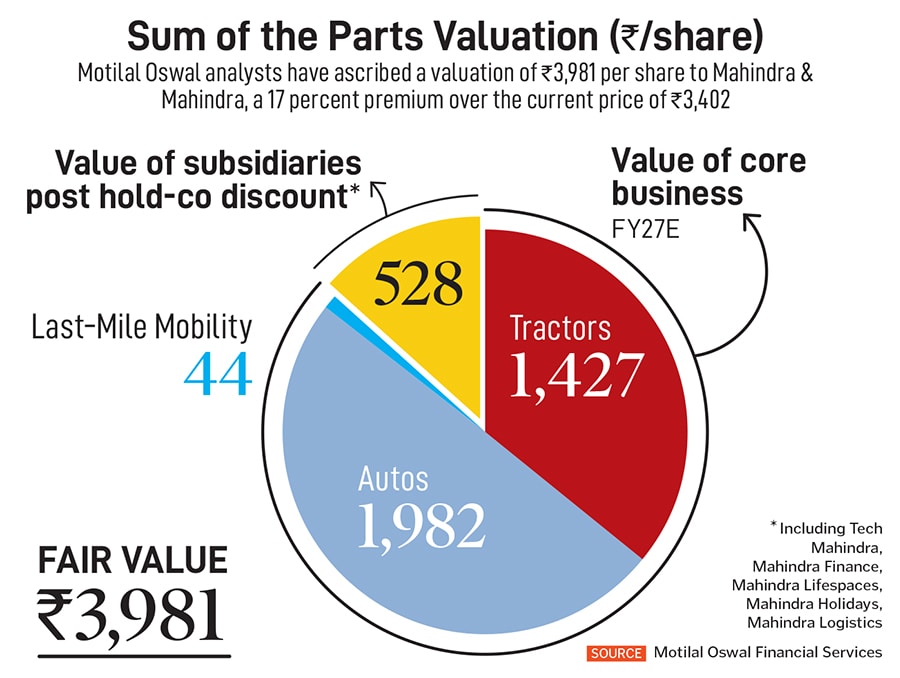
After the December 2025 quarterly earnings, Motilal Oswal research analysts Aniket Mhatre and Jeemit Shah expect M&M to post a compound annual growth rate (CAGR) of 18 percent in Ebitda over FY25-28. Ebitda, short for earnings before interest, tax, depreciation, and amortisation, is a widely followed indicator of profitability.
![]()
“In terms of new launches, M&M has launched the new XUV7XO in January. Apart from this, it plans to launch two new refreshes in the ICE (internal combustion engine) segment in 2026. In EVs, the company has launched the XEV 9S,” the analysts said in a note to clients in February.
“Semiconductor availability remains tight, with memory chip shortages affecting the broader industry. M&M has secured short-term supply at a premium while executing mitigation and localisation measures for the long term,” they added.
ICICI Securities analysts Shashank Kanodia and Bhavish Doshi are equally bullish on M&M’s businesses. “Demand remains robust across product categories, though segment-wise growth mix for FY27 is still evolving. In tractors, the outlook remains positive despite weather uncertainties, supported by favourable rural drivers and strong base,” they said after the Q3FY27 earnings.
Shah emphasises that clarity of purpose—what to do and what not to do—helps position the organisation better. It also includes staying calm in a crisis.
Ready for critical dependencies
In 2025, Shah appointed Hemant Sikka as the new managing director and CEO of Mahindra Logistics. It functions as a third-party logistics service provider involved in supply chain management, warehousing and corporate transportation. The company restructured business verticals—splitting the consumer and manufacturing verticals with dedicated leaders. It also integrated Whizzard and Last-Mile Delivery into one unified vertical.
![]()
Mahindra Logistics swung into profits for the December-ended quarter, after 11 successive quarterly losses.
Logistics is one of the growth gems identified by Shah after he became group CEO. Aided by the fact that the core businesses are on track, he can devote attention to the smaller ones that show high potential. This is a portfolio of 10 businesses ranging from renewable energy to tech services that the group believes can scale significantly in valuation. The valuation of these “gems” has already jumped manifold since the time Shah took charge.
He now believes that Mahindra Group will witness organic and inorganic growth for all its growth gems. “But they should have earned the right to go out and acquire companies,” he says, and points to the trucks and buses business, which had at one point struggled for momentum.
Mahindra commercial vehicles had a strong month in January, reporting a 40 percent year-on-year growth in sales, including exports. Providing a range of light commercial vehicles, it acquired SML Isuzu, which will help in scaling up.
After nearly a decade of being hampered by poor asset quality and margin concerns, Mahindra Finance, under the leadership of Raul Rebello, has bounced back and focussed on growth, rather than just on controls. In the December-ended quarter, profits surged 96 percent, disbursements 7 percent, assets under management 12 percent, income 15 percent and net interest margins 27 percent.
Mahindra Holidays has started to move beyond vacation ownership—which is not growing rapidly—and will now focus on the non-business leisure hotels space. This is being planned over the next five years.
![]()
Being the CEO
The role of a modern global CEO is constantly evolving and in a data-driven world, artificial intelligence and cyber security matter as much as drawing talent and formulating turnaround strategies.
“The ability to have clarity of action, handle a crisis, work with teams, support and be tough on them, being empathetic or prescriptive, all of these matter,” Shah says. With the global economy highly uncertain, he says it is important that CEOs have “the ability to look around corners”.
“We are concerned about everything, including the things we know might happen. But what truly worries us are the things we cannot foresee,” he says.
For examples, he cites the semiconductor shortage that affected the auto sector out of nowhere and the rare earth metals crisis which slowed the charge of EVs.
“The response to each of the critical dependencies and the fallback plan are all important for CEOs to deal with,” Shah says.
These five years have validated Anand Mahindra’s assessment when Shah was chosen as the CEO. The group chairman called Shah “the right leader”, adding that he embodied the spirit of Mahindra Rise [the group’s vision] and a unique ability to forge long-standing relationships with the company’s customers, partners and employees.
Shah’s next challenge is to sustain growth in a highly exposed macroeconomic environment.