Hiring through a hackathon
Once campus events, hackathons are now major talent‑spotting grounds for tech firms, increasingly supplementing traditional hiring
By Samidha Jain
Last Updated: Mar 24, 2026, 11:26 IST12 min

Mohammad Faiz Ali and his team entered the first edition of Meta’s Llama hackathon in November 2024. The annual event organised by Meta has a number of categories like AI for Societal Good, Build on WhatsApp etc. Under the ‘WhatsApp and Governance’ category, in which they participated as individual developers, they built ‘CivicFix’ in 36 hours to help citizens report grievances via WhatsApp voice notes without needing to know which department to contact.
Ali went on to receive funds from the government and worked on this project under his company 4Lunches, a creative tech studio and AI lab based in Bengaluru that he founded in 2020 along with co-founder Madhusree Narayan. Today, the hackathon project has evolved into real governance conversations and pilots with the governments of Maharashtra, Tamil Nadu, Punjab and Karnataka.
Katyayani Nath first participated in a hackathon organised by her college Narsee Monjee Institute of Management Studies (NMIMS), Mumbai, in 2018 when she was a student of its MBA + BTech programme. The excitement of that hackathon led to her participating in many more. Today, Nath has taken part in more than 15 hackathons, including campus and off-campus ones like those organised by companies such as Myntra and Flipkart. Over the last three years, her experience has meant that she has also been a part of managing and coordinating hackathons for the Smart India Hackathon (SIH)—a government-backed hackathon initiative, on behalf of her current employer Mathworks. SIH works with companies and marketers for the event’s smooth organisation, promotion etc.
A hackathon is an event in which a large number of people engage in collaborative computer programming. Hackathons in India have undergone a dramatic evolution from being niche campus events to becoming one of the country’s most dynamic and competitive talent acquisition engines.
As tech companies push for faster hiring cycles and hands-on skill evaluation, hackathons now serve as high visibility arenas where problem-solving, speed, creativity and teamwork are tested in real time. IT giants, global product companies and startups are increasingly hosting their own branded hackathons, blurring the old boundary between ‘campus events’ and ‘corporate recruitment channels’.
For students, they offer more than just a thrill of a 24/36/48 hour coding sprint; they are becoming gateways to internships, pre-placement interviews, industry exposure and peer networks that often matter more than traditional CVs.
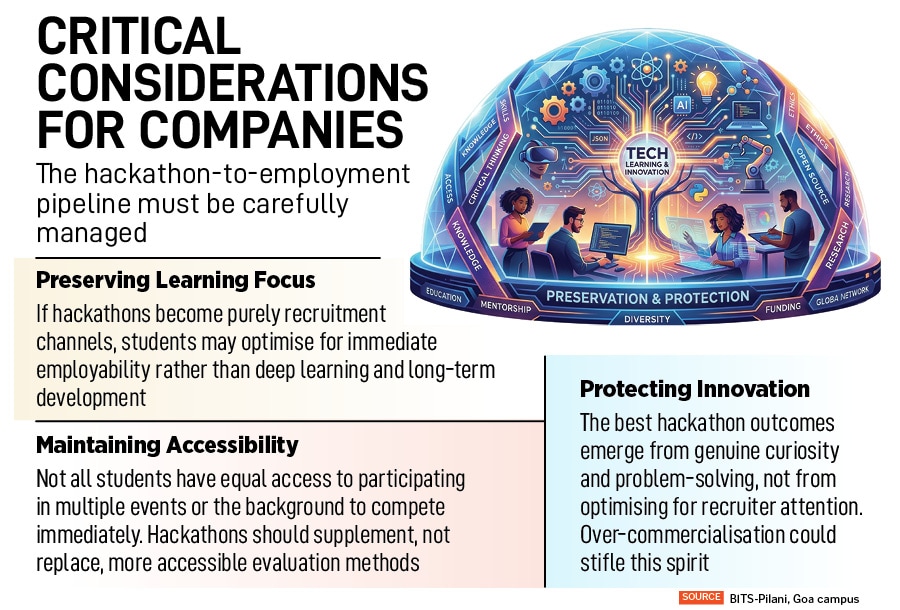
Birla Institute of Technology and Science (BITS)-Pilani sees hackathons as a strong complement to traditional classroom learning. “The main goal of hackathons at BITS Hyderabad is skill building, followed by industry collaboration. The hackathons act as intense learning experiences where students get hands-on exposure to new technologies, learn how to quickly build working prototypes, and collaborate under time pressure,” says a BITS-Pilani Hyderabad campus spokesperson. The institute hosts numerous hackathons each year, ranging from focussed club-led events to large campus-wide competitions. In total, over 1,500 participants take part in hackathons and coding competitions on the campus annually.
Hackathons also act as a social networking forum where engineers across all levels can build important connections, and help youngsters with internships, job references, career guidance and peer learning.
Though not meant to be placement events, they are increasingly also giving students visibility. “Students who actively participate in hackathons tend to perform better in technical interviews overall because of the hands-on experience they gain, says the BITS spokesperson. “Learning and innovation come first, and career benefits are a natural side result.”
Nath, who works as a marketing strategist at Mathworks, says many of her friends, including her younger sister have received excellent offers through hackathons. “Hackathons open doors through industry exposure, networking and visibility even if the offer doesn’t come immediately. Qualifying or performing well becomes a strong signal,” says the 25-year-old based in Bengaluru.
According to a LinkedIn post by IICPC (InterCollegiate and Informatics and Competitive Programming Conclave) founder Ayush Kumar a couple of months ago, over 18 full-time recruitment offers were made in the QuantFest 2025 in SDE (software development engineering), ML (machine learning) and Quant roles across top-tier US quants and partner firms. It added that Jane Street Capital, an American multinational quantitative investment firm, was taking 25 students for their Hong Kong 1-week SEE Quant/SWE Bootcamp while Hudson River Trading was taking over 20 students for their Mumbai event; they were also considering many of them for their bootcamp-cum-internships.
According to Rupesh Nasre, faculty, department of computer science and engineering, IIT-Madras, hackathons are like spark ignitions and also permit demand meeting talent supply. IIT-Madras organises annual in-person hackathons, with up to 100 students, as well as virtual ones, which receive up to 10,000 registrations. For the IICPC CodeFest prelims, the institute conducted a hackathon on January 31, in which 9,000 students participated. “This off-campus hiring permits more seats for on-campus recruitment. As long as students’ academic learning is not adversely affected, these should be encouraged. The hackathon’s preliminary prototype should be followed by mature research by taking the prototype to the research labs, to create fire,” he says.
As the nature of hackathons evolves to become recruitment platforms, the onus of organising hackathons has been shifting from ‘only campus’ to a ‘mix of campus and companies’, and promises faster prototyping, cross disciplinary creativity and new hiring pathways.
As AI-assisted development rapidly reshapes global software workflows, India is also witnessing a parallel shift inside its engineering campuses with vibe coding and AI-driven hackathons emerging as the new frontier of tech experimentation. What began as casual coding events have evolved into structured innovation sprints where students collaborate with AI copilots, build rapid prototypes and learn to engineer at a new velocity.
Institutes like IITs and BITS, with their deep industry partnerships, find themselves at the centre of this transformation and play a key role in shaping how future engineers understand and adopt AI in real development environments.
Recent examples include the Eli Lilly Hackathon during the annual technical fest (350 participants) and the Bharat Varsity Hackathon at BITS Hyderabad’s 2025 cultural fest, which drew 800 to 1,000 students.
Companies have gotten on to the hackathon bandwagon with projects and themes closely related to the functions they are in need of, with the bigger view of creating a pipeline of hiring.
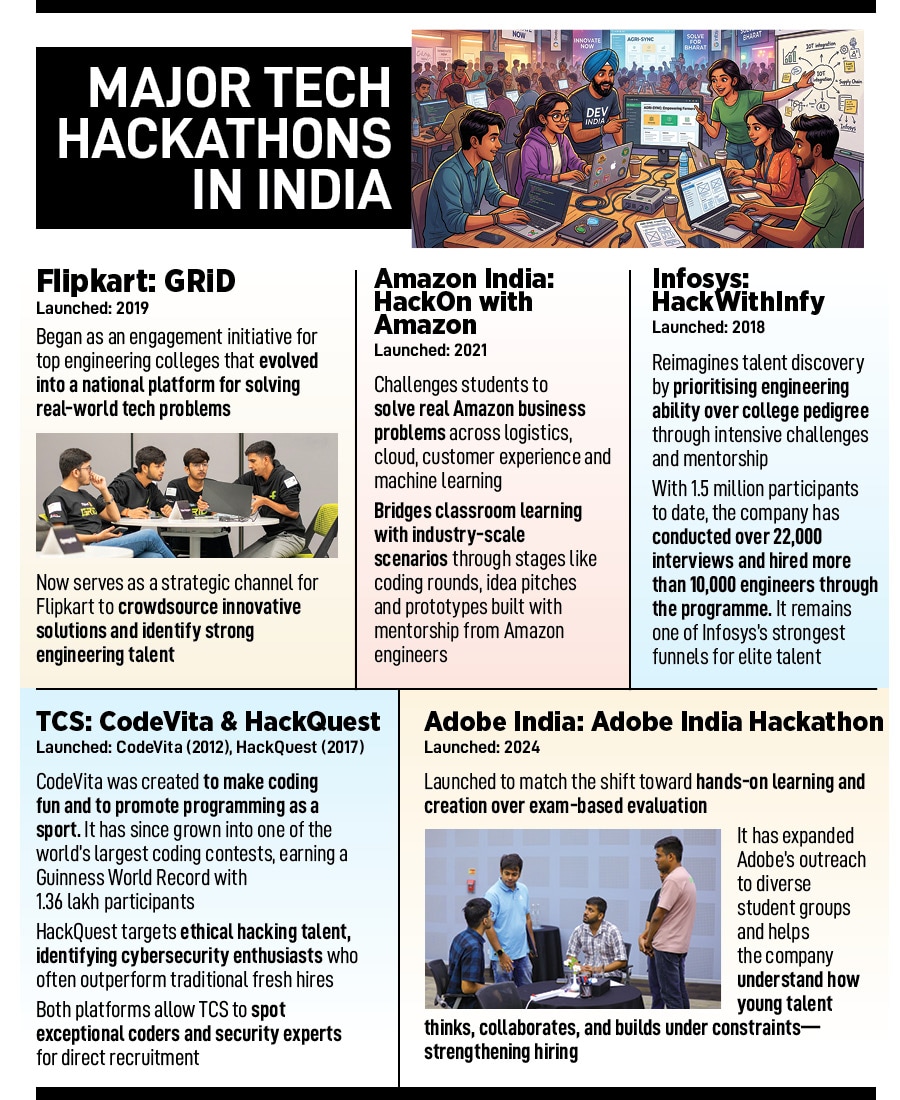
In 2018, Infosys launched HackWithInfy to reimagine how the company identifies and engages India’s top engineering talent. Since inception, 1.5 million engineering students have participated in the hackathon.
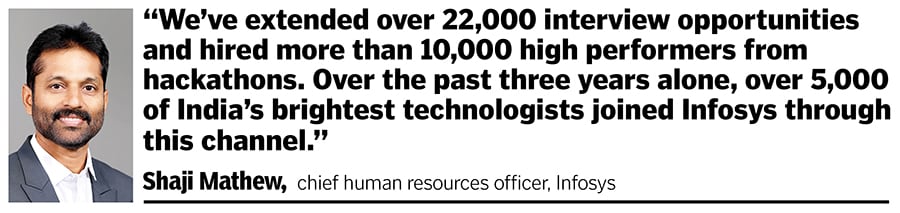
“We’ve extended over 22,000 interview opportunities and hired more than 10,000 high performers from these. Over the past three years, over 5,000 of India’s brightest technologists joined Infosys through this channel—many now leading critical AI, cloud and digital transformation initiatives,” says Shaji Mathew, chief human resources officer, Infosys.
Mathew adds that platforms like HackWithInfy lead to faster onboarding, stronger early-career impact and superior retention compared to conventional campus recruits. “The platform proves that when talented engineers have the opportunity to demonstrate their abilities in rigorous, mentored settings, the results benefit everyone—candidates gain recognition based on merit and organisations secure performers who accelerate business outcomes.”
Flipkart’s annual hackathon GRiD is another corporate hackathon that complements traditional hiring. “GRiD allows us to reach a scale that traditional campus hiring cannot,” says a Flipkart spokesperson. In 2025, GRiD received close to 1.7 lakh applications, enabling the company to engage talent far beyond metros and top-tier institutes.
“Since we cannot physically visit every college, GRiD becomes a powerful equaliser giving high potential engineers from Tier II and III towns and lesser-known colleges an opportunity to compete on the same stage. Also, through its rigorous multi-stage assessments, we not only engage talent at scale but also identify standout performers who join us as interns or full-time employees,” the spokesperson says.
Amazon’s HackOn too has engaged 2 lakh students from over 100 institutions across India since 2021. In its recent edition, participants built prototypes addressing real business challenges around Sustainable Shopping Experience, AI-Powered Trust & Safety Platform, Enhanced Fire TV Experience and Smart Payment Optimisation.
The tech giant believes hackathons serve as a two-way street for the company. “Students gain insight into Amazon’s focus areas, problem-solving culture and the types of challenges the company tackles daily. Amazon, in turn, identifies candidates who demonstrate technical excellence, creativity and collaboration in extended, hands-on scenarios,” says an Amazon spokesperson.
Meanwhile, in 2021, the ninth season of CodeVita, an annual Tata Consultancy Services (TCS) Hackathon, was awarded a Guinness World Record for the ‘World’s Largest Programming competition’ with a participation of 1,36,054 students. “CodeVita is not only a platform to encourage the world’s top coders, but also an avenue for TCS to identify and attract the best coders to join our growing community of skilled coders,” says Sudeep Kunnumal, CHRO, TCS.
The company believes hackathons create a strong talent pipeline as the joining ratio of people through these programmes is higher than traditional campus hiring. Not just that, TCS also uses hackathons internally to upskill their workforce and create an environment for continuous learning.
It’s not just big IT firms... startups too are organising hackathons that also serve as recruitment platforms. For example, electric vehicles company Battery Smart conducted its inaugural tech hackathon HackSmart from January 31 to February 1, in partnership with Amazon Web Services (AWS). The company received over 1,000 registrations and shortlisted more than 200 participants from premier engineering institutions, including IITs, BITS-Pilani and NITs.
Ali of 4Lunches sees hackathons as an effective way towards recruitment and believes that in the age of AI and vibe coding, hackathons are becoming more inclusive. “At 4Lunches, we treat hiring like a mini-hackathon because it tests first-principle thinking under a finite clock. It is a much better barometer for talent than formulaic, traditional tests,” he says.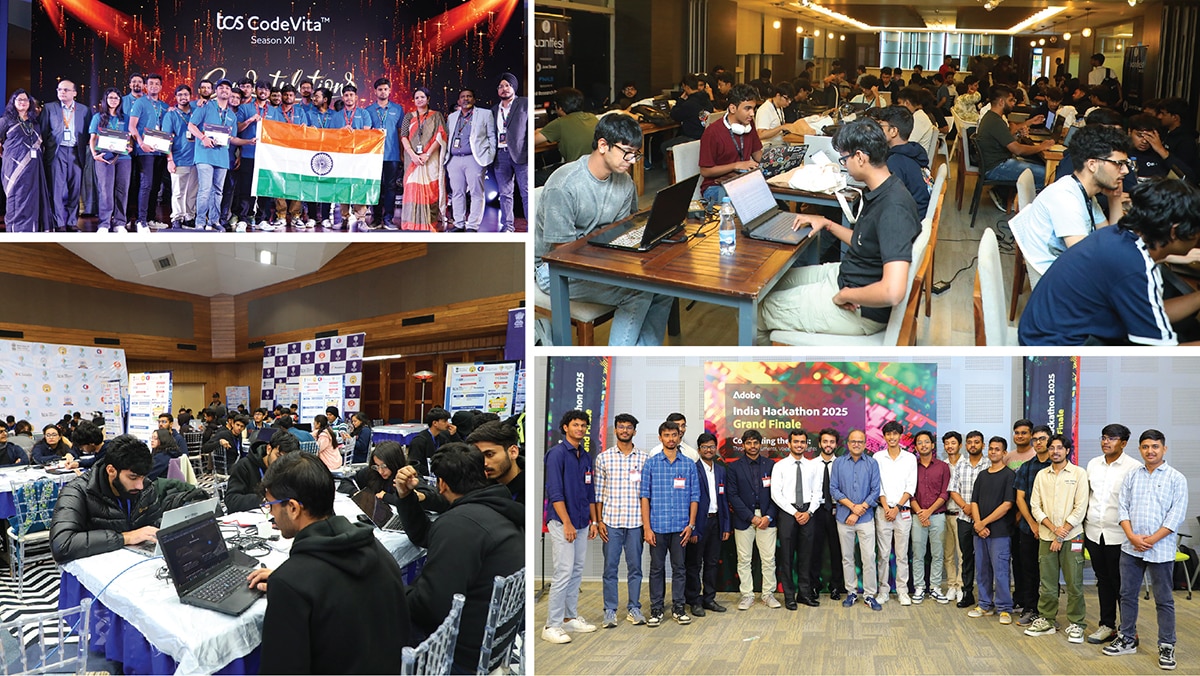
According to staffing company Xpheno, the number of tech companies opting for a hackathon screening and assessments has nearly doubled over the last two years. “We see it becoming one of the top choices of clients for preliminary screening of candidates in bulk hiring scenarios,” says Trupthi BT, business head, contingent hiring–tech, Xpheno.
As per Xpheno’s observations, hiring through hackathons has gained popularity across product firms, SaaS, fintech and tech GCCs where core development skills are critical. The interactive and physical format of hackathons serves as a rigorous quality barn that evaluates high-level technical skills, such as algorithms and coding practices, parameters that were less prevalent or partial in older MCQ-based assessments and tests.
According to PwC’s 27th Annual Global CEO Survey released in 2024, 52 percent CEOs consider lack of skills in the workforce as a barrier inhibiting reinvention. With the shift in hiring using hackathons, the gap in skills is being filled by hiring people after testing their skills in real time. “While data from hackathons does not offer specific long-term performance metrics, completing a hackathon provides approximately 80 percent of the fitment check. As a selection process, it establishes the candidate’s technical fit and readiness to get productive on short onboarding runways,” says Trupthi.
She adds that companies think candidates found through hackathons are more likely to be good hires and more likely to stay longer with the company. “A candidate who willingly commits several intensive hours on a working challenge has already demonstrated a commitment to the brand and a clear understanding of the job role expectations.”
Swati Rustagi, vice president, employee experience, Adobe India, too sees hackathons as a real-world audition, allowing candidates to demonstrate practical problem-solving in ways standard tests cannot fully capture. “They allow us to observe collaboration, iteration and execution capabilities that closely reflect real workplace environments, helping us identify high-potential talent earlier in the process.”
At Flipkart too, though traditional campus hiring remains essential for securing the top academic percentile from premier institutes, channels like hackathons play complementary roles. “Together, they enable us to build a more robust and heterogeneous tech workforce.”
For most companies, a mix of traditional hiring and recruitment through hackathons makes for a perfect recipe. “Traditional assessments continue to evaluate organisational fit, collaboration style and long-term potential—dimensions that hackathons complement but don’t fully capture. Hence, a strategic mix of both can lead to a holistic talent strategy,” says an Amazon spokesperson.
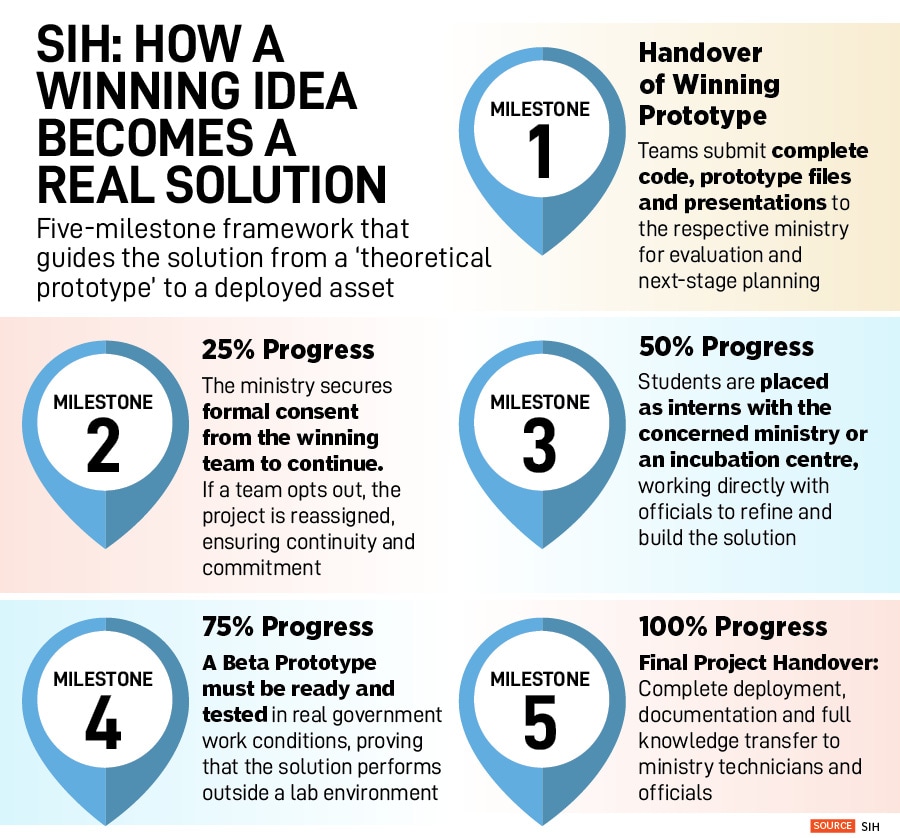
Apart from campus and corporate hackathons, governments too have been organising hackathons in an attempt to find solutions to common problems, and also enabling students and developers find employment or getting funding as entrepreneurs. The government hackathons act as a bridge between citizens and government policies and action.
A few examples include the Agri India Hackathon launched to accelerate innovation in agriculture; DARPG (Department of Administrative Reforms & Public Grievances) Hackathon to improve India’s grievance redressal systems; Jal Shakti Hackathon aiming to mobilise researchers, startups, students and innovators to tackle India’s most urgent water challenges; Bhashini Hackathons aimed at accelerating development of speech-to-text, translation and language AI applications across India’s diverse linguistic landscape.
The winning teams from these hackathons attain government funding to build software to solve for citizens’ issues.
The SIH began in 2017 as a government initiative for the ‘Viksit Bharat @ 2047’ vision. Its aim is to build a future where young India leads the global stage through social awareness, technological maturity and a spirit of entrepreneurship. It has evolved from a competition (in which students can participate through their colleges) into a nationwide movement with 22.18 lakh participation.The initiative received 72,165 idea submissions from over 68,000 teams in 2025. The ideas—when fully developed—have been adopted by several ministries and bodies, i
ding Isro, NTRO, NCIIPC, Ministry of Ayush, Ministry of Fisheries, Animal Husbandry & Dairying, Department of Science and Technology for internal development.
YUKTI-National Innovation Repository, an initiative by the Ministry of Education, which aims to create a repository of innovations and startups from academic institutions, providing mentorship, funding, and connections to investors and incubation units, has also been pivotal in supporting SIH alumni. To date, over 100 startups with 9,654 SIH alumni members have emerged from the SIH ecosystem, tackling challenges in sectors like health care, education, social welfare, water, education and sustainability. Some examples include Raffesia Technologies, Tune AI, Viji, Privaseverse Cyberspace, Ridemap and Janta24.“By
presenting students with real-world challenges faced by government departments and industries, SIH encourages them to move beyond theoretical learning. It empowers them to become ‘producers’ rather than just ‘consumers’ of technology. Whether it is creating AI-powered systems for railway safety or low-cost hardware for agricultural efficiency, SIH provides the scaffolding for youth-led innovation to directly impact nation-building,” says Sarim Moin, innovation officer, Smart India Hackathon.
BITS-Pilani, Goa campus, is also involved in organising the state government’s Goa Police Hackathon which combines skill-building with social impact.As
part of this hackathon, students tackle real-world law enforcement challenges like AI-based deepfake detection, voice recognition for prison security, CCTV forensic analysis, cyber patrolling tools, and sexual offence investigation assistants. The 48-hour hackathon (now in its third edition) bridges the gap between classroom theory and practical application in critical public safety domains, with solutions often moving to actual deployment.
First Published: Mar 24, 2026, 11:39
Subscribe Now(This story appears in the Mar 20, 2026 issue of Forbes India. To visit our Archives, Click here.)