Smoke billows from an ongoing fire near Dubai International Airport as a train of the Dubai Metro moves over vehicles on a highway in Dubai on March 16, 2026. Photo by AFP
Advertisement
For years, India’s elite have fuelled Dubai’s residential boom making the Emirates their favourite second address.
Over the years, Bollywood royalty, sports legends and tech billionaires have quietly assembled luxury penthouses in the Emirates Hills and Palm Jumeirah drawn by privacy, luxury and tax-free perks. Icons like Shah Rukh Khan (Palm Jumeirah), Salman Khan (The Address Downtown near Burj Khalifa) and the Bachchans (Jumeirah Golf Estates) own grand villas and penthouses across the city. In fact, actors Alia Bhatt and Ranbir Kapoor recently launched Dubai’s luxury DAMAC Islands 2 waterfront project, where villas and townhouses reportedly start at Rs6.5 crore.
Meanwhile, a rapidly expanding Indian middle class also simultaneously snapped up apartments in Jumeirah Village Circle and Dubai Silicon Oasis.
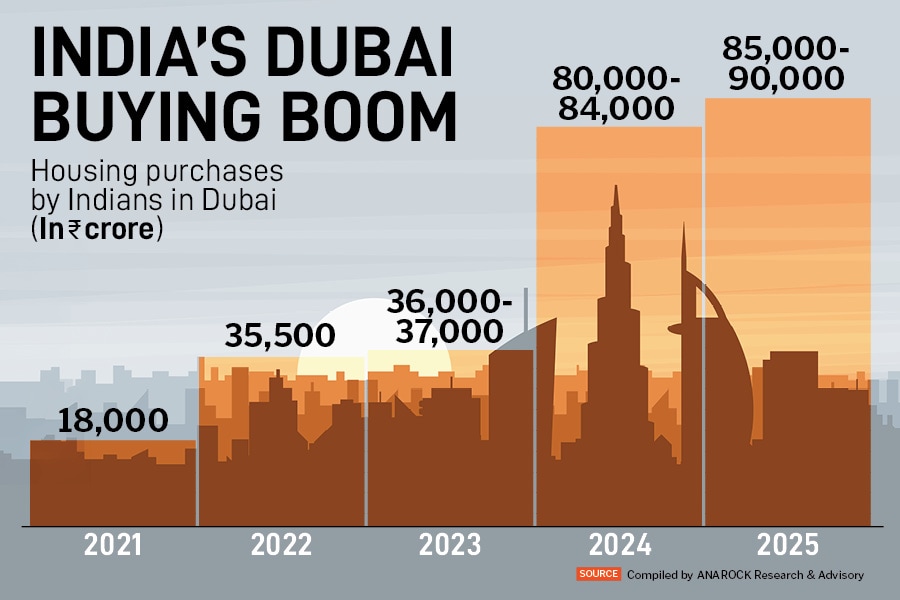
The escalating Iran-US-Israel war, however, now threatens to derail the growth of the world’s most ambitious real estate market. Before the war began earlier this month, Indian housing purchases in Dubai surged from roughly Rs18,000 crore in 2021 to an estimated Rs85,000 crore to Rs90,000 crore in 2025, a near fivefold jump in just four years, according to data compiled by ANAROCK Research.
The Indian surge in Dubai buying
A recent Kotak Mahindra Bank survey ranks the UAE as the fifth most preferred migration destination for ultra-wealthy Indians, with 13 percent choosing it after the US, UK, Canada and Singapore.
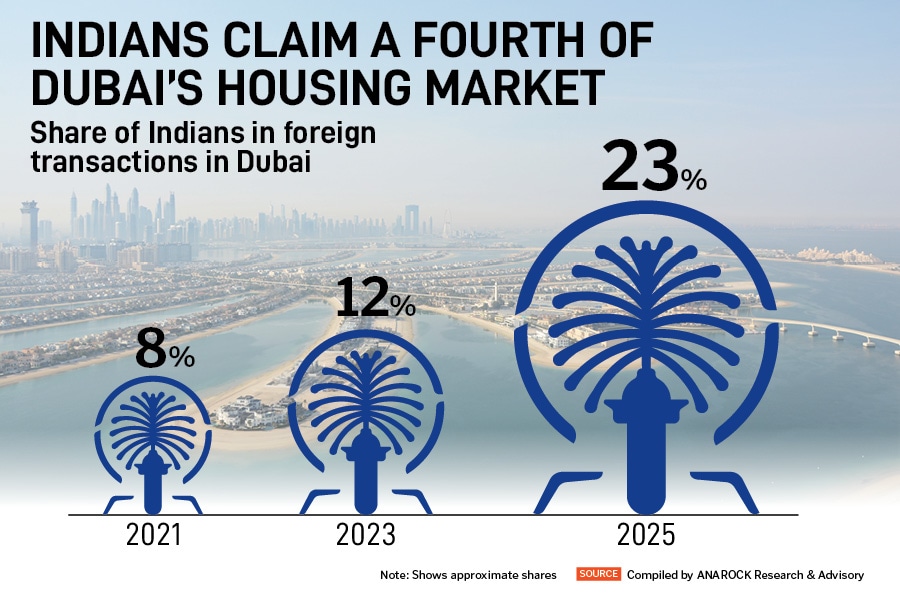
Indians, who accounted for just 8 percent of foreign residential transactions in Dubai in 2021, had by 2025 claimed nearly a quarter of the market—the single largest foreign buyer cohort.
This surge has been fuelled by tax-free yields and the allure of the Golden Visa as the Emirates is viewed as a wealth shield pegged to the US dollar. The appetite showed no signs of cooling—that was until the war began and missiles started flying.
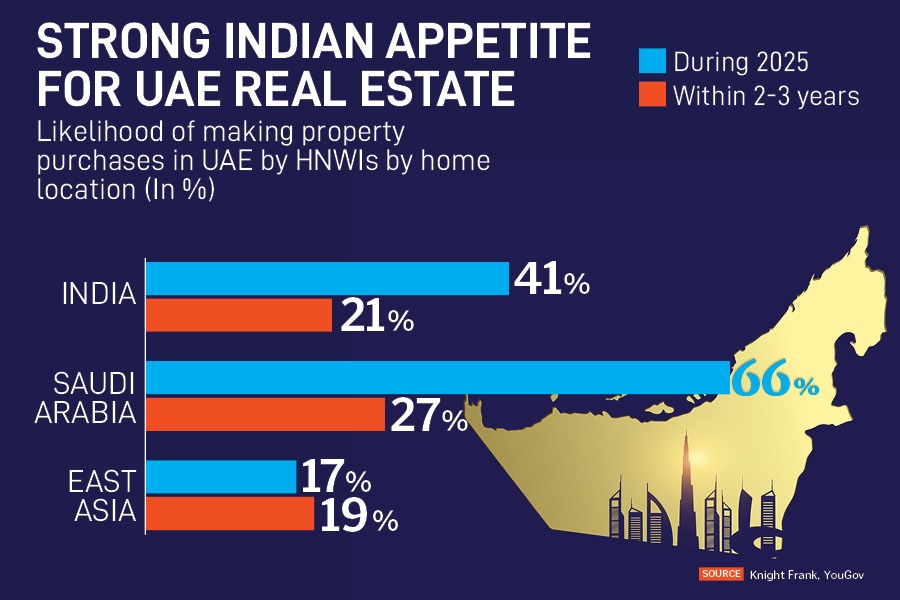
A Knight Frank survey of high-net-worth individuals (HNWI) conducted last year captured the scale of Indian ambition in the UAE at, what now looks like, peak confidence. About 41 percent of Indian HNWIs said they were likely to purchase a property in the UAE during 2025 itself, second only to buyers from Saudi Arabia (66 percent). Another 21 percent of wealthy Indians indicated they would buy within two to three years, painting a picture of a buyer base that was not merely interested but actively committed.
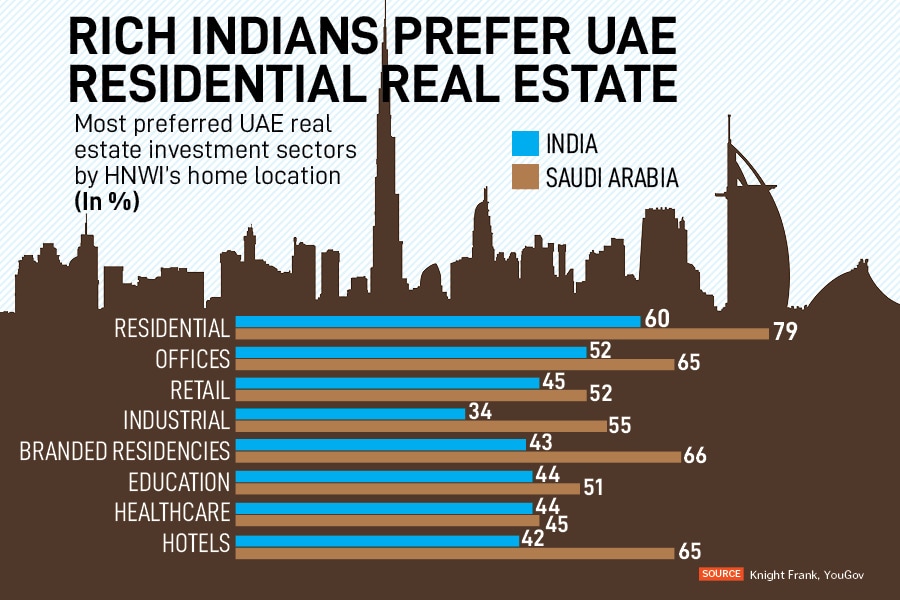
Among preferred sectors, residential real estate led Indian HNWI choices at 60 percent, ahead of offices (52 percent), retail (45 percent), branded residencies (43 percent) and a range of alternative asset classes, including health care, hotels and education—suggesting Indian investors were treating Dubai as a high-yield asset hub rather than just a vacation spot. Saudi Arabian HNWIs display the strongest near-term conviction in UAE real estate. Their preferences skew heavily toward residential (79 percent) and branded residencies (66 percent), but unlike Indian buyers, Saudis show notably stronger appetite for industrial assets (55 percent) and offices (65 percent).
However, the targeting of Dubai’s financial district and its international airport, combined with nearly 2,000 Iranian drones and missiles fired at the UAE since the war began, has shattered the city’s image of absolute security.
Beyond residential buying The stakes extend well beyond luxury real estate. Dubai has become a critical node in India’s IT and financial services architecture. Major Indian IT firms like Infosys, Wipro, TCS and a clutch of other mid-tier players run significant Gulf operations out of the Emirate, serving regional clients and using it as a launchpad into Africa and Europe. Any sustained disruption to Dubai’s status as a neutral financial hub would ripple directly into Indian corporate earnings.