India’s youth is leaving farms, but skill gaps mean stagnant pay
Young people are leaving behind agriculture faster than ever, but lack of adequate training means they are stuck in cities with low-paying informal work and no growth prospects
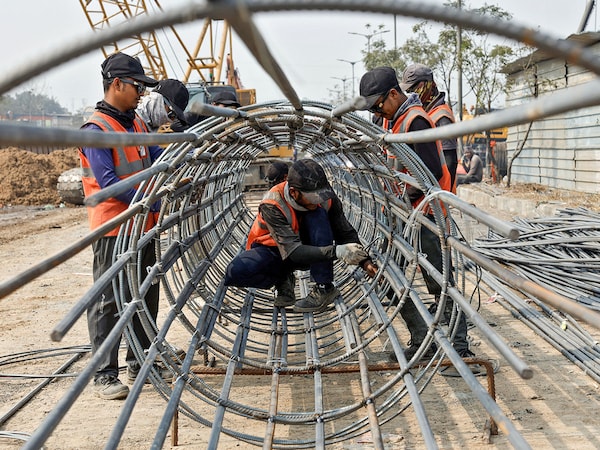
While youth from land-owning families can often afford to wait for “suitable” aspirational jobs, those from landless or marginalised backgrounds are frequently forced into immediate, informal labour like painting or construction to support their families.. Photo by Amit Dave / Reuters
Advertisement
India’s labour market is witnessing a paradox: While young workers are exiting traditional agriculture at record speeds, the promised transition into high-productivity manufacturing and modern services has largely stalled. The State of Working India 2026 report reveals that instead of moving into stable, high-paying jobs, the youth are increasingly turning towards informal sectors, such as construction, low-productivity services, or casual salaried work where earnings have largely stagnated.
A shift in aspirations
The demographic dividend is driving a massive shift in the workforce’s sectoral composition. Between 1983 and 2023, the share of young men (aged between 20 and 29 years) in agriculture plummeted from 56 percent to 27 percent. This decline was significantly faster than that of older men (aged 30-64 years), whose participation fell from 58 percent to 36 percent in the same period. Younger men are exiting agriculture faster than women, whose workforce share rose post-pandemic.
This “faster exit” is fuelled by rising education levels and a clear shift in aspirations; younger cohorts are increasingly turning away from traditional farming. However, this exit is not uniform. Access to non-agricultural work is heavily mediated by social identity, including caste and land ownership. While youth from land-owning families can often afford to wait for “suitable” aspirational jobs, those from landless or marginalised backgrounds are frequently forced into immediate, informal labour like painting or construction to support their families. Occupational patterns in the village reveal a sharp caste divide. While SC/ST workers are concentrated in labour-intensive sectors like construction and agriculture, other castes dominate high-status roles as owner-cultivators, rentiers, or formal salaried employees.
Among the youth, a significant shift is occurring, in which dominant castes are moving away from active cultivation—retaining land only as absentee owners—while securing formal private-sector jobs at five times their population share. Although aspirations are similar across groups, the children of landed, dominant castes are far more likely to enter the formal sector due to superior initial endowments. Conversely, ST respondents cite distress migration for livelihood as a primary barrier to higher education, trapping them in the construction sector.
Perhaps the most concerning finding is the stagnation of life-cycle earnings. While graduate earnings rose sharply between the 1990s and 2010s, that momentum has vanished. Recent cohorts of graduates are entering the workforce at salaries that have not increased in real terms compared to previous generations.
“The growth in earnings in the initial years of a career is steeper, indicating the importance of early growth, but the line then flattens out,” the report notes. Furthermore, even within the salaried sector, work is becoming increasingly casual, offering fewer benefits and less security than in the past.
For women, the situation is even more complex. While female labour force participation is at a four-decade high, much of this is driven by self-employment and unpaid family work in agriculture, particularly in the post-pandemic recovery. In the urban ‘gig’ economy, young, highly educated women are turning to online platform work to balance professional aspirations with heavy household responsibilities and social expectations.
The skill mismatch: ITIs under pressure
India’s formal skill training architecture, centred on Industrial Training Institutes (ITIs), has expanded rapidly but is struggling with a widening quality gradient. While the number of ITIs has exploded, driven largely by private institutions after 2005, the quality of training in many of these newer private centres is poor, often scoring in the lowest bands on national scales.
This has led to a paradox of certification where India is producing more certified workers than ever, yet industry leaders continue to report severe skill shortages. The report highlights a weak spatial link between ITIs and manufacturing hubs. States with high manufacturing employment do not necessarily have more ITIs, suggesting that many institutes were built for “coverage” rather than to meet specific industrial needs. As of 2024, there were 15,000 ITIs across India, an increasing proportion of them private.
Despite these gaps, vocational training still offers a significant “premium” for certain groups. For those with only primary or middle-school education, vocational training acts as a substitute for formal schooling, providing a 22 percent earnings premium in technical or manufacturing roles. For graduates, the premium is more moderate, acting as a signal of hands-on knowledge rather than a transformative skill.
Historically, ITIs were urban-centric, strategically placed near industrial hubs to facilitate apprenticeships and direct employment. However, since the late 1960s, a significant geographic shift has occurred. Today, 70 percent of new ITIs are established in rural areas, and approximately 75 percent of trainees graduate from rural institutes.
This “ruralisation” of supply stands in stark contrast to the geography of demand. According to the Sixth Economic Census, 66 percent of manufacturing establishments with hired workers are located in urban India, while only 34 percent are rural.
Education: Growing access but persistent inequities
India is on track to meet many of its National Education Policy (NEP) goals for higher education enrolment. Female enrolment has almost caught up with male enrolment, a significant achievement for social infrastructure.
However, “inequities remain not just in the availability of colleges but also in huge variation in the costs of different kinds of degrees,” the report warns. Technical degrees like engineering remain prohibitively expensive for poorer households. Consequently, students from SC and ST backgrounds are still more likely to pursue Humanities and less likely to enter high-earning professional programs like Medicine or Engineering.
The path forward
The report notes that a “supply-side approach” focussed solely on imparting skills is insufficient. Without a complementary policy framework that enables formal firms to expand and create high-quality jobs, millions of skilled and educated youth will continue to find themselves in a self-perpetuating equilibrium of low-productivity work.
As the demographic structure shifts toward an older population by 2036, the window to productively engage this youth workforce—roughly 263 million strong—is narrowing.