Giti Tire: On a roll
Executive Chairman Enki Tan has spent the past two decades building the Singapore-headquartered company into a top supplier of EV tyres
Last Updated: Mar 13, 2026, 16:23 IST11 min
It was a clear September morning in Northern Germany when Chinese EV giant BYD’s electric hypercar Yangwang U9 Xtreme blasted to a record speed of 496.22 kmph at the ATP Papenburg test track, beating the 2019 record of 490.48 kmph clocked by Bugatti’s Chiron Super Sport 300+ to become the fastest production model on the planet. A month earlier, the U9X lapped the Nürburgring Nordschleife’s “Green Hell”, the 21-kilometre mountain circuit through Germany’s Eifel forest notorious for 300 metres of elevation shifts and over 70 turns, in under seven minutes, a record for an electric vehicle.
Under the machine’s nearly 2.5-tonne body, and connected to four electric motors, each capable of a rotational speed of 30,000 rpm to deliver over 3,000 horsepower, was a set of semi-slick GitiSport eGTR2 Pro tyres. The high-performance wheels showcased the latest technology from Giti Tire, the Singapore-headquartered manufacturer that’s been quietly cornering the global market for EV tyres.
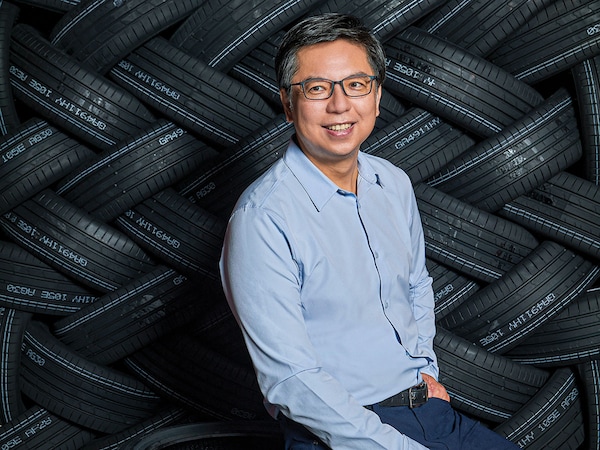
The pro tyres, built for ultra-high speeds and responsiveness in extreme motoring conditions, are a culmination of two decades of investment in tyre innovation and design, spearheaded by Giti’s 57-year-old executive chairman Enki Tan, a medical doctor-turned-auto executive. Since joining the company’s listed Chinese unit in 2003 as executive director and taking the top group job seven years later, Tan has transformed Giti from a regional player into a global heavyweight, selling its tyres in over 130 countries.
“If you go to Bhutan, you’ll see our tyres. If you go to New Zealand, you’ll see our tyres,” says Tan, in an exclusive interview with Forbes Asia in Jakarta, adding that he even bet with a friend on a trip to Iceland that they’d spot Giti’s tyres while there (they did).
Industry publication Tyrepress ranks the company as the world’s 15th largest tyremaker by sales. With $3.1 billion in revenue for 2024, Giti has manufacturing capacity to roll out over 100 million tyres annually for conventional gas-powered cars as well as EVs, motorcycles, trucks and buses from five factories, three in China and one each in the US and Indonesia, the country from where it draws its roots.
Now Tan says he’s ready to take the company further, driving it back into the tyre industry’s top ten where France’s Michelin and Japan’s Bridgestone have long topped the leaderboard. (Giti briefly cracked the elite ranks in 2015.) It’s a tall order: The company will need to pump up substantially to overtake the industry’s current No. 10, Chinese tyremaker Sailun Group with $4.9 billion in sales and capacity to produce 140 million tyres annually.
Tan is counting on Giti’s technical capabilities to capture more customers. “To just build factories and start pushing products in the market doesn’t work anymore. Those brands that can build [their technology] and be in the key markets, and with key growth partners, will be the ones that survive,” he says.

While typically not headline-grabbing, the act of driving, from acceleration and braking to stability and control, relies on the humble tyre, the only part of a car that touches the road, points out Tan. By his estimates, he’s spent over $2 billion in the past five years on both R&D and manufacturing sites to produce tyres that meet an increasingly complex range of requirements for passenger and commercial vehicles. From givens like safety and durability to next-gen must-haves like energy efficiency and smart monitoring through sensors embedded in the tyres. Tan explains that their sensors measure eight variables such as tyre pressure and temperature to assess wear and tear.
Giti owes its tech prowess to the 800 engineers working at its four far-flung research centers in China, Germany, Indonesia and the US. “Most people don’t understand tyres,” says Tan. “I have people telling me, ‘Hey, they’re very easy to make. You just pour the rubber inside the mould and then the tyre comes out.’ It’s not so easy.”
Take the U9X hypercar. Giti proposed over 30 tyre designs, says Yan Feng, head of Yangwang Research Institute at BYD’s R&D division, by email. “To achieve world records in both top speed and lap time on such an extreme vehicle, close collaboration with a tyre supplier is essential.” Given their long-time association of over two decades, Giti was “the clear choice” for the project, he adds, elaborating that the tyre they jointly developed used a heat-resistant fiber of high-tensile strength to ensure stability at high speeds. Even the smallest irregularity or wear in the tyres “can significantly impact vehicle speed and safety,” says Feng.
For Tan, the project put Giti through its paces and proved that “we can produce a product way beyond [a tyre’s] daily application. You can imagine the forces in turning a corner at 300 kilometres an hour,” he notes. “This is interesting because it also intersects with EVs.” Unlike tyres in conventional cars, EV tyres require a higher load index (EVs are heavier than their gas-engine counterparts), low rolling resistance (the less energy used, the greater the driving range) and optimised tread patterns (for both traction and to reduce road noise).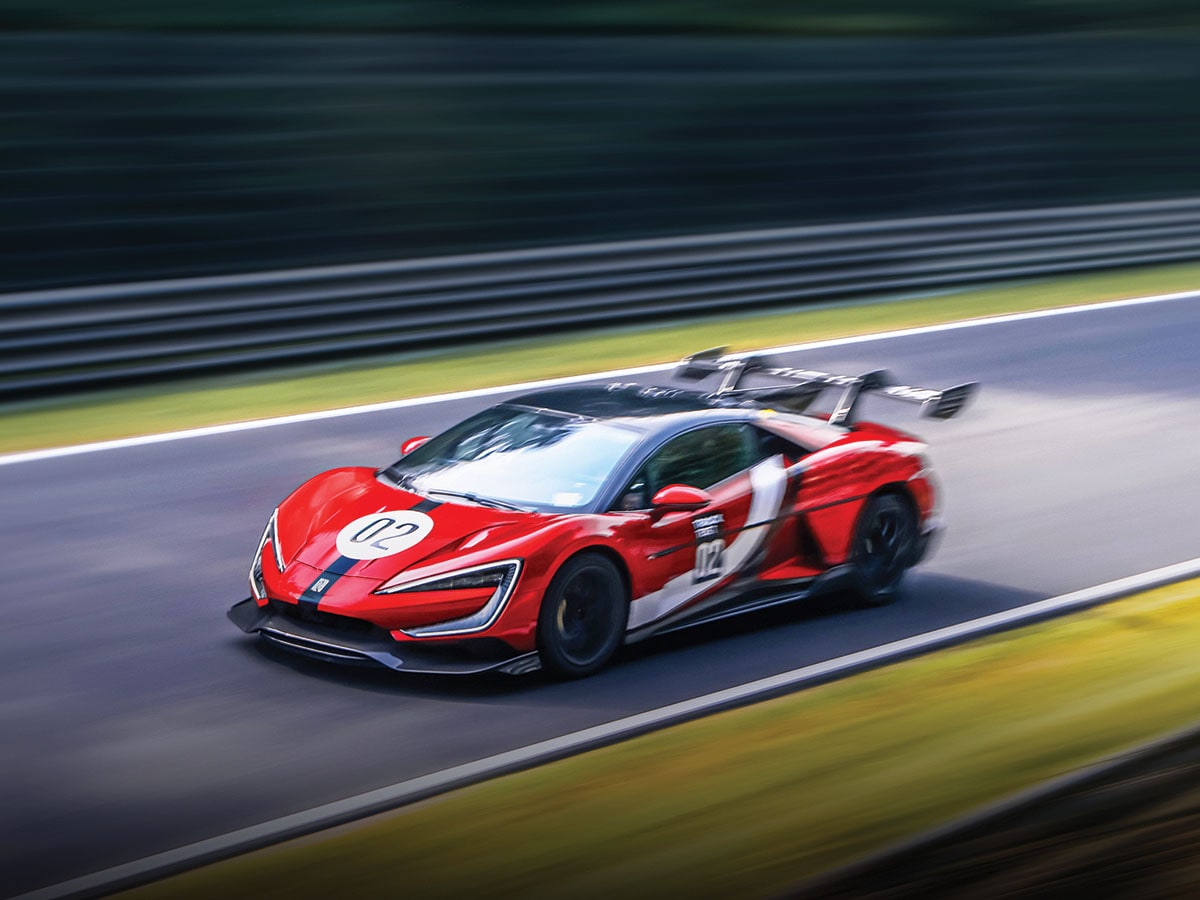
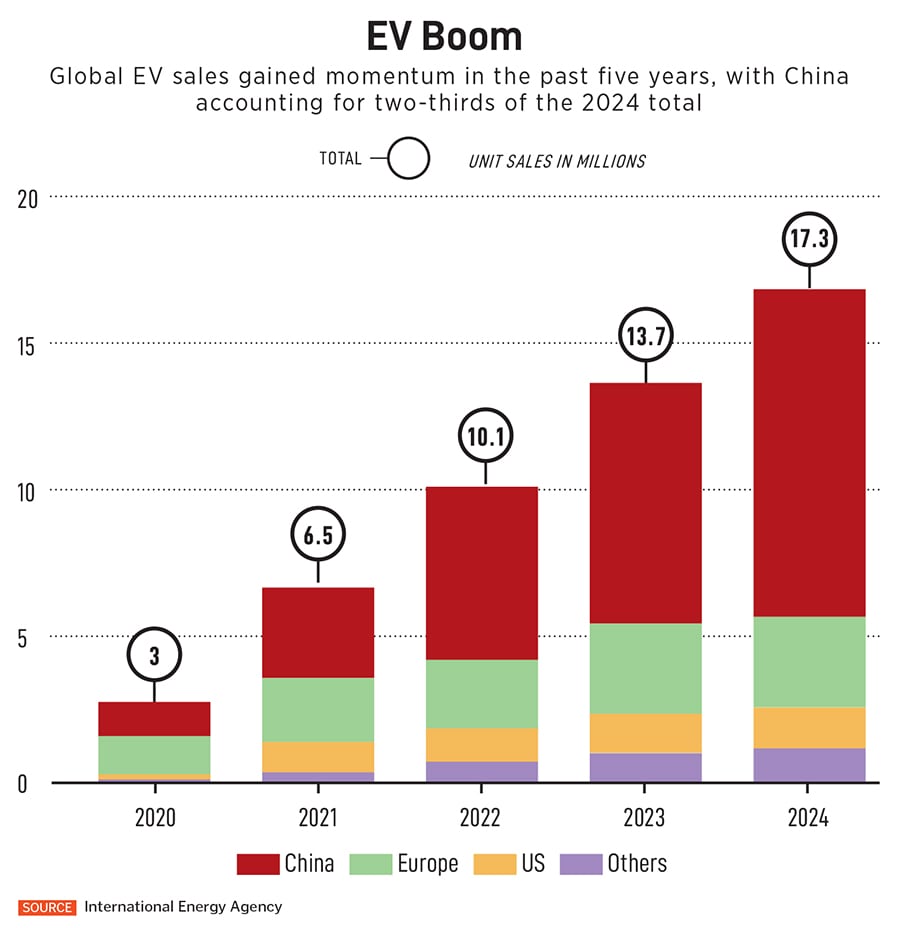
His bet on making Giti an EV tyre specialist to accelerate growth couldn’t be better timed. Worldwide, the number of electric cars hitting the road is increasing every year; EVs accounted for a fifth of global car sales in 2024, compared with 18 percent the previous year, according to the International Energy Agency (IEA). China has raced ahead as the biggest EV market, thanks partly to government subsidies, racking up sales of over 11 million electric vehicles, or nearly two-thirds of the total global market.
Over the past decade, EV tyres have become Giti’s fastest-growing business and the one with the most potential, says Tan. More than half of the 300 original equipment manufacturer (OEM) car models it supplies are EVs, per the company’s recent Singapore Exchange filing for a S$750 million ($579 million) bond offering. Achieving that traction is thanks to a long-term view that led Giti from its comfortable position as a tyre supplier to Japanese automakers in Indonesia to tie up over 20 years ago with Chinese carmaker Chery Automobile to make tyres for its popular QQ City series of compact cars.

“We’ve been selling EV tyres… since the beginning of EV manufacturing in China,” says Tan. Being in the right place at the right time saw Giti snag its first EV tyre contract with BYD in 2010, expanding its seven–year-long association with the carmaker, initially as a supplier of tyres for its gas-engine cars. Today Giti is a leading OEM tyre supplier for EVs in China and counts Geely Auto, XPeng and NIO among its customers. China, in turn, is the biggest EV manufacturing hub in the world, making up more than 70 percent of global production, according to the IEA.
That focus on the Chinese EV market could be Giti’s ticket to move up the ladder in terms of global market share, says David Shaw, CEO of London-based consultancy Tire Industry Research. “Giti will probably hit its target of becoming one of the top 10 tyre manufacturers in the world,” he adds. “The only question is how long will it take them to get there.”
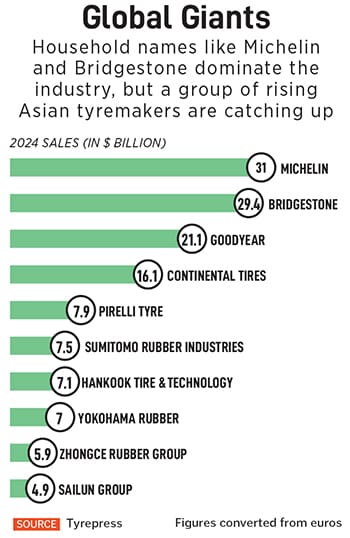
Giti’s EV push comes as leading tyremakers—Michelin, Bridgestone, Goodyear and Continental Tires—are ceding market share to other players, such as Giti, South Korea’s Hankook Tire & Technology and Japan’s Yokohama Rubber, whose high-tech factories can make quality tyres comparatively cheaply, says Shaw. Giti’s aim to be among the global top ten is “perfectly possible because the big names are struggling,” he adds. (Giti’s senior management team includes executives from Michelin.)
Tan’s multiple sightings of Giti on his travels are partly due to his efforts to make it a recognised brand around the world. The company tied up this year with Volkswagen, in which the two kitted out the German carmaker’s electric van ID Buzz with GitiSynergy H2 tyres for an 80,000 kilometre journey through 75 countries that began in September in Hanover. The expedition, which aims to set a new Guinness World Record for visiting the most countries in one journey in an EV on a single set of tyres, will be yet another gruelling test of Giti’s tyres. As Shaw says, “Giti is sending out the message that our technology is good.”
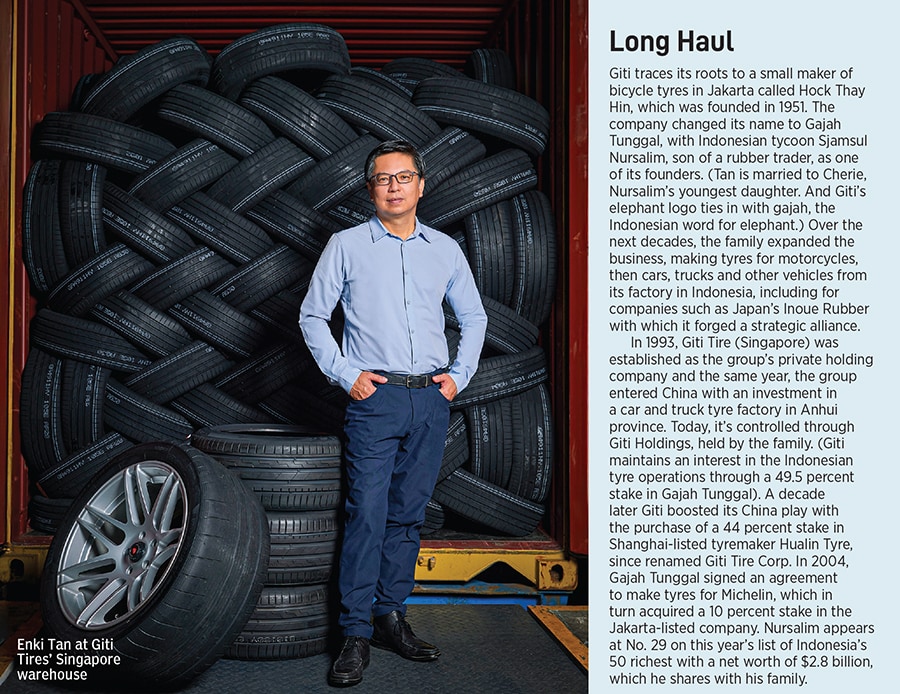
Tan, who grew up in Kuala Lumpur—he remains a Malaysian citizen—says he’s always been passionate about cars. His family owned a car repair shop but an interest in biology led Tan to study medicine at the University of Sydney. After graduating in 1992, he spent the next six years working as an anaesthesiologist in hospitals in Australia, Hong Kong and Malaysia, before he switched gears to earn an MBA from MIT in 2000.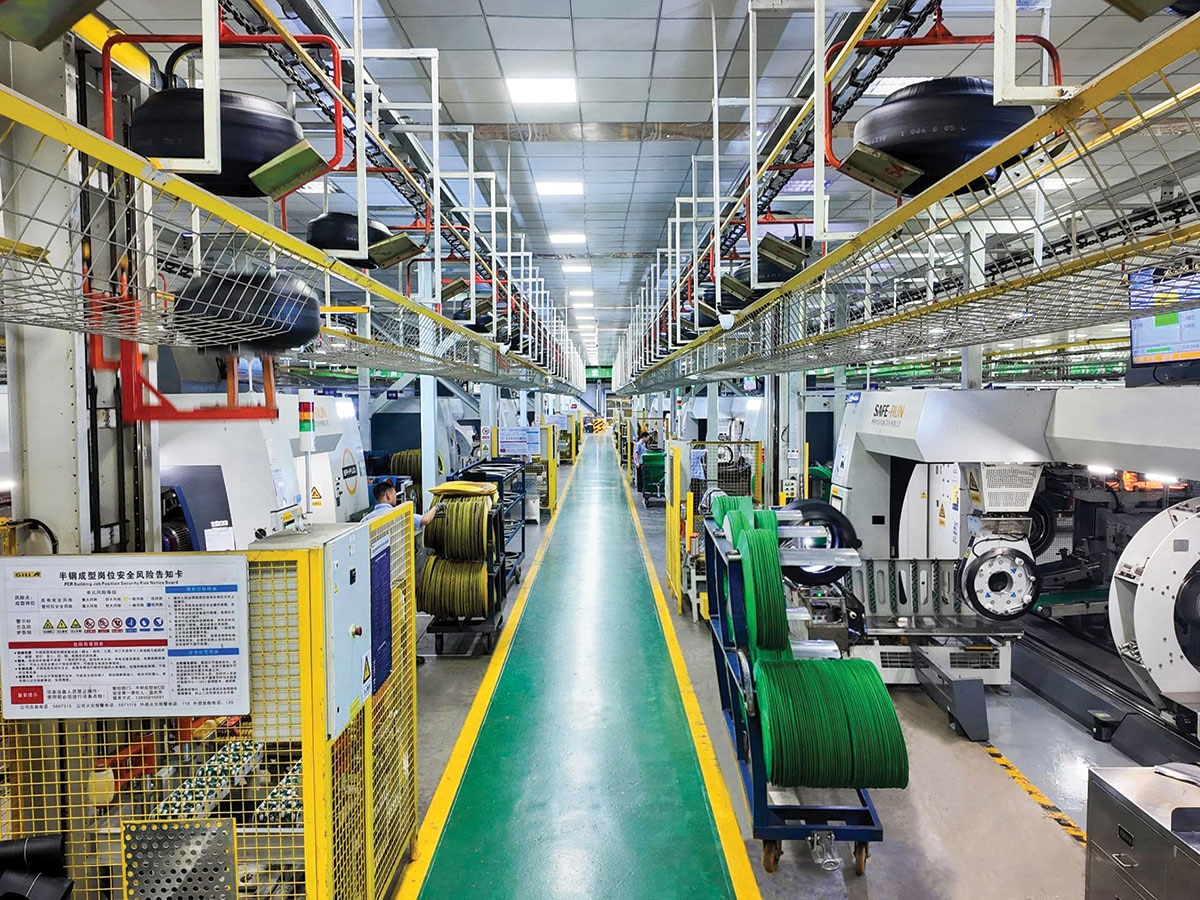
Both experiences have helped him navigate challenges at Giti, explains Tan: “In medicine, you always need to know the root cause of any problem. In business, you also need to know the root cause. If you don’t know the root cause, you’re only treating the symptoms, and the company will not grow because you haven’t fixed the underlying problem.”
A few years after joining Giti, Tan, by then executive director for international sales, began visiting automakers across Asia, Europe and the US to pitch Giti tyres. While the OEM market is smaller than the tyre-replacement market, which makes up the bulk of tyre sales, Yash Agarwal, an auto equities analyst at Gurugram, India-based Nirmal Bang Securities, says the OEM segment offers a much longer runway for a tyremaker, providing an opportunity to collaborate on tyre design with an auto company and seed potential higher-margin replacement sales.
Tan recalls drawn-out negotiations for an OEM contract with a big German carmaker. The vetting process took years and required Giti to undergo frequent audits to ensure compliance with strict manufacturing standards before it landed the contract. Tan says that gaining the trust of one major manufacturer opens the doors to building other relationships. “The only other brand you see [besides the car itself] is the tyre. So you are automatically representing the car brand. They have to trust that you can deliver.”
Among his pitstops was South Carolina, an American auto manufacturing hub. Giti, which has been exporting tyres to the US, one of the world’s biggest tyre markets, since 2005, opened a 158,000-square-metre factory and R&D center in Chester County in 2017. Today it churns out around 5 million tyres a year, making up a quarter of the tyres the company sells in the US. (The rest are still imported from Indonesia.)
While acknowledging the $560 million buildout cost more than a factory with similar capacity in Asia, he says it was a way to strengthen ties with Giti’s American customers and reduce supply chain risks—a forward-thinking move, as it turns out, in the wake of President Donald Trump’s sweeping tariffs on imports into the US, including goods from China and Indonesia. “We built it just in time,” Tan says, adding that the unit helps to demonstrate Giti’s commitment to the US market.
Yet Giti’s home turf in Asia holds the most promise for future growth, in particular China, the world’s largest car market with 31 million vehicles sold in 2024. In the first half of 2025, China made up about 44 percent of Giti’s total sales, followed by Indonesia at 26 percent, the company says. Growth in the global tyre market will be driven by Asia-Pacific, says Nirmal Bang’s Agarwal, noting headwinds in Europe and the US, where car prices have increased significantly and interest rates remain elevated.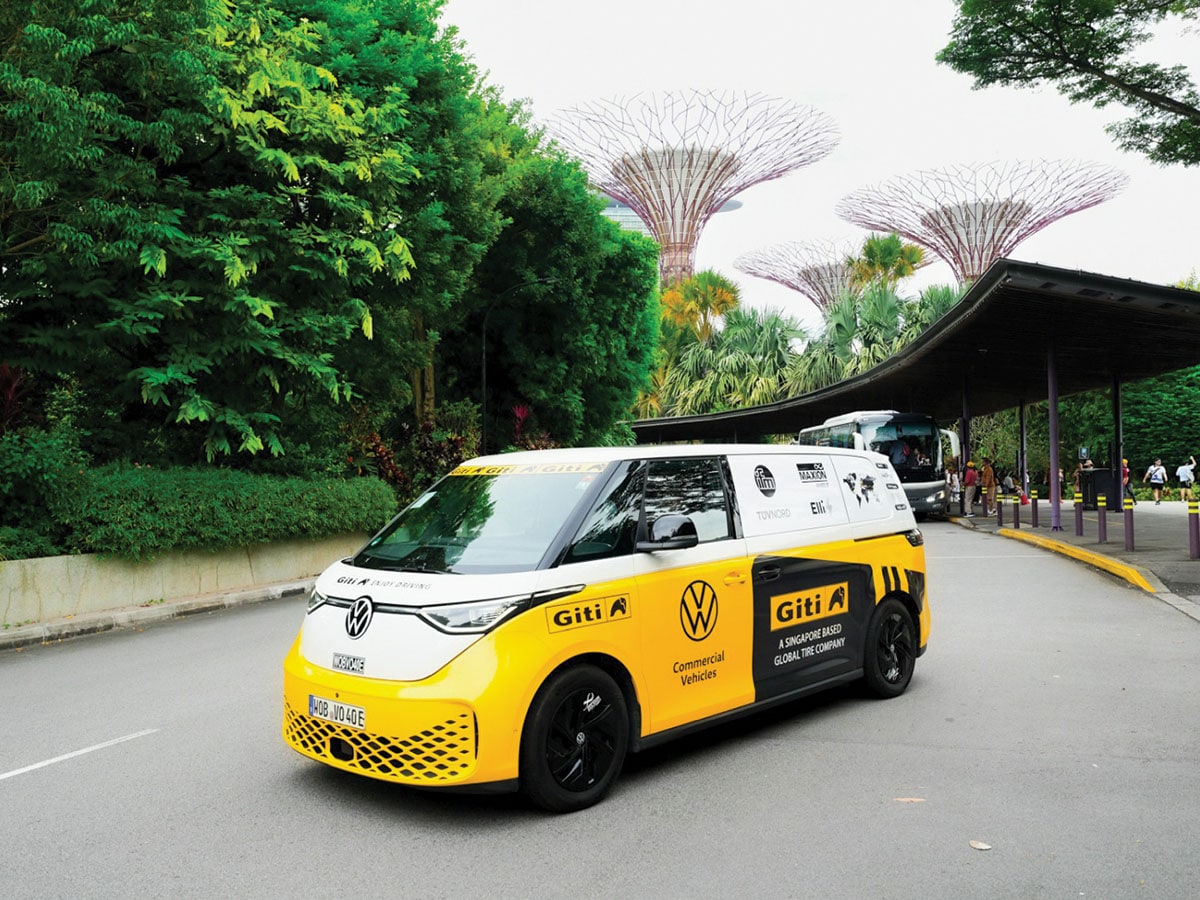
According to New York-based TechSci Research, China’s tyre market will nearly double in size to $102 billion in 2030 from $55 billion in 2024. That’s about half of the global total, which is expected to hit $240 billion by the end of the decade, growing at a compound annual rate of nearly 11 percent. In anticipation, this year Giti opened its first production line at its new factory in Anhui province, a car manufacturing center in eastern China, with plans to ramp up to full production capacity of close to 23 million tyres by 2027.
For Giti to crack the industry’s top ten, it needs to have better relationships with the top automakers as well as increase its exposure to EV and SUV tyres, says Agarwal. “Only then will they be able to have a higher top-line growth as compared to normal mid-single-digit growth that we are expecting in the tyre industry.” For the past three years, Giti has clocked a modest compound annual sales growth of 7.6 percent.
Among the speed bumps Giti faces as it revs up is a shortage of natural rubber amid high demand for the key material used in tyres, alongside competitive pricing between brands as tyremakers jostle for an edge in a crowded marketplace. While rubber futures on the Tokyo Commodity Exchange, a benchmark in global rubber trade, have dipped slightly since the start of the year, prices are up 80 percent since 2020. Overall, roughly half of Giti’s revenue in the past three years was spent on raw materials, including rubber, nylon, polyester cord, steel wire and carbon powder.
To mitigate the impact of costlier inputs on profitability, the company has centralised purchasing to secure bulk rates for materials, sourced from a global network of multiple suppliers. It’s also recently introduced a new tyre prototype, which it claims is made mostly of sustainable materials, including recycled rubber and plastic bottles. The efforts are paying off: Giti’s net profit in 2024 climbed over 80 percent to $129 million from $71 million the year before.
Looking down the road, Tan notes that tyre technology has to keep pace with a fast-evolving market where products “are getting better and better”. But he cautions: “You cannot just sell the product, you have to serve the customer so that they see other value propositions...and trust in your brand.”
—With additional reporting by Jonathan Burgos and Gloria Haraito
First Published: Mar 13, 2026, 16:59
Subscribe Now(This story appears in the Mar 06, 2026 issue of Forbes India. To visit our Archives, Click here.)