The question came from one of Rahul Mishra’s embroiderers when he spotted a celebrity wearing a copy of Mishra’s Tigress Artistic Work designs on a television show. This happened in November 2024, laying bare the invisible cost of fashion plagiarism—not just lost designs, but also lost dignity and livelihoods.
Mishra was unaware of how the copy of his Sunderbans Collection was made—whether it was a buyer who replicated the design, or one of the hundreds of photographers at India Couture Week who sell CDs or pen drives with high-resolution images of collections for a paltry sum of ₹5,000-odd, which may have made their way to the big mills of Surat.
It was not merely the existence of a cheaper replica that disturbed him. What was especially concerning was that these replicas were publicly patronised by individuals who had both access to and awareness of the original work. For Mishra, the issue went beyond mere violation. He was troubled that when individuals with visibility and means are seen endorsing copies, it sends a damaging message—not just about ownership, but also about the value we collectively place on originality, labour and craft.
Mishra’s designs being plagiarised was not one episode, but a recurring reality. In 2017, one of his Paris Couture Week collections was copied by an Indian brand. “Maybe I did not have the wherewithal to pursue a case then, as a case like this handled by a senior counsel costs several lakhs,” he recalls. “So, finally, I just settled with an apology.”
At this juncture of his life and career, however, Mishra says his motivation has shifted. While compensation would act as a deterrent, his broader aim is to set a precedent for India’s creative industries—one in which intellectual property is respected and defended. “You can seek inspiration from anything that is in the public domain, but you can’t replicate a handmade process that involves a certain degree of effort by using a computer or a machine. I have a problem with that,” he says vehemently.
![]()
As per submissions made before the court by senior counsel Jayant Mehta, who led the representation from the legal team at Khurana & Khurana Advocates, the defendants had intentionally replicated the unique visual and thematic elements of the Tigress Artistic Work, including embroidery patterns, specific floral motifs, their precise arrangement and the overall aesthetic and get-up of the plaintiffs’ garments. This, the submission stated, created a false impression that the defendants’ products bearing these elements (‘impugned products’) emanated from the plaintiffs.
On August 4, 2025, a landmark order was passed by Justice Tejas Karia in the lawsuit against the defendants for passing off and unauthorised copying of Mishra’s Tigress Artistic Work, including imitation of the overall get-up of his garments and floral motifs identical to those in the celebrated Sunderbans collection. The judgment read, “In view of the above submissions, it is prayed that the defendants are liable to be restrained by an injunction from any further use of the Tigress Artistic Work and associated flora artwork on their impugned products and/or any other goods/services.”
The ruling clarified that unique fashion motifs and intricate embroideries qualify as “artistic works” under India’s Copyright Act—a departure from traditional interpretations that had long left fashion vulnerable to imitation. The court further said that “whenever a designer goes to court over plagiarism, this order will be referred to,” confirming its status as a precedent-setting judgment.
The injunction granted against multiple manufacturers, sellers and ecommerce platforms sent a strong message to the fast-fashion industry: Unauthorised replication is not merely unethical, it is legally enforceable.
A crucial aspect of the judgment was its acknowledgement of the human element behind luxury fashion. The court recognised that Mishra’s designs support the livelihoods of over 2,000 artisans, whose skills are an integral part of India’s cultural heritage. Protecting his intellectual property, therefore, was also seen as protecting a fragile craft ecosystem from being hollowed out by mass-produced counterfeits.
![]()
Plagiarism is not just rampant in Indian fashion—it is complex, layered and deeply systemic. India’s massive wedding wear market and booming occasion wear economy create fertile ground for imitation. Some customers want Sabyasachi or Manish Malhotra aesthetics at one-tenth the price. This gives rise to boutique knock-offs, Surat, Chandni Chowk or Sarojini Nagar adaptations, and Instagram pages recreating couture looks within days. The line where inspiration ends and copying begins is often blurred.
Copying happens across the spectrum. Couture is copied by boutiques. High-street brands lift runway ideas. Instagram designers replicate viral looks. No tier is completely clean. India’s vast unorganised market only accelerates the process, making copying faster, cheaper and harder to regulate.
The prevailing sentiment within the industry is that intellectual property protection is weak and enforcement slow. Many designers lament that while design and copyright laws exist on paper, fashion continues to receive limited protection. Legal action is expensive, time-consuming and rare. By the time a case progresses, the trend has often already faded.
Leading fashion designer Anita Dongre, founder of the House of Anita Dongre, who has encountered plagiarism at several points, says, “Over the years, there have been moments when I have seen exact replicas of our handcrafted pieces appear online or in stores within days of a collection’s release.” What hurts her the most is not the copying but how it dismisses the months of work put in by numerous artisans. “When something made slowly and mindfully is reduced to a quick imitation, it affects the entire ecosystem behind the design. It takes away respect from the hands that create.”
For a designer, every creation is born from years of learning, observation, and a deep understanding of people, culture and emotion. A design is not a standalone object—it is an extension of philosophy, a creative language refined over decades.
Couturier and founder of the eponymous label, Manish Malhotra, echoes this sentiment. “When someone copies my creations, it isn’t just about the garment; it’s about taking away a part of that journey and the intention behind it.” He believes calling out plagiarism is necessary because clients place trust in originality and sincerity. “If copies start circulating, that trust gets shaken. It also sends the wrong message to the industry, that taking someone’s hard work is acceptable… and it isn’t.”
For Dongre, speaking up is not about naming or shaming, but about safeguarding creative integrity and livelihoods. She agrees with Malhotra that copying diminishes the value of original work and confuses the consumer. “For a brand rooted in craft, authenticity and slow fashion, plagiarism disrupts trust and misrepresents the care and detail we put into every piece.”
Speaking about how plagiarism impacts craft sustainability, Malhotra says, “Our artisans are central to the brand, and reviving India’s age-old crafts has always been close to my heart.” Their skills are generational, passed down over centuries. “When a design is copied and mass-produced, the real craft gets pushed aside.” Machine-made imitations may flood the market, but they can never replicate the emotion, time or skill embedded in handwork.
Viral, Then Stolen
Plagiarism has become more visible in the digital age, where access and comparison are instantaneous.
Couturier Anamika Khanna finds it frustrating that she is sometimes unable to produce her own ideas because they have already been copied. In her view, this often stems from fledgling designers who replicate existing work rather than develop original thought. “It bothers me to think that they are not making an effort to come up with an original idea… they are relying on their social media feed and finding the easy way out.” The scale of plagiarism worries her deeply. “It’s almost at a place where I don’t know where it’s driving Indian fashion to.”
![]()
Fashion designer Vaishali Shadangule, who has seen her designs copied blatantly, offers a more philosophical perspective. “When designers replicate our work, it’s almost an unintended acknowledgement that we are building something original and relevant,” says Shadangule whose entire collections and signature cording technique have echoed across markets, even internationally.
So, do India’s IP laws sufficiently protect fashion designers? “India has made progress, but fashion moves much faster than the laws meant to protect it,” says Malhotra. “By the time a designer takes action, the copy has often reached the market, and the damage is already done.”
“Indian IP laws are improving, but fashion design still falls into many grey areas,” adds Dongre. Embroidery layouts, motifs and textile techniques need clearer recognition and simpler legal pathways. “What we need is faster redressal, better awareness among young designers and a framework that understands ornamental and craft-based design. Protecting creativity should not feel complicated.”
Malhotra concurs. “There should be a system that is simpler and quicker… something designers can rely on. We need stronger protection for embroidery and craft techniques, especially for our karigars who form the backbone of the industry.”
Over the last decade, social media has emerged as a double-edged sword. While anonymous Instagram handles like Diet Sabya have helped identify and call out what they term #gandicopy, the same platforms enable designs to be lifted instantly. Dongre notes, “Social media accelerates visibility; your work can reach the world quickly. But that also means it can be copied instantly. The upside is that plagiarism is easier to spot, and communities call it out faster. The challenge is heightened vigilance.”
What can designers do to protect themselves? Malhotra believes awareness is key. “Young designers, artisans and even customers need to understand why originality matters. When we respect creativity, the whole industry grows, and our craft traditions grow with it.”
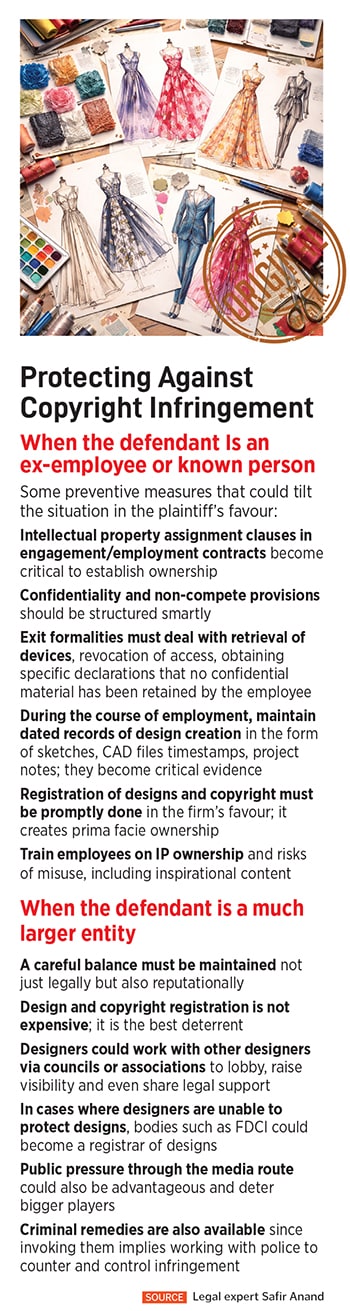
Shadangule hopes design schools emphasise courage and integrity over imitation disguised as inspiration. Dongre advises registering sketches, motifs, prints, and embroidery layouts. “For young designers, my advice is simple: document everything. Register your work, maintain dated archives and be proactive. Your creativity is your intellectual property—protect it from the beginning.”
Legal expert Safir Anand, who has handled plagiarism cases for designers such as Malhotra, Sabyasachi, Shantnu and Nikhil, and Dongre, says designers are often able to secure swift legal relief in clear cases of infringement. Interim injunctions are frequently granted on the first date of hearing.
![]()
Anand notes that right holders are rarely denied appropriate relief. “In Dongre’s case, the Delhi High Court dealt with a design infringement matter where her fashion house alleged that the defendant was manufacturing and selling garments, including lehengas, that copied her registered designs.” The court granted an ex parte ad interim injunction restraining the defendant from producing, selling or distributing the infringing garments, though the matter was later settled.
He adds, “Sabyasachi had filed a design lawsuit for infringing on his registered designs of lehengas. The Delhi High Court granted an injunction, ruling that the defendants’ designs were prima facie obvious imitations of Sabyasachi’s designs.”
In Malhotra’s case, the Delhi High Court also granted an ex parte ad interim injunction. “The Court held that continued misuse could cause irreparable harm to the plaintiff’s reputation and goodwill, and ordered immediate removal of infringing URLs and content, pending further proceedings,” Anand says.
Addressing concerns about delays, Anand points to the Commercial Courts Act as a landmark reform. “Every matter has its facts and circumstances to consider. Especially now, the Commercial Courts Act has been introduced in India and is a landmark reform that acknowledges the commercial importance of intellectual property and aims to offer quick disposal.” He adds that stricter timelines, dedicated commercial courts and proactive interim orders, including John Doe orders, have strengthened enforcement, even though delays may occasionally arise due to procedural complexities.
Shadangule feels that one of the ways to tackle the problem of plagiarism is to keep evolving the craft, deepening the technique, and taking her own language forward. As she succinctly puts it, “Copies freeze a moment in time; creators move on.”