Dressed in a red salwar-kurta, Vaishali Shadangule was just 17 when she left home at 3 am, boarding a train from Vidisha to Bhopal without a ticket. Perhaps she didn’t know then that the trip of 60-odd km would also be the start of her creative journey.
At home, Shadangule remembers, a horse cart would arrive every morning to take her brother to school, while she could study only till the eighth grade, as long as it cost nothing. As a teen, she pitched in with work—taking tuitions, selling paintings, designing mehndi—to earn and fund her education. But that night, she chose to break away.
Today, at 47, Shadangule stands among India’s most singular design voices—celebrating a quarter century of work rooted in Indian textiles, craft, and handloom, while supporting over 3,500 families of weavers across seven states. She is the first Indian woman designer to showcase on the official calendar of Paris Haute Couture Week, the first to open a flagship store on Boulevard Saint-Germain in Paris, and to launch a Western bridal line in Barcelona (in 2025).
Yet, the 17 years she spent at home were far from wasted.
The values that define Shadangule’s design philosophy were quietly absorbed from her mother for whom sustainability was a way of life. She would repurpose old saris into frocks or curtains, vegetable peels were used as compost for plants. These lessons have formed the foundation of her brand. “These things stay with you,” she says. “They become instinct.”
When she started her brand in 2000, she followed these ideologies almost subconsciously. “I have always been conscious about not throwing away fabric, but finding ways to use every bit,” she says. “When you treat nature like a part of your body, you are careful about what you create, how you create it, and how you treat people.”
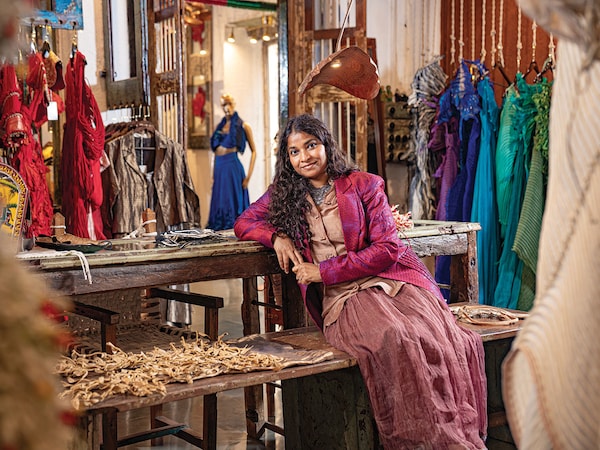
This philosophy underpins everything she does, including her atelier in Mumbai’s Kala Ghoda, which was built using repurposed doors and windows. “I arrived with a truck filled with broken windows. The security guard wouldn’t let me into the building. I begged him for some time and patience.” She also drapes fabric directly on the dummy, avoiding unnecessary cutting.
But the start wasn’t easy. When she left home, Shadangule was hard-pressed for money, and took up multiple jobs in Bhopal. At one of them, she discovered her intuitive flair for fashion—styling colleagues, suggesting how garments could be paired or worn differently. A colleague encouraged her to consider fashion design, a field she hadn’t even known existed.
She spent a few days at a local fashion institute, learnt what a croquis was (a dummy sketch of a human figure), and began drawing. She managed to get hold of the syllabus of Mumbai’s SNDT University and studied fashion design online, she says. She put together a portfolio and started applying for jobs across cities, moving to Vadodara, and later to Mumbai, where she landed a job at an export house in Bandra. “It was challenging,” she recalls. “I couldn’t speak English. I couldn’t express myself. All I could do was design.”
A severe accident almost broke her back, but seven months later, she was back on her feet, searching for work. To survive, she became a gym instructor. She carried her portfolio to the gym, showing it to clients between sessions. One such client—the wife of a bank manager—was impressed enough to request a loan of ₹50,000 for Shadangule to start her own boutique. “I couldn’t sleep that night,” she says.![]()
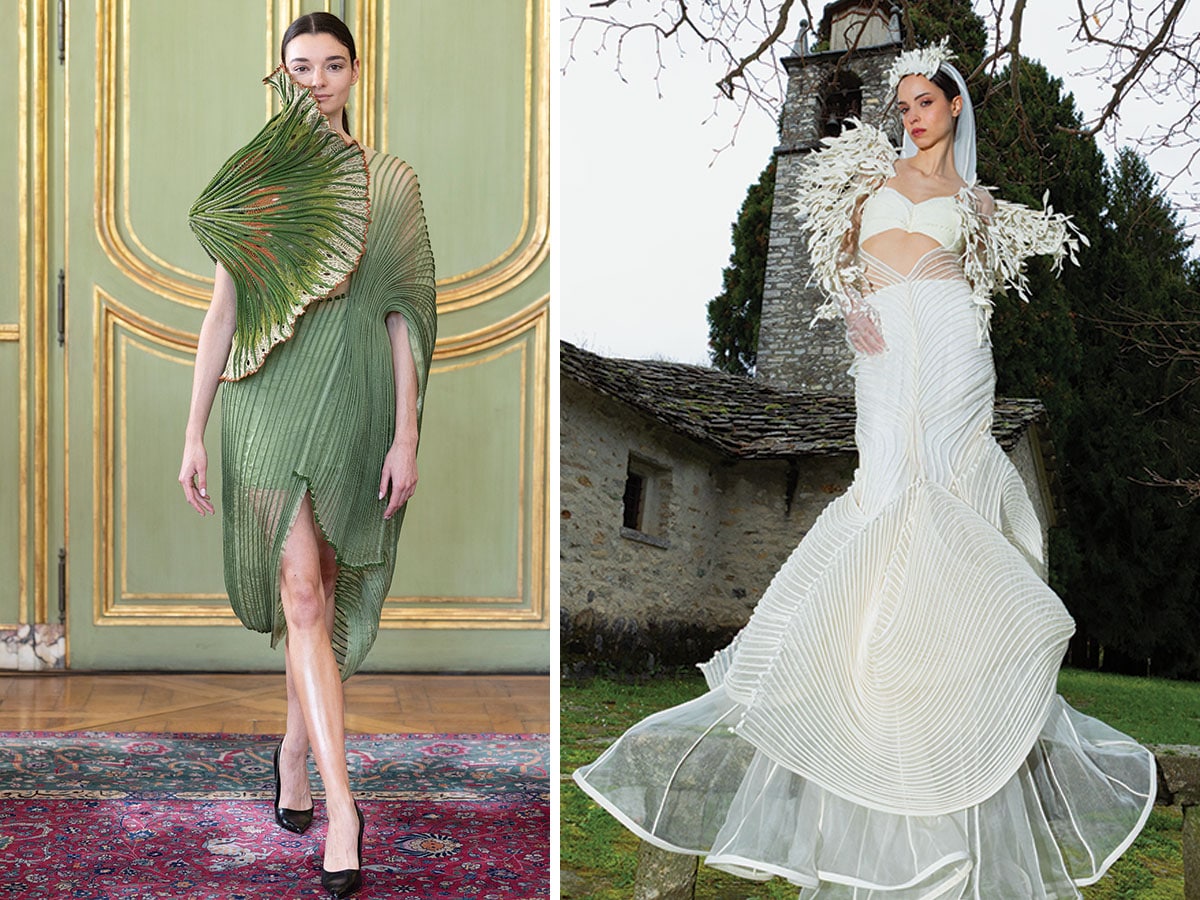
Shadangule’s Western bridal wear collection from Barcelona Bridal Fashion Week; her Fall/Winter 2025 collection, titled ‘Kintsugi’, is inspired by broken shells and the Japanese art of repairing pottery with gold (left)
In 2000, Shadangule opened a 100-square-foot shop in Malad. With three sewing machines, she began making corsets using Chanderi—a fabric reminiscent of the saris her mother would wear.
After running her shop for nine years, Shadangule signed up for a PG course in fashion design at Pearl Academy in Delhi. Ambika Magotra—professor and associate dean, Jindal School of Design and Architecture—who was heading the department then, says, “She was the most committed student ever. Design training was what she was seeking to refine her skills in.” This was followed by a Master’s degree from Milan in 2013.
Her relationship with Indian textiles and handloom weavers soon became the soul of her work. She travelled extensively—across MP, the Northeast, West Bengal, Maharashtra—spending days with weavers, understanding techniques that had survived generations. On her first visit to Chanderi village, she watched the painstaking process of weavers setting up nearly 5,000 threads over two weeks to prepare the warp.
In Maharashtra and North Karnataka, she went in search of Khun fabric—a lightweight textile known for its small, intricate geometric patterns and vibrant, contrasting borders—that she remembered from her grandmother’s blouses. In 2011, following a handwritten label stitched on the inside of a Khun blouse that read Guledagudda, she walked through farms and fields for days to reach the weavers. “They were initially reluctant to show their handwoven fabric,” says Shadangule. Asked why, the weavers said their profession was considered impoverished and people would not give their daughters in marriage. They eventually opened up, and what began with five looms soon grew to fifty.
In Assam, searching for Kesa Paat silk, she walked for four hours to reach a village. The women wove after finishing their household work, the rhythmic sound of looms filling the air. “I recorded those sounds,” she says. Later, on National Handloom Day in 2025, for her show Naad, weavers performed live, their looms creating the soundtrack as models walked the runway. “Once you engage a weaving family, you must ensure continuity,” Shadangule says. “It’s a responsibility.”
Today, she works with more than 3,500 families, giving three to four times the standard wages. But she rues the loss of the handloom culture, with synthetic yarns replacing cotton and silk, and artisans leaving villages in search of jobs.
![]()
Redefining Couture
At Lakmé Fashion Week 2011, for the finale walk, Shadangule wore a sari and a bindi. “People said I had guts,” she laughs. Fashion, at the time, was heavily westernised. The following season, her models walked barefoot, in saris, with gajra in their hair, bindis, and toe rings—everything the fashion rulebook advised against.
Shadangule’s designs draw deeply from nature, and her proprietary cording technique—gave fragile handwoven fabrics structural integrity, transforming Chanderi, Maheshwari, and Khun into sculptural couture for runways in Paris and Milan. A core purpose of the technique is also to repurpose scraps by turning them into hand-rolled or braided cords, which are then manipulated into three-dimensional forms resembling organic textures such as tree bark, coral formations, spiralling leaves, and seashells.![]()
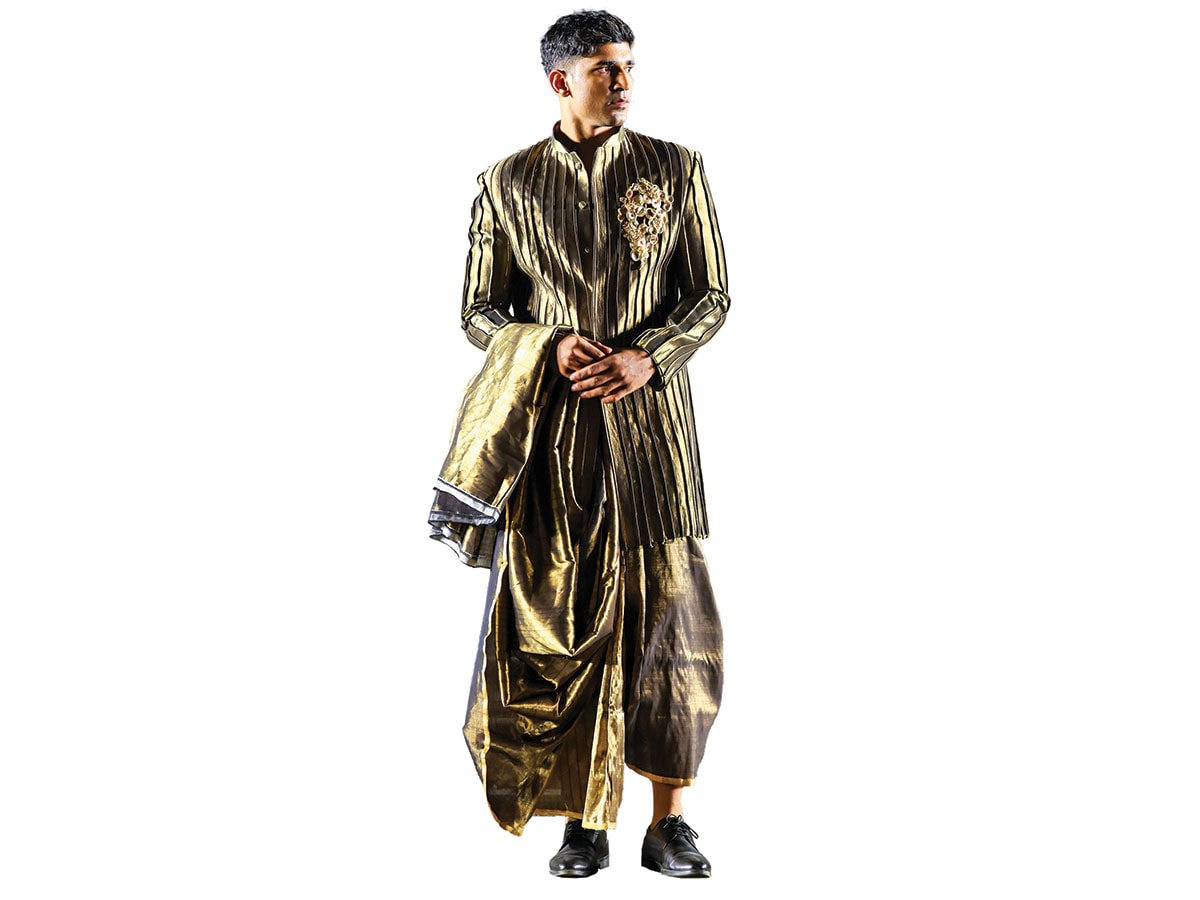
Shadangule launched her menswear line in November.
Photo by Mexy Xavier
Initial reviews were lukewarm. “They said it wasn’t market-friendly,” she recalls. “But it was my expression.”
In 2019, Alessandro Giuliani—president of the Italian Chamber of Commerce in India and later a director at Vaishali S—visited her atelier. “It was very different from anything I had ever seen in the shows in India,” says Giuliani. He felt that, for its sheer creativity and sustainable processes supporting weavers, it deserved to be repositioned as Haute Couture on the official Paris Haute Couture calendar.
In July 2021, Shadangule became the first Indian woman to be showcased on the official Paris Haute Couture calendar. “Giuliani’s unshakeable belief in me has given me the strength and vision to continue during tough moments.”
Her Fall/Winter 2025 collection, Kintsugi, marked her 25th anniversary as well as a creative interpretation of resilience. Inspired by broken seashells she saw lying on a beach in Socotra in Yemen, and the Japanese art of repairing pottery with gold, the collection explored beauty born from rupture. Murshidabad silk, coral-like cording, oxidised bronze, moonlit ivory, and ocean blues flowed across the runway. Accessories were cast from real broken shells.
“As a designer, my role is to create something original. I cannot pay heed to what’s trending in the markets,” she says. “Inspiration has to come to me. An original design may take time, but it will stay relevant forever.”
Over the years, Shadangule has realised whatever she creates becomes a trend. “Everybody is using the cording technique. It was quite disturbing initially, but I told myself I would keep evolving and try to stay ahead of the curve.”
Even today, Shadangule remains bootstrapped. “I believe in slow, sustainable growth. It gives me the freedom to hone my creativity as I please.” She resists chasing trends or numbers. “If you are only chasing money, you cannot revive textiles.” Her newly-launched menswear line, strengthening her Paris store, and expanding her Western bridal line remain her current focus.
In retrospect, she admits 17 was too young to leave home. “My daughter is 18 now,” she laughs. Rebuilding the relationship with her parents took time, but, despite the tough years, Shadangule sure has made them proud.