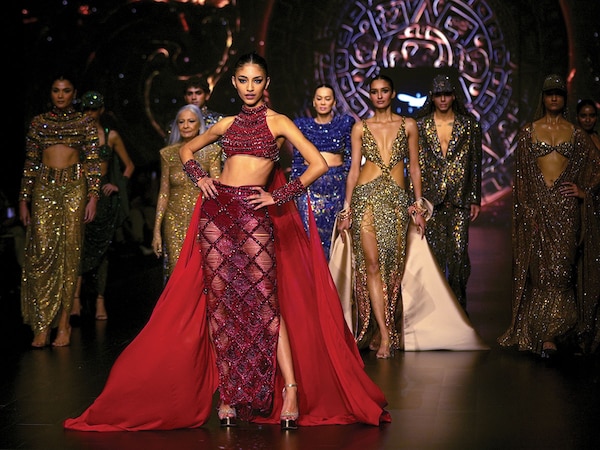
Today, the backstage atmosphere at an Indian fashion show, as described by Akansha, a 24-year-old model from Mumbai, is of calculation rather than excitement. Having practised their walks till the last minute, the models wait quietly, their shoes in hand and clothes expertly pinned, for their cues to go onstage. “Then, a famous celebrity shows up. The atmosphere shifts suddenly. Stylists hover, managers intervene, and phones are out,” says Akansha, who only goes by her first name. “The hierarchy is evident by the time the show starts.” The loudest applause will be for recognisable faces rather than the fall of the fabric or the discipline of a walk.
Once a professional area governed by technique and training, Indian runways are now a “theatre of celebrities”.
Bollywood celebrities have taken centre stage as showstoppers, campaign faces, and runway regulars at India’s fashion weeks, luxury showcases and brand launches—occupying a space traditionally reserved for models. However, global fashion capitals like Paris, Milan, London, and New York continue to predominantly depend on professional runway models, with only occasional celebrity appearances.
Although this change is not new, it has become significant enough to cause concern. For many in the industry, the question is no longer whether celebrities should be on the ramp, but rather what is lost when glamour takes precedence over skill.
The fashion and film industries have always been interdependent. For years, while actors have inspired personal styles, designers have depended on movie stars to add aspirational value to their brands. However, the presence of celebrities on runways has grown from special appearances to structural dependence, more so after the Covid-19 pandemic.
According to designer Anita Nayyar, “Designers today are trying to be smarter. They are looking for individuals who can represent their brand in ways other than clothing. And that frequently has to do with influencers or actors.”
The reason is obvious: A celebrity showstopper guarantees media headlines, viral videos, Instagram traction, and brand recall. It guarantees that a fashion show will instantly reach digital platforms and have a far longer shelf life, and not be limited to a specific audience for a fraction of that time. Fashion has learned to compete with movies, reels, and reality TV in an economy where attention is deeply fragmented.
According to Nayyar, who also runs a modelling agency, a model’s primary responsibility is to display the clothing. “That need will never go away.” However, “this is no longer deemed adequate. Nowadays, people want more than just a model. They are looking for relatability, personality, and something extra that helps the audience relate to the brand.” Celebrity appeal has become more of that “extra”.
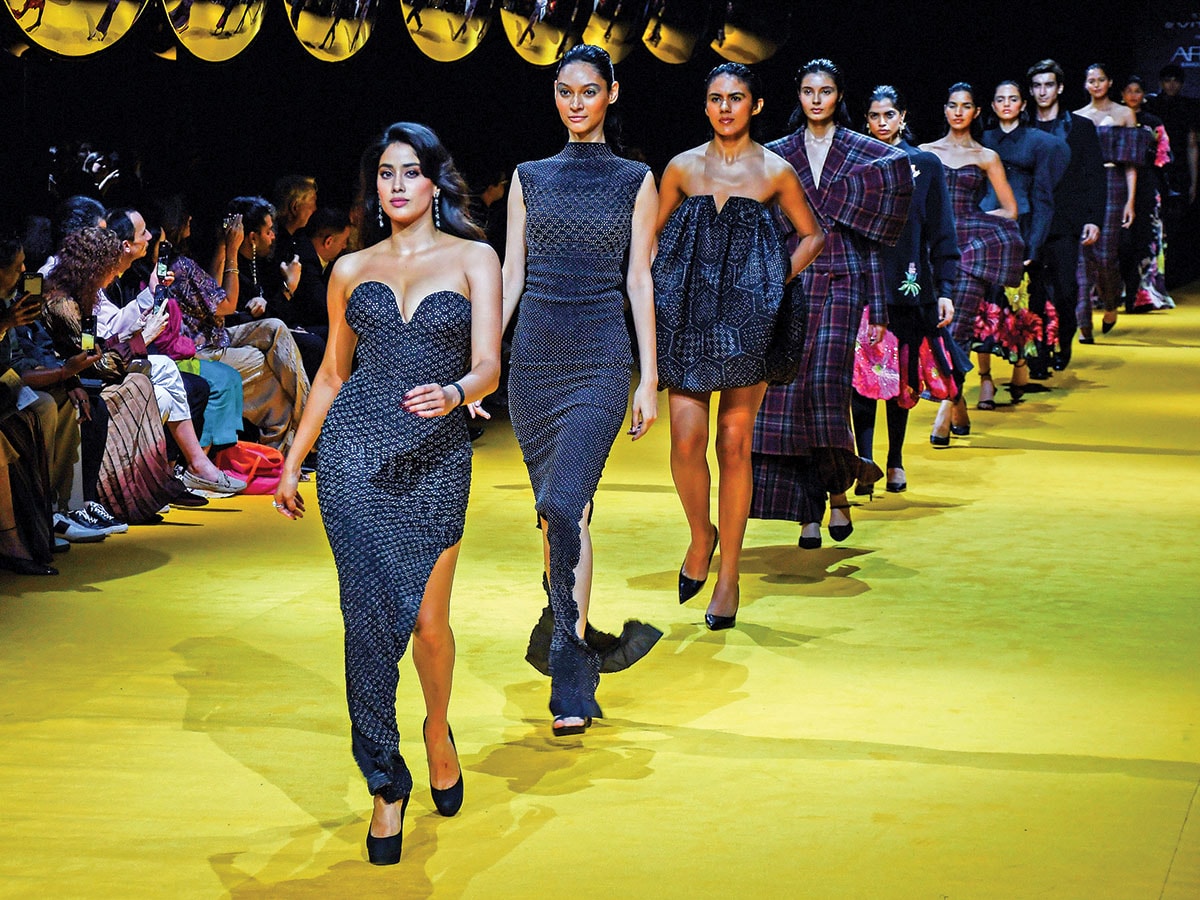
Actor Janhvi Kapoor’s much-discussed runway appearance in early 2025 ignited an online discussion about the distinction between runway techniques and star presence. Videos that contrasted her walk with that of a professional model behind her on the ramp went viral, sparking critical remarks about her posture, pace, and clothing handling. This, while Hollywood celebrities like Zendaya find praise when they do get on to fashion runways, for which they put in significant amounts of practice.![]()
Bollywood actress Janhvi Kapoor walks the ramp in a creation by designer Rahul Mishra at the Lakme Fashion Week in Mumbai in March 2025.
Photo by Ashish Vaishnav/SOPA Images/LightRocket via Getty Images
The discussion that followed struck at the very heart of the matter, not as a condemnation of celebrities but as a reflection of the need to keep the two professions—ramp walking and acting—distinct and separate from one another.
Despite the increasing presence of celebrities, runways continue to rely on professional models to do what they are meant to do—present clothes to buyers.
“This trend has been observed for a while, wherein popular personalities from the world of entertainment and sports have been used as clothes horses on the runway. These shows continue to hire models too, to showcase clothes of the designer,” actor and model Rahul Dev tells Forbes India.
Also Read: India's AI Summit Sparks Debate: Can India Become a Tech Creator?
However, industry insiders warn against the tendency to see the matter as one of hostility. “A designer cannot afford to replace all models with celebrities. That’s not very realistic. One celebrity brings the hype, but the rest of the show still has to depend on trained models,” says Nayyar.
For professional models, this change has meant fewer opportunities, reduced payments and increasing psychological pressure. “There is exploitation, and people don’t want to acknowledge it,” says Harshita Pandey, a 21-year-old model from Mumbai. “When a celebrity walks, the show stops being about fashion and becomes entertainment.” Pandey speaks from experience. “We are trained for this. We follow height guidelines, practice for days, understand the runway channels, and know how to walk with the clothes. When a celebrity walks, the focus is on their face… not on the clothes.”
![]()
Model Praveen Mishra points at brands that also look for influencers with high social media following. “They may have followers, but they definitely lack the skillset for which models invest time, energy and discipline,” he says. According to him, models have a specific rulebook for the runway, but when it comes to celebrities, all these are not considered, which disappoints models.
The economic disparity is equally striking, more so in an industry where models have traditionally had to take up side gigs to supplement their incomes. “A celebrity is paid multiple lakhs for one show,” says Pandey. “A runway model is paid ₹15,000 to ₹25,000 for three days as a package. If designers can afford to pay celebrities, why not pay models who know their craft well?”
This discrepancy makes things worse in an ecosystem where freshers have often had to forsake cash payments and settle for barter (where they get to take home the products they showcase) or simply the chance to be seen on a ramp. “Exposure is no way to pay the bills,” Pandey says. “And once brands get accustomed to not paying, it becomes the norm.”
“It’s fair to say that many brands view models as convenient partners for barter, but this doesn’t work for everyone, perhaps explaining why many models maintain additional sources of income,” says Goes Ethan, a 23-year-old model from Mumbai. He also sees exposure as an opportunity in disguise to understand, learn and grow in the industry. “Money will speak for itself once you are well established.”
Mishra laments the situation as a systemic problem. “Models are being pushed to the background and made background performers,” he says. “To control celebrity payments, model payments are reduced. At the same time, people who don’t know how to walk the runway are being given prominence.”
Models also begin to feel that they can be replaced. “There were times I felt like reconsidering the profession, but the passion never goes,” says Akansha. However, Pandey feels the audience is slowly recognising the difference between celebrity involvement and technical delivery, citing the Janhvi Kapoor incident. “People know the difference now,” she says. “That’s why awkward walks get trolled. A runway without a celebrity can still be successful. But a runway without models is not a runway.”
Not all people consider the celebrity takeover as a zero-sum game. Some people think it is an inevitable development, and one that models need to adjust to, not resist.
![]()
Soham Patil, who runs a model training and management agency called Model Mentor, says, “Celebrities became more active on the runway post-Covid. But now even celebrities are competing with influencers. Today, it’s not Bollywood versus models… it’s all about personality and personal branding.” In Patil’s opinion, modelling alone is no longer enough in India. “Models today cannot bank on one source of income. They look at acting, digital content, and influencer marketing. Branding is the key to survival.”
He agrees there is financial pressure. “Budgets are not fixed. There’s less stability. That impacts morale.” But he thinks models are still the heart of fashion storytelling. “Celebrities are attention-grabbers. Models are the ones who actually sell.” Ethan adds: “What brands look for is the face value more than skills, which sometimes upsets models, but that’s sadly how the industry works, and we have to go with the flow.”
“A designer may want one celebrity for the show. That doesn’t diminish the importance of 39 other models,” says Nayyar. She also points out larger changes in the fashion industry towards diversity, age inclusivity, and authenticity—areas in which India is still playing catch-up. “India is lagging in the way it represents women. The world wants to see real faces now—not perfection, not fillers, not eternal youth.”
For models today, social media has become an inevitable part of their profession. According to Pandey, it’s like having a LinkedIn profile that showcases not only their looks but also their personality, posture, confidence, and knowledge. Mishra agrees and says that models of previous generations only concentrated on their work, but with the social media explosion, there is now a requirement to produce content consistently.
Nayyar also disagrees that celebrity presence will counter creativity. “Art suffers only when insecurity is in the room,” she says. “Business will always do what it has to do. But art is what people remember.”