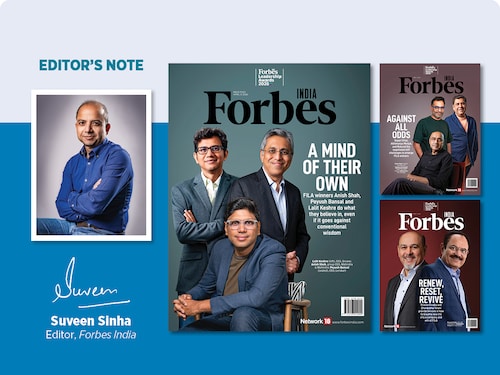
Leaders let go of control and ego to drive business success
Leaders simplify challenges and grow strong businesses gradually
Distinct leadership styles drove top performance industrywide
Even before he took charge as the group CEO of Mahindra & Mahindra (M&M), Anish Shah presided over a decision to sell SsangYong Motor. In 2011, M&M had acquired the South Korean company known for its sports utility vehicles.
Anand Mahindra, part of the promoter family, had himself driven the SsangYong purchase. Now he was giving up executive responsibilities and handing them over to Shah. Shah, armed with Anand Mahindra’s assurance that there were “no holy cows”, has gone on to take several more tough decisions, including exiting more than a dozen companies. For a group bearing the name of a family, this is brave and unusual, especially coming from its first non-family group CEO.
Peyush Bansal has built a unique startup for India. At a time when others of his ilk were focussed on services, mostly replicating models that had succeeded in the United States, Bansal built a product-focussed company that is unique. He has taken it to 15 countries and created a successful hybrid model combining online and offline retail.
Gopal Vittal, when Airtel was up against it, went against traditional telecom wisdom and, instead of playing the usual high-volume game, switched to seeking high-value users. He lost 40 million users overnight, but was unruffled because those were low-spending subscribers who clogged networks and stressed call centres. The push for high-value post-paid users revitalised Airtel.
Abhimanyu Munjal, one of the scions of the sprawling Munjal family, which has created behemoths that rule motorcycles and cycles, chose to start a financial services company from scratch after roughing it out in two salaried jobs at Citibank and ABN Amro. His first salary was ₹13,000 and Hero FinCorp’s inaugural team had 2.5 people; the half is thanks to a person who worked in another company as well. It is now one of India’s largest non-bank lenders with ₹56,000 crore worth of assets under management, up from ₹300 crore in 2011, and serves 13 million customers.
Speaking of humongous numbers, Groww is the only investment app in the country to cross 100 million cumulative downloads—a feat achieved through an unwavering focus on the customer. No vanity metrics for its founders. Instead, they have focussed on transparency and trust.
In 2022, twin brothers Mukund and Madhav Jha, the founders of Emergent, began thinking of ways to make the best use of ChatGPT, which had just been launched. After trying out various things, they began building a platform for non developers, where the complexity is lower, but the entire workflow can be automated.
Chandubhai Virani, at Balaji Wafers, takes one territory at a time, scaling demand and distributors before setting up a plant. At Force Motors, Prasan Firodia has invested in new platforms while embracing new discipline and renewed strategic focus to turn the pandemic shock into a period of rapid growth.
All of them did their own things. They figured out the best course of action and followed it with all their heart and might. They are all winners. They are all leaders. And maybe one day their stories will rise from the pages of your magazine to become biopics.
It is not a far-fetched idea. Anand Mahindra, who went to a film school, says it taught him to see patterns—to tell stories and to empathise with characters. “Leadership isn’t that different; you’re trying to understand motives, build a narrative and inspire your cast. I don’t ever want to lose that side of me,” he says in an interview in the Leading Asia series by McKinsey.