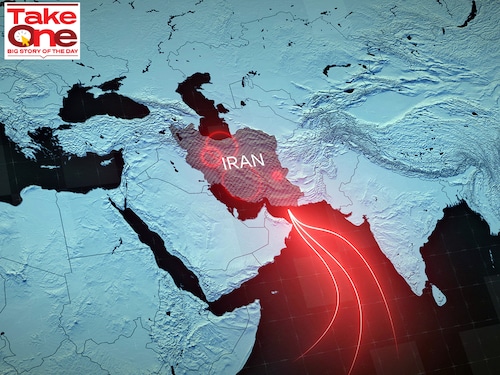
Escalating tensions and oil price spikes have rattled global markets, with Indian equities falling sharply amid fears of inflation, slower growth, and prolonged geopolitical uncertainty
On Monday, Indian benchmark indices Sensex and Nifty crashed nearly three percent each as investors braced for an economic fallout of the escalating situation in West Asia. Photo by Shutterstock
Advertisement
In a Nutshell
Sensex, Nifty plunge 3% amid global market turmoil
Brent crude tops $100 as Strait of Hormuz closure hits supply
Indian markets fall 8% in 2 weeks, valuations now attractive
Uncertainty in the stock markets typically takes the shine off risky assets like equities. With the long-drawn conflict in West Asia, the market rout has worsened as the global sell-off has accelerated amid mounting economic jitters that are now feared to last longer than anticipated earlier.
On Monday, Indian benchmark indices Sensex and Nifty crashed nearly three percent each as investors braced for an economic fallout of the escalating situation in West Asia. Markets elsewhere in Japan, China, and Hong Kong have also tanked around three to six percent during the day.
On Saturday, US President Donald Trump had warned that Iranian power plants would be destroyed if Tehran failed to "fully open" the Strait of Hormuz to all shipping within 48 hours. Trump set a Monday deadline, Reuters reported. Iranian attacks have effectively closed the Strait of Hormuz, which carries a fifth of global oil and liquefied natural gas, causing the worst oil crisis since the 1970s.
In retaliation, Iran said that it will attack Israel's power plants and plants supplying U.S. bases in the Gulf if Trump carries out his threat to "obliterate" Iran's power network, the country's Revolutionary Guards said, according to Reuters.
In Asia, Thailand, India, and South Korea are the most vulnerable countries to higher oil prices due to higher import dependency.
“The biggest risk to the market is global trade policies and commodity prices, including crude,” says an analyst at Tata Mutual Fund. The global macroeconomic landscape is partly shaped by US policies in 2025, the ongoing war in West Asia, and the squeeze in the Strait of Hormuz, as well as monetary policies in Japan and key monitorables in the US in 2026, they say.
Brent crude has surged above $100 per barrel following significant disruptions to traffic through the Strait of Hormuz (SoH). The last time oil prices surged past $100/bbl was in 2022 following the start of the Russia-Ukraine conflict.
“Unlike the unprecedented closure of the SoH, the Russian supplies largely remained intact. Thus, investors are likely to be more concerned about the current situation as it is more disruptive to energy supplies and prices. There are no signs of the disruptions ending at the moment. A regime change in Iran or a truce forced by economic pain can end this conflict, in our view,” says Saion Mukherjee, head of India equity research, Nomura.
The current geopolitical escalation is more concerning as the SoH accounts for 20–25 percent of global trade in oil and LNG versus Russian supplies of eight to 10 percent.
“While the resolution of US-India tariffs has been a big positive, the increasing geopolitical risks have impacted investor sentiment and equities. Geopolitical conflicts typically trigger short-term market turbulence, but they have not resulted in sustained equity underperformance historically,” say analysts at Axis Asset Management.
The duration and extent of the conflict remain highly uncertain, and one needs to see how this plays out. The Strait of Hormuz is a vital chokepoint, and crude oil prices will be key here, analysts at Axis Asset Management add.
India has a high dependence on imports for crude oil, natural gas and LPG. The SoH accounts for 43 percent and 63 percent of India’s crude oil and LNG imports. Supply disruptions can adversely impact industrial production as almost all manufacturing industries have linkages to the oil and gas supply chain.
A sustainably higher oil and gas price environment will adversely impact a fledgling growth recovery, drive inflation higher and strain external balances. “We estimate that for crude oil prices up to $90/bbl, the impact may largely be borne by oil companies and the government. Any incremental burden beyond this level will be passed on to consumers through higher fuel prices, in our view,” Mukherjee explains.
Indian markets have lost almost 15 percent from the one-year high mark. However, a few analysts feel the sharp corrections in Indian markets in the last few weeks have made valuations fair.
“Valuations are now attractive, earnings expectations have seen an improvement and economic momentum has picked up with budget support. The earnings cycle seems to have bottomed out, with signs of a sustained recovery ahead,” analysts at Axis Asset Management say.
They explain that while India’s macroeconomic fundamentals have remained resilient and the trade deal between the US and India has come through, earnings have been better than expected, though the impact of the conflict is likely to show up in the short term.
“India’s growth is largely driven by domestic consumption, capex recovery, digitisation and manufacturing realignment, hence geopolitical shocks are typically interruptions, not inflection points,” they explain.
The Indian markets have corrected by eight percent over the past two weeks. Such a steep correction was last seen on two occasions in the past decade: during the Covid-19 pandemic in 2020 and at the start of the Russia-Ukraine conflict in 2022.
“The market valuations in terms of price-to-earnings (PE) or spread over bond yields are at the low end of the valuation band that prevailed over the past four years. We think an additional five percent correction (similar to the correction during the Russia-Ukraine war) is a distinct possibility in the near term, with small- and mid-cap stocks at relatively greater risk,” Mukherjee says.
He adds that adverse flow dynamics can drive markets even lower in the short term. The domestic equity inflow growth has slowed down in the recent past. The valuation threshold for FIIs is lower, aggravated by concerns about the impact of AI and higher oil prices.
He sees up to 10-15 percent risk to consensus earnings estimates for FY27 in case oil prices remain elevated at current levels. “Our base case assumes a 7.5 percent reduction in consensus earnings estimates with the PE multiple at 18.5 times. We see a December Nifty target in the range of 21,000–29,100, with our bull case assuming an immediate de-escalation of geopolitical tensions,” Mukherjee says.