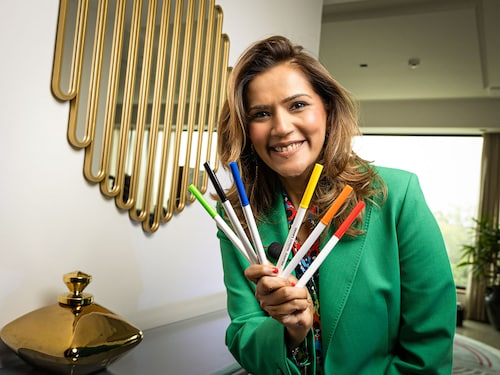
In 2021, a cold call set in motion a partnership that would eventually bring a global creativity brand to India. Pete Ruggiero, president and CEO of Crayola, recalls receiving an unexpected call from Pooja Jain Gupta, pitching the idea of introducing Crayola to the Indian market.
“She called me on a Saturday afternoon in 2021.” Ruggiero did not recognise the number. “For whatever reason, I decided to answer it,” he says. On the other end was Jain, managing director of Luxor Writing Instruments, making a pitch to bring Crayola to India. “I cold-called him. It started from there,” Jain says.
For her, the moment had been years in the making. “My father and I were walking at a fair when I had just joined the company, and he told me—whoever brings Crayola will change and transform the way kids’ creativity functions in India,” she says. “During the Covid pandemic, I was sitting at home and I thought—let me just try.”
She tracked down the CEO and called. “He didn’t know who I was. We spoke for about 40 minutes, and here we are today.”
That call has now translated into a formal partnership. Luxor announced a long-term agreement with Crayola LLC to manufacture and distribute its products in India, marking the US brand’s entry into one of its largest untapped markets.
Luxor has already been manufacturing Crayola products in India for export over the past two years, supplying global markets from its facilities, generating about $5-6 million in sales over that period, Jain said. The company currently operates eight manufacturing facilities and expects to set up a dedicated unit for Crayola as the business scales over the next three to five years. According to the company, the initial rollout will include over 85 product variants, such as crayons, markers, colour pencils and creative kits, with plans to expand to over 200 SKUs (stock keeping units).
For Ruggiero, the pitch landed at the right time. “At that time, I was COO [chief operating officer], and I was thinking about how Crayola should expand globally,” he says. “We were underrepresented internationally, and India stood out immediately.” The United States is currently Crayola's largest market, followed by Canada.
“There are 436 million children in India, and we weren’t selling anything there. There are 27 million babies born every year. Families are looking to build a better life for their children through creativity. It was extremely compelling then, and it is even more exciting now that we are launching.”
The partnership will see Crayola products manufactured in India under a co-branded “Luxor Crayola” label—the first time the brand has adopted such an approach globally. “This is not just about selling in India,” Jain tells Forbes India. “This is also about building manufacturing capability here for global markets.”
Ruggiero said Crayola had already begun shifting parts of its manufacturing base out of China over the past decade, building capacity in Southeast Asia, and now sees India as a key part of its future supply chain. “We began to migrate away from China in 2011 and built capabilities in Southeast Asia,” he said. “Now, as we expand globally, we want to build products closer to where we sell them.”
He added that India offers both scale and manufacturing capability. “The expansion in Asia is a major opportunity for us… There’s also the capability to take the scale of that launch and sell that to other Asian nations, to Europe, and to the United States.”
India’s stationery market itself is sizeable and growing, with Jain placing estimates at Rs 10,000-12,000 crore for the overall market. School supplies account for a significant share of this. Within this, the colouring and creative segment remains under-penetrated compared to writing instruments, which have traditionally dominated demand.
Also watch: 'My first salary was Rs 1,743': Pooja Jain Gupta, MD of the Rs2000-cr Luxor Group
Beyond Writing Instruments
Luxor’s move into the colouring and creativity segment reflects a broader push that Jain has been working on for over a decade. After the death of her father, founder DK Jain, in 2014, she took over the company and began exploring adjacent categories. “We will not move away from writing instruments, but we will build a complementary business which suits our core,” she had said at the time during an earlier interview with Forbes India.
“Bringing Crayola to India is a defining step in Luxor’s long-term vision to strengthen the creative and colouring category,” Jain says. “As education evolves, creativity must move from the margins to the mainstream of how children grow and develop.”
Luxor expects the Crayola business in India to generate $6-8 million in its first year, with a target of scaling it to around $40 million over the next five years, Jain said.
Inside India’s Colouring Market
Currently in India, Camlin (Camel) dominates children's stationery in the Rs 50-120 range due to its popularity with schools. Products such as plastic and jumbo wax crayons are typically priced between Rs 60 and Rs 110.
DOMS competes closely in this band, often pricing similar packs slightly lower, around Rs 50-100, while Apsara operates at the lower edge of the segment, with basic crayon packs starting near Rs 50 and going up to Rs 90, particularly popular in Tier-2 and Tier-3 markets.
Faber-Castell sits higher up the ladder. Some SKUs like basic wax crayon packs fall in the Rs 90-120 range. Most of its portfolio, however, moves quickly beyond Rs 150, positioning it as an entry-premium brand.
Luxor already operates in this band with its own crayons and an established distribution network. Crayola products in India are expected to be priced about "15-20 percent higher than comparable mass-market products"; this price is expected to reflect higher safety standards and manufacturing compliance, Jain said.
She also expects the creativity and colouring segment to be currently growing at 15-20 percent annually, significantly faster than the broader stationery industry, which is expanding at about four to six percent.
“At a time when children are growing up in increasingly digital environments, the partnership aims to encourage hands-on creativity and imaginative play,” Luxor said in its statement. Execution, however, will depend on how the brand is positioned within a price-sensitive and school-driven market.
More Adults Taking Up Colouring
Ruggiero said the demand for colouring products is also expanding beyond children. “We’re actually seeing more and more adults,” he said, adding that the company is launching a range aimed at teenagers and adults. “I believe it’s all about stress management. The colour and hands-on creativity help teenagers and adults to lower their stress levels.”
Jain pointed to a similar trend in India, where younger consumers are increasingly using colouring as a break from screen-heavy routines. “When they colour, they actually get into a therapeutic, meditative state… even if it’s 30 minutes a week,” she said.
Luxor brings distribution scale and manufacturing capability. Crayola brings brand equity and product design. The co-branding signals a long-term play rather than a simple import-led entry.
For Jain, the outcome also ties back to that early conversation with her father. “It was a vision that was defined to me,” she says. “I remembered it, I took a chance, and now we are building this together.”