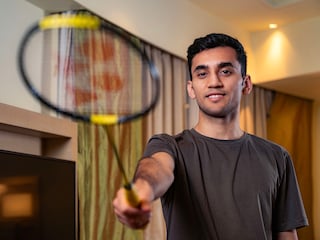
History books will remember Lakshya Sen as the runner-up of the All England Open 2026. But if you read beyond the stats, you'll know that's only a part of the story. Only the second Indian to reach the finals of the prestigious tournament twice, the 24-year-old put together a run defeating World No 1 Shi Yu Qi in the opening round, No 6 Li Shi Feng in the quarterfinal, and winning a gruelling semifinal against Victor Lai, hobbling with cramps in the deciding set.
The All England performance is the latest in a series of podium finishes for the World No 12 that saw him win the Australian Open—it marks a turnaround from a slump he faced post the Paris Olympics, where he became the first Indian male shuttler to reach the semis. In a conversation with Forbes India, Sen reminisces about his All England campaign, how he turned the tide in the past few months and his build-up to the Los Angeles Olympics in 2028. Edited excerpts:
Yes, it feels good to finally win again, to play good badminton after a long time. All England was a good tournament run for me, especially when you look at the last one year. After Paris [Olympics in 2024], this was an important tournament that I wanted to do well in, and I’m happy with the way I performed. And the Australian Open gave me the boost to start believing again that I can win big tournaments.
After winning the Australian Open [in November], it was important to keep my body fit, because I knew I was playing well and I was in a good rhythm throughout the last three-four months of the last year. It gave me a good chance to improve my ranking. And also playing those matches week after week helped me get back to my form. I started this year pretty well where, although I had two quarterfinal losses, those were high-quality matches, and I came very close to winning. So, when I went to All England, I was well prepared and in good shape.
Q. In the last six months or so, you've also been consistently making it to the quarterfinals of tournaments. It seems like you flipped a switch somewhere.
In the first part of 2025 I was injured a bit and was not able to perform to my level. I also had to miss a few tournaments because of that. But, of late, I focussed a lot on my recovery and building my game up. I found a few training blocks where I didn't play a lot of tournaments, so I could train to improve physically and overcome injuries. When I got back after a break of those few months, I was happy to go out and play week after week.
Q. When you are not winning enough matches, how do you keep the mind going?
I would say patience is the right word when it comes to dealing with injuries or even first-round losses. You have to wait for the right time to come. Those periods, especially when you have to stay away from the court, are very tough mentally. During this phase, I changed a few things. Earlier, I would try and hurry up my recovery, or if I was losing matches, I would get impatient during some matches. I took some time off and had a good training period; when I got back to the court, I was enjoying badminton again. Eventually, it came down to playing more matches to find my rhythm.
Q. In the All England semi-final, you were playing Victor Lai, tied one game each, and in the decisive game you were hobbling with cramps. The umpire told you that you either retire or continue playing, you had to forego a few points because you couldn't cover the court. Yet, you won that game and the match. What was going on in your mind?
I could feel the cramps in both my legs when I started the third game; just after five-six points I knew my legs were cramping. I didn't want to show it to my opponent so early in the game, but after 11-12 points it was quite evident to him that I couldn’t move freely on the court. At that point, I was just trying to play one point at a time because I didn't know if I would be able to finish the match. So, I was not thinking too far ahead in the future, because then thoughts of whether I would be able to continue playing, or whether my cramps would get worse after playing five points, were crossing my mind. I was taking every possible help from the physio and the coaches, and trying to take a few breaks in between. The umpire was not happy.
Q. He showed you the yellow card.
Yes, but that wasn’t a major concern for me. [I was worried] more about recovering in between points, trying to go for winners and keeping the rally short—that was my game plan. I was just not ready to give up at any point. I was just testing myself that, okay, let’s see how many points I can play. If the legs give up at 18, they give up, but I am not giving up. And because I had a lead, I was trying to play tactically by keeping the rallies short and attacking more whenever I got the chance.
Q. When you had to forego a few points, did you begin to doubt yourself?
Sometimes, I was getting those thoughts. But I was telling myself to take one more point and not thinking about finishing the match. Getting to 21 was not the target, it was just winning the next point.
Q. In the final, you had a lead but you had to eventually concede. Was it the exhaustion of it all? You had three one-hour-plus matches in the tournament.
It was a good match, and all credit to him [Lin Chun-Yi, the men’s singles winner]. But, yes, overall when you have those long matches in a tournament, it eventually tires you out. Even in the semi-final it was quite evident that I was struggling with cramps. I did whatever I could do to recover well and I just wanted to give my best for the final. I did whatever I could at the start of the first and second games, and I have no regrets.
Q. When you look back at the final, was it a missed opportunity, a learning experience or a bit of both?
A bit of both. It was my second All England final and [to not win is] a little heartbreaking. But with the way I played throughout the tournament, fought in the semi-finals, that I defeated [World No 1] Shi Yu Qi in the first round, which I hadn’t been able to do in our last four meetings, and that I was physically able to test myself to the maximum will give me a lot of confidence going into the next few tournaments.
The last few months have been quite decent in terms of performances… I know [I haven’t had] many wins but [in] a lot of the matches [I came] close to winning, and I’ve had some semi-final and final podium finishes. That is something I want to consistently do in future.
Q. Another of your so-near-yet-so-far moments was in the Paris Olympics, where you were the first Indian male shuttler to reach the semis and was within sniffing distance of the bronze medal, but lost that match. What do you think you could have done differently?
Again, as I said before, [even in that match] I did whatever I could in that moment. I gave my best with whatever resources I had. Obviously, it feels bad to come so close and lose, but I don’t have many regrets.
Q. We are exactly halfway into the next Olympics cycle, two years away from LA28. How will the Paris experience add an edge to your preparations for LA?
LA will be my second Olympics, so the Paris experience will help me. Paris was quite a good memory, so I’m looking forward to 2028. We’ve only two years left, and preparation for LA will start soon. I will be participating in major events this year—like the World Championships and the Asian Games—and through those I want to keep improving.
Paris has taught me how to manage the off-court things. With an event as big as the Olympics, a lot of things balloon, like the media, people’s attention. I’d like to maybe switch off from everything and focus on badminton. The Olympics qualification cycle will start next year, and I’m looking forward to planning and playing those tournaments smartly.
Q. Now that you’ve overcome your post-Olympics slump, tell us how you turn around from challenging phases.
Every slump phase is a bit different—sometimes it’s injuries, sometimes it’s first-round losses. Some come when you haven’t trained enough or haven’t played enough. You’ve got to sit down with your coaches and analyse where the problem lies. You’ve got to be patient to keep working on it even though the results might take some time to show—three-four months, or even a year at times.
Q. Who’s the toughest opponent you’ve played?
In recent times, I would say Shi Yu Qi. You have to be absolutely at your 100 percent to win. And he has been the most consistent in the last few years.
Q. You’ve been mentored by the great Prakash Padukone since you were 10. What have you learnt from him?
The discipline and the dedication to the sport. And how to be very, very professional. I’ve been around him from a very young age, and I’ve learnt so much by just seeing how he conducts himself on and off the court.
Q. You left your home in Almora when you were 10, and moved to Bengaluru to play badminton. Now, when you look back on the journey, what are some of the most abiding memories?
As a kid, when I would walk on to the court in Almora, I’d always want to become an Olympian, win big titles. From there to now, playing in such big events, making podium finishes, winning titles as the Thomas Cup or the Australian Open… to be doing things that I manifested when I was a child gives me goosebumps.