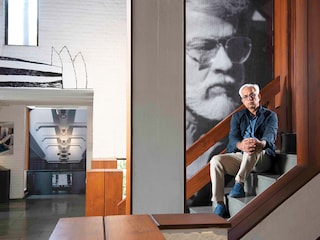
Amid the bustling market and bylanes of Lajpat Nagar in Delhi, stands a house behind high terracotta-coloured walls. The house, with walls of exposed red bricks and raw concrete, is built over multiple levels, with corridors opening onto courtyards, rooms giving way to terraces, and staircases that not just connect different levels but add to the geometric architecture of the structure.
Gujral House, as it is called, stands on Firoze Gandhi Road and was the home and studio of artist, architect and muralist Satish Gujral. Now, thanks to the efforts of his son Mohit Gujral and daughter-in-law Feroze Gujral, the house has been transformed into an exhibition space and has been opened to the public in the year of his birth centenary.
Gujral House is the latest to join a small clutch of examples in which the homes and studios of artists in India have been conserved by transforming them into museums, galleries, exhibition and performance spaces. In Delhi itself, the house of sculptor Amarnath Sehgal is one such instance, while in Kolkata, the house of painter Jamini Roy—acquired by DAG a few years ago—is another recent example.
Also on the list are the Roerich International Memorial Trust in Kullu, Himachal Pradesh, where Russian painter and writer Nicholas Roerich and his family lived and worked for about 20 years; the Visva-Bharati University, Santiniketan, West Bengal, and Rabindranath Tagore’s ancestral home in Jorasanko, Kolkata, where the Nobel laureate’s belongings are archived; and the Raja Ravi Varma Temple of Art, from the Royal House of Kilimanoor, which aims to uphold and preserve the artistic legacy of Raja Ravi Varma.
In the West, preserving the homes and workplaces of celebrated artists and authors is common: In England, there is Virginia Woolf’s home Monk’s House in East Sussex, Jane Austen’s house in Hampshire, Charles Dickens’ residence in London and Shakespeare’s birthplace in Stratford-upon-Avon, among others; while in Europe there are examples, including Claude Monet’s House & Gardens in Giverny and Paul Cézanne’s Studio in Aix-en-Provence in France, Salvador Dalí House Museum in Port Lligat, Spain, and Rembrandt House Museum and Van Gogh House in Amsterdam, Netherlands.
However, despite the multitude of celebrated artists and authors in India, preservation of their homes, studios, memorabilia and legacies remains woefully rare.
When the Gujral House opened its doors to the public in end January with the ‘World of Architecture’—an architectural retrospective that situated 10 of Satish Gujral’s most significant architectural projects within the rooms of the house—it was a culmination of the ideas that went behind the transformation of a residential space into a public one.
“When my father was alive, I made a commitment to him that this is what I would do; that I would try and evolve this house into a space that is commemorative of the idea of Satish Gujral. He was a multifaceted architect, a multifaceted artist, and he also always believed, from the early days of muralism, that art is something that should be there for the public to enjoy,” says Mohit, former CEO and board member at DLF. “He also felt in those early days that appreciation of art was still low in India, at least for modern art. And he thought, if I can make a contemporary home, I could actually educate the public on how art is placed, how it is perceived, how lighting is done.”
For Mohit’s parents, the house became a living gallery, because Gujral didn’t believe in formal art galleries, and chose to sell his own artworks. “He was a great believer in knowing who was buying his art, because there had to be an emotive connect and appreciation for what he did. That was the ethos of who he was,” he says.
When Mohit’s father built the house, he had built it like a living studio. “For him, the brief was always: How can each space be transformed to his evolving style? So, no two rooms ever, I think, in the life cycle of the house remained what they were meant to be physically or operationally,” recalls Mohit. Consequently, the children had to move about within the house, based on how Gujral was playing around with spaces at that time or phase in his life.
After the passing of his parents, Mohit felt there was scope to modernise the space to make it better suited for display—the quality of light in a residential space is vastly different from that in a gallery—along with adding modern air-conditioning. “A lot of family homes go through transformations in spaces and materiality as the affluence of the individual or their tastes grow, including the interference of family members. So, the idea also was to restore this house back to its original form, to how it was conceived, taking away the layers of history, of living, which are now being displayed through photographs,” he says.
Gujral built the house between 1968 and 1970, and hired renowned architect Raj Rewal, then a young man, for the project. “He even got married in my parents’ home in Tilak Marg,” recalls Mohit, “and he was hired to do three homes—for my father, uncle and my father’s sister.”
Although work on the other two houses progressed quickly, Gujral halted the process of construction because he felt it was going more in a conventional direction. Subsequently, he got lots of changes done in order to bring in a third dimension and levels and volumes that are not there in the other two homes. Modernism was the new language of India at that point in time, and so, the house came to speak the contemporary modernist language of that time.
Amarnath Sehgal in his workshop
This January, the National Gallery of Modern Art (NGMA) in Delhi hosted a retrospective to commemorate Gujral’s birth centenary. Kishore Singh, who curated the show, says, “The diversity and range of his work is why he has been called the Leonardo da Vinci of Indian art. He used his training at the Mayo School of Art in Lahore to overcome one of the greatest challenges: The loss of his hearing in a swimming accident as a child.”
He adds that Gujral always reacted to the horrors and violence of the Partition from a space of silence in his studio because of this impairment. “Because his speech was also impaired, he could never be part of artist movements and collectives. That loss meant he was not part of their discussions and critiquing. So, he always considered all things very deeply from the silence of his studio.”
Rajan Sehgal at the Amar Nath Sehgal Private Museum
Reha Sodhi, curator of the inaugural ‘World of Architecture’ show at the Gujral House, adds that Gujral came to architecture through drawing. “Long before he built in brick or concrete, he trained his eye in line, proportion and the human figure—disciplines he often described as ways of understanding how space breathes. This grounding shaped an architectural language rooted not in technique alone, but in lived experience,” says Sodhi. “Gujral resisted boundaries between art and architecture, insisting that structure itself must speak. Responsive to climate, culture and memory, his buildings emerge from context rather than being imposed upon it.”
This retrospective show presented architecture not as an extension of Gujral’s art, but as its embodiment, where form, material and life converged into a complete and living language. The selections had a chronological structure to trace the evolution of his distinctive language from the early 1960s Modi Nagar project through to the Ambedkar Sthal in the 2000s. “The eight selected projects highlight recurring themes: Site-responsive design, the interplay of light and shadow, spatial fluidity, and a tactile use of brick, stone and concrete rooted in regional traditions yet informed by modernist influences,” adds Sodhi.
Mohit believes art appreciation, other than in financial terms, is still a nascent part of Indian culture. “A lot of people buy art because it reaffirms their wealth. And they see it as an investment opportunity. Of course, there are a few people who are genuinely, deeply appreciative of the art itself,” he says. “These are early days, and we are hopefully some of the early believers who think we can help influence a greater interaction with the public, allow them access and dialogue.”
Despite becoming a public space to display and discuss art, Mohit feels a part of this house will always be Satish Gujral’s home, and a home for his art.
Coming from a similar place in history as Gujral—who was born in the Jhelum district of undivided India—sculptor Amarnath Sehgal was born in Campbellpur of undivided India and moved to Delhi post-Independence and Partition. In 1952, he—along with two other artists, Gujral and MF Husain—was given the plot of land by then Prime Minister Jawaharlal Nehru so that the young artist could set up his practice and create art for his new country. It was in 1967 that the Sehgal family moved into the house for good.
Jamini Roy’s house in Kolkata was acquired by DAG in March 2023. Photo Courtesy DAG
Today, located on a corner plot opposite the Lala Lajpat Rai Park in the Jangpura neighbourhood of Delhi stands Sehgal’s residence and studio; it is a multi-level structure that was built with the intention of creating large-scale sculptures, a gallery for viewing and a personal space for new ideas.
“My older brother Raman and I inherited what our father had left behind,” says Rajan Sehgal, the younger son of Sehgal and chairman of the board at Jupiter Wealth. “We lived in this space from the beginning, in 1965. We left for Europe in between for a year and a half when he was building his career, and returned in 1967. In those days, building a career as an artist was not an easy job. But he was fired with a kind of passion and love for the arts, which was different from the rest of the family, because they were a Partition family.”
The motivation for Rajan and his brother was clear. “We had to honour our father’s 60 years of hard work, which kept us fed and together as a family,” he says. Following the passing of Sehgal in 2007, the residential part of the structure was modernised for his wife to live in, after which Rajan and his brother got started on preserving the studio.
“We wanted to preserve his life, his works, his journey and the detailed granularity of that journey. We wanted to build this on the basis of the archives that he had left behind,” recalls Rajan. “He was, I would say, almost a kabadiwala; he kept every single piece of document, including the ticket of the steamship that he took when he went to the US. There were about 289 boxes of such things.”
The brief that was given to the architect was clear: They wanted to keep the same footprint, the same ethos and feel of the place. “Some of the floors are just the same. They are stone, so they survive. But we wanted to modernise it, because we needed the walls to represent his art, his photographs, his creations and poetry,” explains Rajan.
By working with curators and archival teams, within the limited space of 1,500 sq ft, Rajan was able to sort through the archival material over a period of six to eight months, giving shape to what became the Amar Nath Sehgal Private Museum. “We took time to put the building blocks of the life of a man and his works in such a manner that if somebody comes in, someone who did not know him, at least they can get a feel of who he was,” says Rajan. “The objective was to preserve his journey on the walls and in the art that he left behind.”
The family possessed quite a few pieces of Sehgal’s artworks, although not many because he had sold quite a lot of them and also given 13 of them to NGMA in Delhi; his works also form significant parts of private collections in the country. Apart from creating a space to commemorate the artist, Rajan realised that “once you set up the studio, you need to create a vision, a programming, and footfalls. Plus, we had a clear objective that yes, although we have inherited a legacy, we ourselves will be remembered by what we do with the legacy”.
Sehgal was focussed on helping young artists because he himself had received help along the way from various people. Consequently, Rajan and his brother wanted to design a programme with a philanthropic focus that would endorse their inherited legacy and make it more relevant today. The museum partners with Children’s Hope India to run school curriculums and work with schoolchildren in Bindapur and Vikaspuri in Delhi. It also supports young artists, by providing financial assistance, mentorship and residency programmes. “Our objective is purely to add value, give financial assistance and help them flower in their own way,” says Rajan. “We are not imposing anything on them, and when they sell their artwork, they get 100 percent of the proceeds.”
Transforming another artist’s home and studio into a centre of art and culture is DAG, which acquired painter Jamini Roy’s home in Kolkata in March 2023.
Nicholas Roerich’s house in Kullu, Himachal Pradesh; the unveiling of bronze busts of Nicholas and Helena Roerich at IRMT in 2019 (left)
Born to a landowning family in 1887 in Beliatore in Bengal’s Bankura district, Roy had trained in European academic-realist painting in Calcutta (now Kolkata), but subsequently came to be known for his distinctive style that was inspired by folk artists and sculptors, in particular the simplicity and aesthetics of Santhal life. In 1949, he moved from his home in North Calcutta’s Baghbazar neighbourhood to the more upcoming area of Ballygunge Place. He built his house over multiple phases, and lived there with his family till his passing away in 1972.
“After the death of Jamini Roy, his son Amiya had petitioned the then-central government that Roy’s studio be acquired by them and converted to a permanent gallery. After a lot of hard work, he succeeded in doing so. The studio was acquired by the government, which bought perhaps more than 100 of his paintings. But ultimately the gallery didn’t happen. Since then, the family wanted something along the lines of a gallery or museum in that house, but we didn’t know how that would actually happen,” Arkamitra Roy, Jamini Roy’s great-granddaughter, had told Forbes India in an earlier interview.
Unable to maintain the large structure, the family reluctantly put the property up for sale, and, in 2018, heard from DAG, which was interested in acquiring it with the sole purpose of preserving Roy’s legacy. According to plans, the museum will have a built-up area of 7,284.17 sq ft and will be spread across three floors, a courtyard, an outhouse and terrace spaces. It will include state-of-the-art galleries that will house the permanent collection as well as rotating exhibitions, a resource centre and a library, art workshops and event spaces, as well as a museum shop and café to complete the visitor experience. Plans are also being drawn up for academic and cultural programmes. “We want to make this a lively cultural centre for the city,” says Ashish Anand, CEO and MD, DAG.
The absence of direct family members can prove to be complicated while preserving an artist’s legacy. For instance, the International Roerich Memorial Trust (IRMT)—in memory of Russian painter Nicholas Roerich—located in Himachal Pradesh’s Kullu district was established in 1992-93 on the initiative of Roerich’s son Svetoslav and his wife Devika Rani, with support from the Embassy of the Russian Federation, Government of India and Government of Himachal Pradesh. It aims to preserve and promote Roerich’s legacy and to develop the protected estate as a world-class museum, educational, scientific and cultural centre.
“Roerich, his wife Helena and sons George and Svetoslav came to the estate in the Kullu Valley in late 1928, after completing the famous Central Asian expedition that Roerich was heading,” says Larisa Surgina, the Russian curator of IRTM. “They stayed there for almost 20 years, till December 1947. It was here that they worked on the first ever treaty on the protection of cultural properties known as the Roerich Pact, and founded the Urusvati Himalayan Research Institute that integrated the wisdom of the East and scientific discoveries of the West. It was in Kullu that Roerich painted hundreds of his beautiful pictures.”
In addition to its museum work, the IRMT is actively involved in cultural activities. It regularly hosts exhibitions by artists from India, Russia and other countries, as well as conferences and scientific seminars. “Twice a year, in May and October, the Roerich Trust hosts the Roerich Russian-Indian Cultural Festivals. Local children and children from Russia participate in painting competitions,” adds Surgina.
The IRMT also runs the Helena Roerich Academy of Arts (for children), where children from the Kullu Valley study Indian music, dance, and painting, as well as learn about Russian and world cultural heritage.