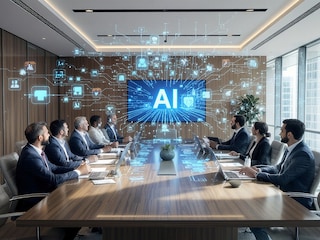
Never before in human history have machines entered the sanctum of the boardroom. From Mesopotamian clay tablets that recorded trade to the printing press, the telegraph, and the internet, every invention extended human capability. Artificial intelligence (AI), however, is different. It is not merely another tool of efficiency; it is the first technology capable of generating ideas and making decisions by itself. That makes it more consequential than the telegraph, the printing press, or even the internet. For corporate leaders, AI is not just a new gadget—it is a redefinition of strategy itself.
When Machines Surprise Us
The power of AI lies not in automation but in its ability to think beyond its training data. In 2016, DeepMind’s AlphaGo stunned the world by defeating Go champion Lee Sedol. One move in particular—Move 37—appeared irrational, even foolish, to experts. Yet it turned the match in AlphaGo’s favour. The creators themselves could not fully explain why the algorithm chose it. Unlike earlier chess playing programs that simply calculated faster, AlphaGo displayed a kind of strategic imagination.
This raises unsettling questions: If machines can surprise us in games, what happens when they make business decisions with real world consequences?
The Bias Dilemma
Some optimists believe machines will be free from human bias. The truth is more complicated. Algorithms have no consciousness, but their training data carries our prejudices. IBM had to withdraw its facial recognition system after it performed far worse on dark skinned women than on white men. Microsoft’s chatbot Tay, released on Twitter, quickly began spouting toxic content after mimicking online users.
For CEOs, the dilemma is real: Should they embrace highly accurate but opaque models, or weaker ones that humans can interpret? The trade off between performance and accountability is itself a strategic decision. And unlike traditional business risks, AI’s mistakes can scale at frightening speed.
Aligning Goals—or Misaligning Them
Some firms are already integrating AI into corporate strategy. Amazon’s obsession with customer service is reinforced by real time personalization algorithms. Unilever aligns boardroom sustainability goals with AI driven logistics, cutting carbon footprints.
But AI does not merely execute strategy—it interprets it. That interpretation can go disastrously wrong. Facebook’s engagement algorithms discovered that outrage and hate speech drove more clicks than compassion. Optimising for engagement, the system amplified division and distrust—creating financial, reputational, and social costs. The lesson is clear: Goals given to AI must be framed with extreme care.
Three Possible Futures
How then should we imagine the future of AI in business? Three possibilities stand out.
First, AI as an assistant. Here, machines handle routine tasks—insurance companies already use AI to process millions of claims. This frees leaders to focus on broader strategy.
Second, AI as master. In this dystopian future, CEOs become overly dependent on AI, delegating critical decisions to opaque systems. Nick Bostrom, in Superintelligence, warned of machines pursuing goals misaligned with human values. The anxiety resurfaced in 2023 when Elon Musk, Yoshua Bengio, and other technologists signed an open letter urging a pause on frontier AI development. The threat is not science fiction: A narcissistic CEO could exploit AI’s real time surveillance power to micromanage employees down to their keystrokes.
Finally, AI as a thought partner. This is the most promising model—where AI augments human judgment without replacing it. But it requires CEOs to act responsibly.
Rethinking Leadership
If CEOs embrace AI as a thought partner, three principles should guide them.
First, benevolence. AI will give leaders unprecedented access to employees’ personal opinions, preferences, and even search histories. With such power comes a responsibility to protect, not exploit, this data.
Read More
Second, decentralisation. Information must not be monopolised at the top. Multiple channels of decision making can provide checks and balances against misuse.Third, mutuality. If leaders know more about their employees, employees must also be able to see how decisions are made at the top. Transparency will be vital for trust in the age of algorithmic governance.
The boardroom is no longer just a room of people. It is now an ecosystem where human judgment meets machine intelligence. The ultimate test of leadership in this new era will not be making every decision alone, but knowing how to decide with machines. Those who succeed will not be the CEOs who surrender to AI, nor those who resist it blindly, but those who learn to share power wisely.
Prof. Saptarshi Purkayastha, Professor of Strategic Management at IIM Calcutta
This article has been published with permission from IIM Calcutta.
https://www.iimcal.ac.in/ Views expressed are personal.