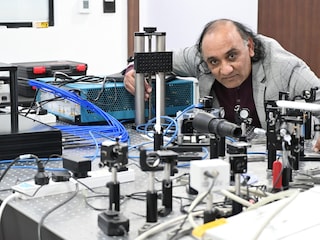
Among the path-breakers, ingenious founders, and professionals working across sectors worldwide, those who never backed down amid challenges, kept questioning norms, and continually reinvented their niches with innovative ideas have gone on to stand apart from the rest. Quantum Seeker Dr. Pramod Kumar is all about this and beyond, who stands tall as a pioneer in the world of photonic intelligence and the like. He serves as a Principal Scientist and Director of Research at QuantLase Research & Development Centre (QRDC) in Abu Dhabi.
One sector that has seen massive acceleration in recent years is artificial intelligence (AI) worldwide. This has drawn attention to the ways the physical limits of conventional computing have become increasingly visible. Power consumption, heat dissipation and silicon saturation are no longer abstract concerns but defining constraints of modern data centres. This is where Dr Pramod Kumar, a pioneer in quantum photonics, enters the picture, advocating a shift from electron-driven computation to light-based intelligence. His work today sits at the intersection of quantum photonics, AI hardware, and sustainable infrastructure.
With a PhD in Laser Technology with Prof. Rupamanjari Ghosh from Jawaharlal Nehru University, he has built his scientific foundation through years of work across India, UCC Ireland, France, and the United Kingdom. His early research in ultrafast laser physics and quantum photonics shaped a deep understanding of how light behaves at extreme speeds and scales. This background has now even more emphasized his role at the QRDC in Abu Dhabi. He has been approaching photonics as a structural alternative to silicon-based computing. His work reflects a consistent belief that meaningful progress in AI infrastructure must come from rethinking the physics of computing rather than merely optimizing existing architectures.
At the very core of QuantLase’s work is the Photonic Intelligence Processing Unit (PIPU), which is a system that has been designed for performing the most fundamental operation of AI, matrix multiplication, using light instead of electricity. Unlike traditional GPUs, which rely on transistor switching and generate significant heat, PIPU executes matrix-vector operations through optical interference and propagation. Using Mach-Zehnder Interferometers (MZIs), the processor enables massive parallelism at light speed while consuming dramatically less energy. Also, this isn’t a lab-only experiment.
Under Dr Kumar’s leadership, PIPU has been realized as both a fully scaled laboratory platform and a 5mm x 10mm silicon photonics chip. The chip has already passed commercial-grade foundry validations and complies with international manufacturing standards. This achievement has marked a regional and global milestone, the successful design and validation of the UAE’s first industrial-grade photonic AI chip. It has now formally entered into fabrication in Europe. One of the most defining strategic choices behind this success has been QuantLase Lab’s fabless model. Instead of investing in capital-intensive fabrication facilities, the organization retains full ownership of architecture and intellectual property within the UAE while partnering with European foundries for fabrication and packaging.
Dr Pramod Kumar
This approach has helped demonstrate how leadership in advanced computing can be achieved through architectural control rather than manufacturing scale. This has even led the photonic intelligence position to be seen as a globally collaborative endeavour, not limited by national infrastructure constraints. The photonic AI chip has cleared both the EU Dual-Use Regulation and the Wassenaar Arrangement, confirming that no special export licenses are required. This regulatory clarity removes a significant barrier to adoption and enables smoother global collaboration. With fabrication scheduled to begin in late 2025, initial chip deliveries expected in early 2026, and modular system packaging by mid-2026, the roadmap reflects a disciplined transition from research to infrastructure.
Read More
QuantLase was recently named among the Quantum.Tech Europe 2025 “Hot 10”, placing it alongside some of the world’s most influential quantum and photonics innovators. His participation at the PIC Summit Europe 2025 in Eindhoven further highlighted ongoing work in electro-optic tuning, high-bandwidth indium phosphide (InP) integration, and reconfigurable AI modules, critical components for scalable photonic systems.
In an era where computing demands are outpacing silicon’s limits, his work stands as an editorial lesson in how deep science, when paired with disciplined engineering and global collaboration, can quietly reshape the foundations of the digital world.
The pages slugged ‘Brand Connect’ are equivalent to advertisements and are not written and produced by Forbes India journalists.