Chandubhai Virani recalls some of the first loans his family and he took for their wafers business in Rajkot in the 1980s—from one for a rickshaw, to ₹8 lakh for a tempo and then ₹3.6 lakh for a small factory.
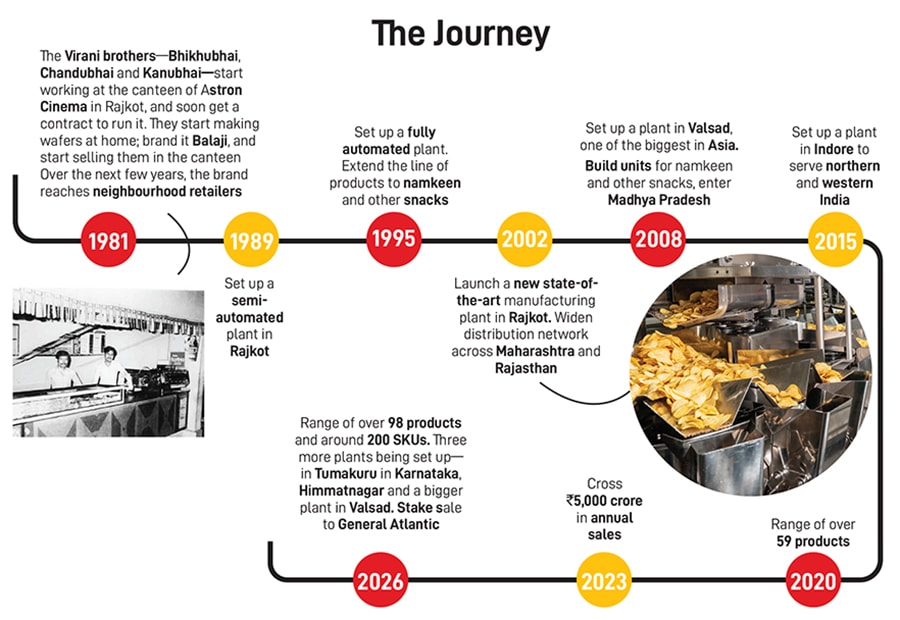
“And we kept moving forward, kept taking loans, ₹1 crore, ₹2 crore, ₹5 crore, ₹25 crore, ₹100 crore, we took loans up to ₹200 crore. We have so far invested ₹2,500 crore… and put up factories, but for the past 15 years, we have not taken any loans for expansion and projects,” says Virani, who started out with his two brothers. Bhikhubhai and Kanubhai, running a cinema canteen, going on to become a supplier of wafers to the canteen and then selling them in the open market. They founded Balaji Wafers in 1982, and incorporated it as a company in 1995.
Balaji’s recent stake sale to US-based private equity firm General Atlantic—7 percent for approximately ₹2,500 crore, valuing the Gujarat-based snack maker at about ₹35,000 crore—too has little to do with raising capital and more a natural evolution for a family-run business. It’s to bring in professionalism and strengthen key corporate functions of the company, which has now expanded to over 15 states across the country as well as export markets to 25 countries worldwide.
“This company doesn’t need funds. We have started work on three new factories and we have the funds. Then, we make enough profit every year to open one new factory,” says Virani, seated in his office in Rajkot, adding that surveys show that 90 out of 100 family companies shut down, “while the professionally run ones continue for years. The children’s thought was that if a professional company comes in, it will bring in an IPO properly. Our job is to simply make a product, to run the business. For other things, it is good to have a partner”.
He makes the job sound simple, but Virani and his brothers, and their second generation have built a ₹35,000-crore business by cracking the code from supply and manufacturing to retail, keeping the consumer at the centre of it all, providing value for money in the packaged snacks market.
“We understood the consumer, what to give the consumer, at what rate, the quality, the quantity. Because we ensured the customer was satisfied, the shopkeeper’s sales increased, the number of dealers increased, then transporters. Our employees increased, and our suppliers too. People were also happy to partner with us because we never delayed a single payment,” says the co-founder and managing director of Balaji Wafers, which has won the Forbes India Leadership Awards Regional Goliath award.
![]()
The second part of cracking the expansion code has been to never set targets and not rush into expanding across regions.
“The way we work is, we’ll pick a particular region or some states, we’ll expand our distribution to the smallest of towns, and once we reach a particular level, we decide on setting up a plant there. We have focus regions, but we focus at a very micro level. It’s not like you just make a few distributors and move on to the next region,” says Shyam Virani, Kanubhai’s son, and a director at the company.
Having multiple plants means a product reaches a consumer within two to three days of being manufactured, ensuring freshness. There are also frequent services to distributors and from there to retailers, so there’s no overstocking. The channel is lean, going directly from the company to the distributor and retailer, without any super stockist or wholesalers in the middle, and the savings on this are passed on to consumers, he adds.
The other unique thing is the lack of targets. “[Setting a] target means pressure. Pressure turns a human being into a toy,” says Virani, recalling the advice from his grandfather who used to tell them to first become good humans. “I thought then that I am a human, but he meant become someone who people will trust. If people trust you, the business will grow,” says the senior Virani.
The idea is that everyone associated with the company knows and manages their focus areas according to their aptitude. “We don’t do any dumping, we don’t do promotional schemes. We have a pan-India flat pricing, and we just function on that. And that has really simplified our systems,” adds Shyam.
The third part of the code is to listen. In fact, it is one of Virani’s mantras of leadership. “Maintain the capacity to listen,” he says. It is listening to dealers, consumers and shopkeepers that has led them to introduce new products and expand their range, as well as come up with solutions. It’s a trait also passed on to the next gen. “We are more of listeners,” agrees Shyam. “From distribution to working with our suppliers, the culture is we try and solve their problems. And within that, we end up solving our problems too.”
![]()
Passing on the baton
While the first generation set up the first plants, built the company and took the product list to about 10, Virani attributes the growth and scaling of Balaji Wafers after that to the second generation who brought in newer technology, set up bigger plants and took the product list to almost 100. The company currently has four fully automated plants—in Rajkot, Valsad, Indore and Lucknow, and is in the process of setting up three more, in Tumakuru in Karnataka, Himmatnagar, and another bigger plant in Valsad. Besides potato wafers, Balaji offers namkeen, Western snacks, noodles, chikki, papad, confectionery as well as a range of healthy snacks.
“We didn’t have any high-tech machines, the ones we had initially, usme faste faste hum engineer ban gaye [we became engineers trying to fix our machines]. Now we have big, high‑tech plants that probably no one else has. And that has been done by the second generation… we didn’t have the courage to spend so much money,” confesses Virani.
Keyur Virani, Bhikhubhai’ son, the eldest and the first among the second generation to join the company, in 2001, looks after production, purchasing, technology and projects. His brother Mihir looks after sales and distribution as well as a sandwich franchise business and the confectionary business. Pranay, Virani’s son, looks after projects and newer constructions, while Shyam, Kanubhai’s son, looks after sales and distribution. The latest to join is Kanubhai’s daughter Mansi, who worked with Goldman Sachs in New York for nine years and returned to join the company last year. She leads the IT department.
There was no compulsion to join the company, but all the cousins have. There was no handholding or training and everyone took decisions, made their own mistakes, and grew from them. “Woh poochh poochh ke paani nahin peete hain [they don’t ask before taking every sip of water]. Even if they drink more water, they aren’t scared of doing that, they know the older generation won’t admonish them too much,” Virani says.
The older generation has now stepped back from day-to-day activities, but remains active in the bigger picture, in supervisory mode. “One should never retire from ‘karma’ [work]. But one shouldn’t give advice without being asked—that is dangerous,” says Virani, adding that the biggest decision the older generation has taken is ‘Uske gale mein haar daal diya [we have put the garland around their necks]’.”
Shyam, who joined at 22, appreciates the freedom they were given at the company, which taught them to be responsible for their decisions. “If it goes well, well and good. If it doesn’t go well, then you need to learn from it. But ultimately the responsibility is yours. I learnt a lot more that way rather than with handholding,” he says.
The organic manner in which the succession has happened has worked for the company. “With most family businesses, giving away that day-to-day thing is very difficult. And by the time the adults end up doing it, the second generation has already grown older, and can’t develop the capabilities because it’s too late,” says Shyam.
But the company remains their passion. Virani’s schedule includes an office visit every day, to listen to employees and “for a change in the tone of machines”, to attend meetings and visit factories and remain updated about the Balaji world and the world at large.
“The other day Chandubhai had gone to an event where there was a session by someone on the usage of AI and its benefits in business and he insisted on me talking to her [the speaker] and setting up a session for our staff members,” says Mansi, adding that the elders are open to the perspective of the new generation but also put their foot down when they feel something has been tried earlier and hasn’t worked. “But it is all rational argument. It is not like ‘we are more experienced, and we know what we are doing’.”![]()
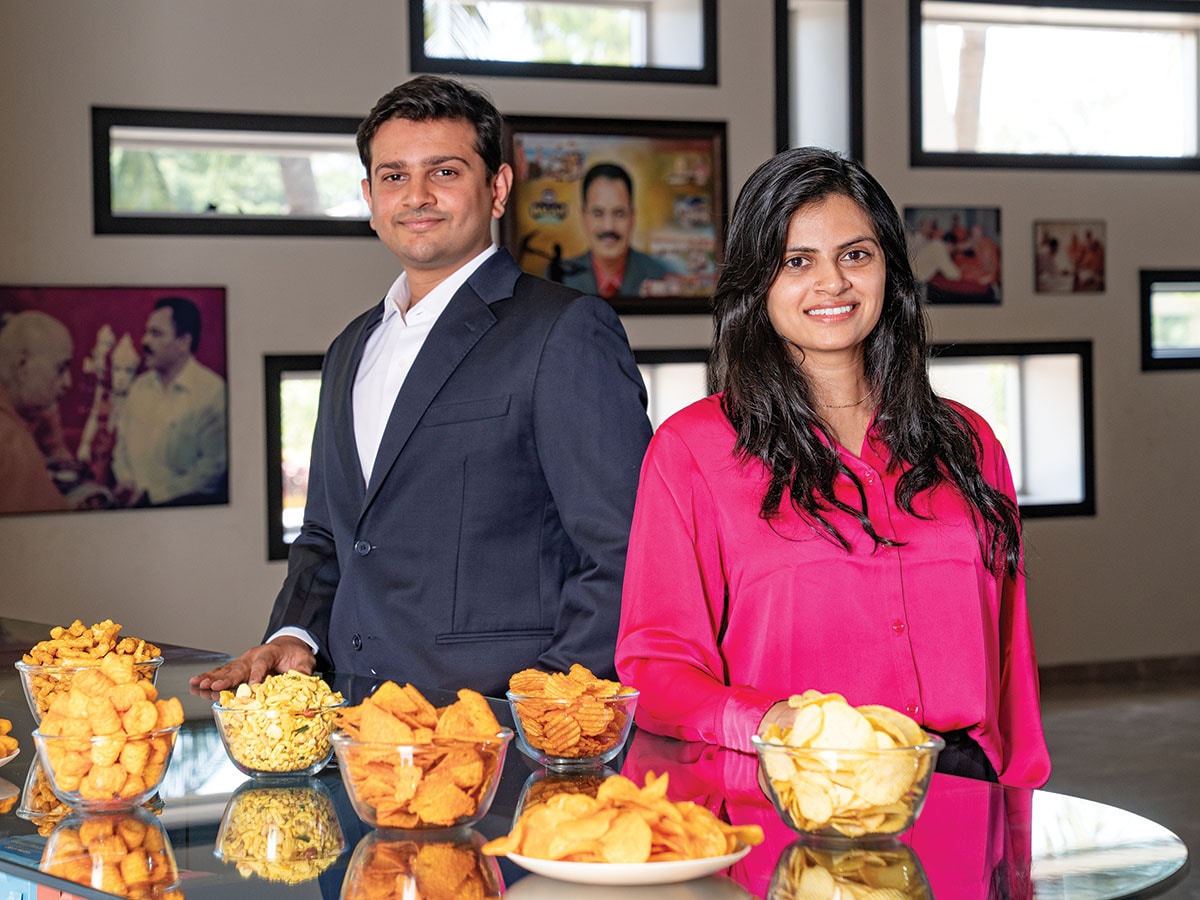
Shyam Virani and Mansi Virani, members of the second generation at Balaji Wafers, believe the freedom to make their own mistakes and learn from them have proved to be good for themselves and for the company
photo by Mexy Xavier
The road ahead
The India snacks market size was valued at ₹50,590.37 crore in 2025 and is projected to reach ₹103,556.03 crore by 2034, growing at a compound annual growth rate (CAGR) of 8.28 percent from 2026 to 2034, according to a report by market research firm Imarc.
![]()
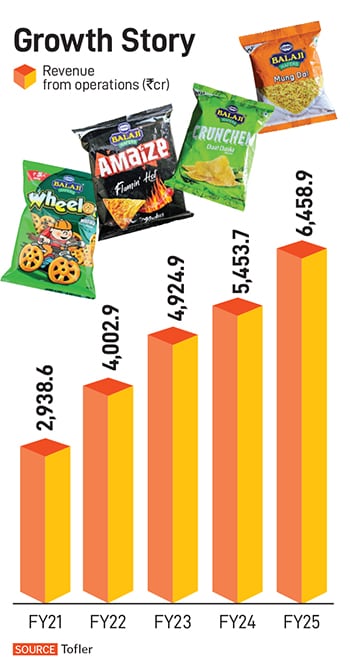
Balaji, which grew at about 18 percent in FY25 and with a projected revenue of ₹7,500 crore and an Ebitda of around ₹1,000 crore this year, seems well positioned to consolidate its position further in the market.
“We’ll have four more plants functioning and we’ll be present in at least 20 states in the upcoming years,” says Shyam, adding that the vision for the company “is to take it to a pan-India level”. The focus is also on exports, for which they have introduced a range of frozen and ready-to-eat products.
It is this growth story that General Atlantic decided to buy into. “Balaji Wafers has been the fastest-growing major snacks brand in India over the last seven years, compounding at over 20 percent annually, built on genuine consumer love, world-class manufacturing and a distribution model that consistently puts fresher product on shelves,” says Shantanu Rastogi, managing director and head of India, General Atlantic.
He adds that there are four things that set Balaji Wafers apart. First, the company invested in fully automated manufacturing long before its peers, giving it a “meaningfully lower cost structure” than many competitors in the market. Second, its direct distribution network, reaching over 1 million stores, gives it extensive availability and real-time insight into consumer preferences. “Third, and most importantly, every efficiency the business extracts from its operations is passed straight back to the consumer in the form of more product for the same price.”
But underlying all of this is a fourth factor that he says is harder to replicate than any operational advantage—the family itself. “What the Virani family has built is rare: Multiple generations working together with a shared passion for the business, clearly defined roles, and a cohesive approach to execution that has kept the company focussed and fast-moving for over four decades. In our experience, that kind of family alignment is the invisible engine behind this great business,” he says.
For Virani, though, the engine is family as well as the employees, the partners and the dealers. And that’s what keeps him going to office every day. “My job is to enjoy the work, meet employees, see if they have any difficulties. It is because of this, of working together, because of their blessings, that even at 70, I don’t have to take any medicines.”