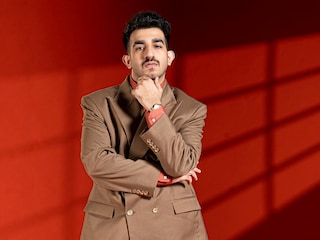
Driven by a passion for honest storytelling, Yashraj Mehra’s journey began in quiet school hallways where he spent his free time writing rap verses. He spent years honing his craft online, building a dedicated following by sharing remixes and raw verses on social media. Since his official debut in 2020 with the EP Azaad Hu Mein, the 25-year-old artist has become a versatile force in the industry. From independent hits like Dhundhla to playback singing for films like Kho Gaye Hum Kahan, Mehra has collaborated with major names like Badshah, Raftaar, and Armaan Malik. His steady rise reached a global peak in 2025 when he earned a Grammy nomination for his work on Sounds of Kumbha. In conversation with Forbes India, the 30 Under 30 listee speaks about his initial days, his writing process, the evolution of hip-hop in India, and globally. Edited excerpts:
I think I always wanted to do this. I used to upload a lot of my free verses on Instagram. I used to rap on open mics. So, initially, that got me a little bit of attention on social media. I think a defining moment was when someone like Ritviz [singer and songwriter] saw my work when I had done a free version of one of his songs, and that really blew up. Eventually, my songs started getting more attention from people in the circuit and got appreciation. I think that was a very reassuring factor. It made me feel that this isn’t my delusion. This is something that people are really enjoying, and they're connecting with my journey. So, I think these were the defining moments.
How I got into hip-hop is a funny story. Growing up, I really enjoyed dancing. In one of my dance classes, I was first introduced to hip-hop as a genre. It was primarily the instrumentals, until I realised that things are being said on it, and those things have such a deep and intricate meaning.
I think the reason for that resistance from family is often the fear of the unknown. I think their entire perspective is based on their worldview of life, which you can’t say is right or wrong. I also faced resistance from my family, but I don't really blame them, because they wanted to see me do better. They wanted to see me not take certain risks, because they know that so many people have failed.
But whenever this kind of resistance surfaced, I think my mother was always a wall for me to keep it out as much as possible, and she has been really protective of me. She always gave me the freedom to pursue anything creative – right from writing, getting on stage, doing drama, or just even hosting events or whatever – she used to always push me to be as creative as I can, even if there was a lot of rigidity from the family or relatives. I think the reassurance that my mom and I gave to each other, I think that always kept everybody’s opinion unimportant, so to say. The resistance definitely bothered me for a long while, but I definitely pushed through it.
Q. What does your writing process look like? How do you balance authenticity with the need to appeal to a wider audience?
I very strongly feel that if something is truly, really authentic, it translates. I don't think you have to change your motive to make sure that your music reaches more people. The very understanding of hip hop is still very niche in this country, and I feel like the people who resonate with certain songs do so based on the energy and the authenticity of the artist. I feel when your work is truly stripped of ego, and if you write something really honestly, I think a lot of people are going to resonate with it, even if it's not the preferred genre of music.
For me, I feel authenticity is the key factor, and has always been my identity. No matter what the canvas is, just being able to write and compose something honestly in a way that makes the most sense – I think that's that. That is the only sort of balance I've always tried to achieve. If I'm writing something, I don't want to waste a single line. I want to make sure that I express something in every line – even if it's imagery or something that’s personal and relatable. I'd say if, as long as you're honest with yourself, as long as you're not trying to push an agenda with it, your work will translate.
Q. Which artists—Indian or global—have had the biggest impact on your style and writing?
I'd say in India, right off the bat, I would definitely pay respects to somebody like Divine and Naezy. To do Hindi hip-hop in a city like Mumbai, and do it in your own language with such flair, was enough reassurance that was required for me to go even stronger in my journey and to strive to be better. And globally, listening to Nas, Andre 3000, J. Cole, Drake—all those who know how to use words to really send a message out there—is inspiring.
From my generation, hip hop artists that I look up to and find their energies relatable are Tyga, ASAP Rocky, etc, who are always pushing the boundaries of hip-hop as a genre and looking at it very creatively. These are artists that I've always admired and enjoyed their worldview. I'm a subscriber to their life.
Q. You said that hip-hop is still a niche in India. How do you see the evolution of the Indian hip-hop scene over the last few years?
I don't think the genre is niche. I think the understanding of the genre in India is. In the next few years, I think the evolution is going to be a lot more regionally driven. There's going to be a lot more regional hip-hop in the picture. There are so many hip-hop artists coming up in Uttarakhand, Ahmedabad, down south, and in the northeast. It's phenomenal how regional languages and regional hip-hop are really taking the forefront, because that's really their form of authenticity and their form of their most honest language. So, I feel like that is going to be the next evolution in hip hop as a genre.
Q. With so many emerging rappers today, what do you think makes you stand out?
I think it’s being able to look at the same objective from multiple perspectives. It's literally like a thumbprint. I feel like what I do in the game will be so unique to my experiences and the life that I have lived, my story, and my surroundings. It’s pretty much going to be incomparable. The same goes for other artists.
I would also just like to say the differentiation factor is creativity. I've always tried to keep my approach towards the music and the videos as creative and as different as I can. Rather than saying certain things laterally, it's always been interesting to play around with it.
I think versatility has to also play a major role in how I see myself and how I cannot just approach music as very simple or old school hip-hop or instrumental, but really dabble around in the sub-genres like disco, etc.
Click here for Forbes India 30 Under 30 2026 list
Q. Looking back, what’s been your biggest learning as an artist so far?
I have been on this journey for about five years now, and I've realised it's really about a longevity chasing thing. It's more of a marathon than it is a sprint. And as generic as it sounds, it's truly finding why you're doing this. And if it's just about trying to probably just have a music video, or show people that you're cool, or be in this magazine – I don't think that is a fulfilling purpose. I think that was a very important thing for me to truly cement in why I am doing this. Is it for any other reason, or is it for really, truly trying to express myself and having something to say? Another important learning is just trying and realising the value of consistency – not just in music, but also consistency in behaviour, consistently showing up, consistently being open to more opportunities, and learning consistently.
Q. Which achievement of yours are you most proud of?
One of my songs, Hausla, made it to a couple of famous YouTubers' live streams and got 100 million views. Other than that, I bought a house of my own. That was very special to me. Also, just being able to spend on my parents, when they don't have to think about so many things before making purchases, like they don't have to go to 20 shops and figure out what the best price of something is, they can just like something and buy it. So, I think these are what I consider my achievements.
I think these personal, small things are so fulfilling that they kind of match up to the professional achievements of playing in festivals, having fans show up at a tour, selling out concerts, and the likes. Just being able to really find a place and be able to do something out of this is really special.
Q. What’s next for you? Any big projects or collaborations in the pipeline?
There is definitely a project coming soon, and I'm super excited about it, because I think it's some of my best writing and some of the best music I've put out. The next couple of goals are trying to reach out to as many people and spread the message as much as I can, and really showcase the voice and the power Indian hip-hop has on a more of a global front.
I wanted to showcase to the world how things operate in hip-hop: The honesty, the vulnerability, and the expression are very different from what people have probably consumed. There is a preconceived notion about hip-hop, which is having expensive cars and having chains around your neck, etc. I think I need to showcase more dynamics in the genre—that's the number one goal.
Q. If your life were a rap verse, what would the opening line be?
That’s an interesting question! I think it’ll be a line from one of my songs –Joota ghasta gayaAur gaana bajte gayaAur mein bhi bachta gayaHaan bolu sachmein ki gaano ne bachali meri jaanKyunki mere jaise log dhoonde kalaa mein insaan
[The lines can roughly be interpreted as: Hard work continued, songs played, they saved me because I found myself in art.]