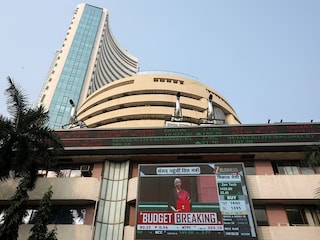
Indian equity markets reacted sharply to the Union Budget on February 1, with benchmark indices tumbling after the government announced a hike in Securities Transaction Tax (STT) on derivatives and a significant change in the taxation of corporate share buybacks.
What began as a routine Budget Day trading session quickly turned volatile. Within minutes of Finance Minister Nirmala Sitharaman unveiling her proposals, the Sensex and Nifty swung into negative territory. By mid-day, the Nifty 50 had plunged around 3.4 percent to roughly 24,572, while the Nifty Midcap 100 dropped about 2.7 percent, reflecting broad-based selling across market segments. By the close, Dalal Street had delivered one of its worst Budget Day performances in recent memory. The Nifty 50 was down 1.96 percent to 24825 while the Nifty Midcap 100 fell 2.2 percent to 57120.
The immediate trigger for the sell-off was the announcement that STT on futures contracts would rise to 0.05 percent and on options contracts to 0.15 percent. For a market that has witnessed an unprecedented boom in retail participation in derivatives, the move was seen as a direct blow to trading activity. Market participants were quick to point out that the increase in STT is likely to reduce overall liquidity in the market, as higher transaction costs discourage frequent trading and speculative participation.
Brokerage and exchange stocks bore the brunt of the reaction. Shares of leading discount brokers and market infrastructure companies plunged as traders feared that higher costs would dent volumes, especially in the hyperactive options market. Shares at BSE fell 7 percent while Agnel Broking was down 8.5 percent. Both have been beneficiaries of the boom in futures and options trading. Analysts warned that the change could alter the economics of intraday trading strategies that depend on low friction costs.
Read More
Yet, even as the market grappled with the derivatives tax shock, the Budget delivered another major change: A complete overhaul of how share buybacks are taxed. The government announced that proceeds from buybacks would now be treated as capital gains in the hands of shareholders, instead of being taxed at the company level. Effective rates of 22 percent for corporate investors and 30 percent for non-corporate investors will apply.
Still, not everyone viewed the change as entirely negative.
“While the increase in STT on equity F&O may lead to short-term market discomfort, the shift to treating buybacks as capital gains offers a meaningful offset and strengthens long-term investor confidence,” says Shrikant Chouhan, head-equity research at Kotak Securities.
Beyond the two headline tax measures, the broader Budget failed to excite Dalal Street. Expectations of substantial personal income tax relief and a big consumption push went largely unmet. Instead, the government chose to stay focussed on fiscal consolidation and targeted welfare spending, leaving growth-sensitive sectors underwhelmed. Market sentiment was also weighed down by the government’s projected borrowing programme of nearly ₹17 lakh crore, a number that investors fear could put upward pressure on bond yields and tighten financial conditions—a development equity markets typically view as negative.
Sentiment was further dented by weakness in global markets, where a sharp sell-off in gold, silver and industrial commodities added to the risk-off mood across emerging markets. Global markets, meanwhile, were shut as it was a Sunday, raising the possibility of an additional reaction when international trading resumes on Monday.
By afternoon, volatility had intensified. Margin calls and stop-loss triggers accelerated the decline, with retail investors scrambling to exit leveraged positions. Even traditional defensive sectors such as FMCG and pharmaceuticals offered little refuge, while banking and IT stocks saw heavy profit-taking.
For now, the verdict from Dalal Street is unambiguous: The Budget has reset the rules of engagement. As traders prepare for the global markets to open and digest India’s policy shifts, February 1 stands as a reminder that in financial markets, tax changes can be as powerful as earnings—and far more immediate.
Read Forbes India's complete Budget 2026-27 coverage here