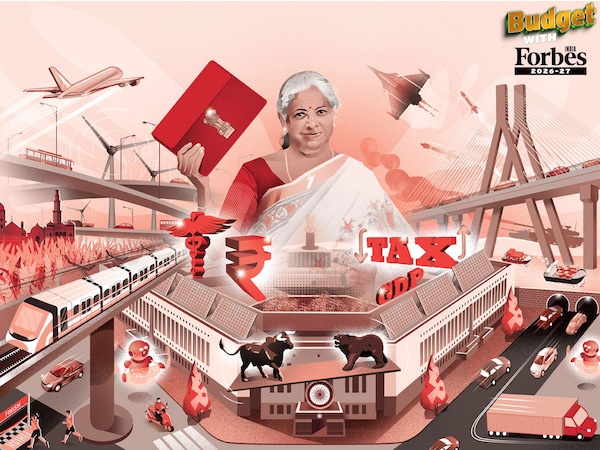
Union Finance Minister Nirmala Sitharaman, presenting the Budget for 2026-27 on Sunday, maintained continuity with the fiscal consolidation framework of recent years while signalling a shift in emphasis from fiscal deficit to the debt-to-GDP ratio. Her ninth consecutive budget also made bold pronouncements to attract foreign flows and push new-age areas such as data centres and cloud services, while promoting old flavours of manufacturing.
The fly in the ointment came in the shape of an increase in securities transaction tax (STT) and the government’s market borrowing programme, which together sent the indices on a wild swing through the day. The India VIX, which tracks market volatility and investor sentiment, surged more than 17 percent to reach 15.66. An index increase like this signals growing anxiety among market participants, which tends to make traders more cautious and amplifies short-term swings in equity markets.
The finance minister told Parliament that the Centre had met its target of bringing the fiscal deficit below 4.5 percent of gross domestic product (GDP) in 2025-26 and estimated the deficit at 4.3 percent of GDP in 2026-27 (FY27).
In a tactical shift, however, India will now target the debt-to-GDP ratio starting fiscal year 2026-27 with the aim to bring it down to 50 percent by FY31 (plus or minus 1 percent). The debt-to-GDP ratio is estimated at 55.6 percent in BE 2026-27, compared with 56.1 percent in the revised estimates for 2025-26.
The announcement comes as India’s debt-to-GDP ratio, a key repayment indicator, has declined from its 61 percent pandemic peak. The FY31 target is vital, as a lower debt-to-GDP ratio boosts credit ratings, expands spending capacity, lowers borrowing costs, and drives foreign investment.
“Since we assumed office 12 years ago, India’s economic trajectory has been marked by stability, fiscal discipline, sustained growth and moderate inflation,” the finance minister said, adding that “conscious choices we have made, even in times of heightened uncertainty and disruption” led to the outcome. “A declining debt-to-GDP ratio will gradually free up resources for priority sector expenditure by reducing interest outgo.”
The Budget also set out the government’s borrowing programme, with net market borrowing estimated at Rs 11.7 lakh crore and gross market borrowing at Rs 17.2 lakh crore for FY27. These figures were closely tracked by market participants during the special Budget-day trading session.
Markets volatile during Budget speech
The Finance Minister announced an increase in the securities transaction tax (STT), levied on purchase and sale of securities, to 0.05 percent from 0.02 percent at present. Moreover, STT on options premium and exercise of options was raised to 0.15 percent from 0.1 percent and 0.125 percent, respectively.
Following this announcement, benchmark indices saw a steep sell-off. The Sensex fell to an intraday low of 79,899, down about 3.4 percent from the day’s high, while the Nifty dropped to 24,572. Both indices later recovered part of their losses. By the end of her speech at 12.30, the Sensex had fallen to 80,931.41, shedding 1,338.37 points, or 1.63 percent, and the Nifty slid to 24,826.25, dropping 494.40 points, or 1.95 percent.
Ahead of the speech, the BSE Sensex was trading at 82,548, up 0.34 percent.
However, the index rose to an intraday high of 82,691 after the Finance Minister outlined plans to scale up manufacturing and said the government would focus on six key areas, including manufacturing, infrastructure, MSMEs and energy security.
“Our government has decisively and consistently chosen action over ambivalence, reform over rhetoric and people over populism,” Sitharaman said, adding that India had pursued “far-reaching structural reforms, fiscal prudence and monetary stability whilst maintaining a strong thrust on public investment”.
In photos: Nirmala Sitharaman’s Budget day sarees over the years
Stocks linked to infrastructure and manufacturing reacted positively initially. REC shares gained around 3 percent after Sitharaman announced plans for seven high-speed rail corridors, while textile stocks such as Raymond and Gokaldas Exports rose after the finance minister proposed an integrated programme to modernise textile clusters and skilling.
Indian stock markets closed on a weak note on February 1 with the Nifty slipping below the 24,900 mark. The Sensex ended the day 1,546.84 points lower, dropping 1.88 percent to close at 80,722.94. The broader market also took a beating, with the Nifty Midcap index declining 2.2 percent and the Smallcap index falling 2.8 percent. Sectorally, IT was the only bright spot as every other index ended in negative territory.
External pressures hit Budget
During her speech, Sitharaman acknowledged the difficult global environment in which the Budget for the coming financial year was drafted. “Today, we face an external environment in which trade and multilateralism are imperiled and access to resources and supply chains are disrupted,” she said, pointing to pressures created by geopolitical tensions and technological shifts.
Despite these challenges, she said India would continue on its long-term development path. “India will continue to take confident steps towards Viksit Bharat, balancing ambition with inclusion,” she said, adding that India must “remain deeply integrated with global markets, exporting more and attracting stable long-term investment”.
“Keeping Atmanirbharta as a lodestar, we have built domestic manufacturing capacity, energy security and reduced critical import dependencies,” she said.
She announced that building on the Rare Earth Permanent Magnets Scheme, launched in November 2025, the Government now plans to extend its support to the mineral-rich states of Odisha, Kerala, Andhra Pradesh, and Tamil Nadu. The aim is to set up dedicated Rare Earth Corridors across these states, designed to boost mining, processing, research, and manufacturing activities in the sector.
The Budget also extends the India Semi conductor Mission to ISM 2.0 with an intent to expand India’s semiconductor sector capabilities and fortify our supply chain.
Riding on this strong momentum of the Electronics Components Manufacturing Scheme, which was rolled out in April 2025 with an initial outlay of ₹22,919 crore, the government now plans to increase the scheme's outlay to ₹40,000 crore.
16th Finance Commission, orange economy, and more
The Finance Minister also referred to the 16th Finance Commission, stating that the government had accepted its recommendation to retain the vertical devolution share at 41 percent.
“As recommended by the Commission, I have provided Rs 1.4 lakh crore to the States for the FY 2026-27 as Finance Commission Grants,” she said.
Drawing specific focus on the orange economy, also known as the creative economy, the Finance Minister said, “India’s Animation, Visual Effects, Gaming and Comics [AVGC] sector is a growing industry, projected to require 2 million professionals by 2030,” she said, announcing support for AVGC content creator labs in schools and colleges.
Sitharaman concluded by reiterating that Budget 2026-27 sought to balance growth ambitions with fiscal discipline as India moves towards its long-term development goals. Sitharaman did not quote a poet or literary figure in her opening remarks. In previous years, she had drawn on poetry and classical texts, including quotations from Tamil, Sanskrit and Kashmiri poets, concluding the Budget speech in 83 minutes.