India’s trade deficit narrows in February, but war impact looms
Merchandise deficit shrinks to $27.1 billion as services exports surge, but economists warn the improvement may be temporary with $100 oil. West Asia conflict risks likely to hit March trade data
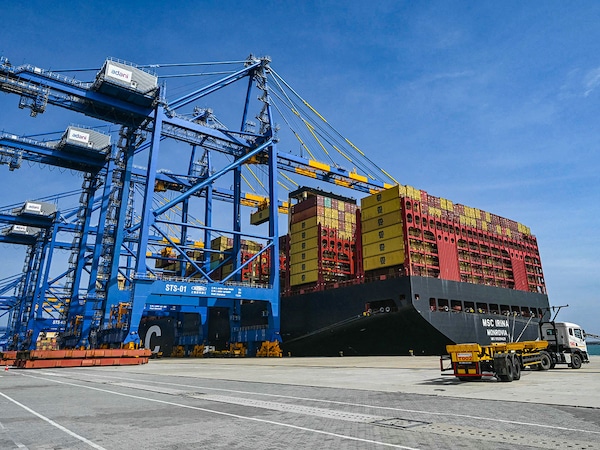
(File) Cargos are unloaded from a ship docked at the Vizhinjam International Seaport in Thiruvananthapuram. Photo by Indranil Mukherjee / AFP
Advertisement
India’s merchandise trade deficit narrowed to $27.1 billion in February 2026, down from $34.7 billion in January, according to government data released on Monday. Exports declined marginally by 0.8 percent to $36.6 billion in February, while imports surged 24 percent to $63.7 billion compared to the same month last year. The deficit, however, remains significantly wider than the $14.4 billion recorded in February 2025.
Economists caution that the improvement may prove temporary as the February figures pre-date the full-scale escalation of the conflict in West Asia.
Services Exports Surge
February data shows a sharp jump in services exports, which rose 25 percent to an estimated $39.5 billion compared to $31.7 billion in February 2025. Services imports also rose, from $14.5 billion to $16.4 billion, but the net services surplus provided a meaningful buffer to the overall trade balance.
On the merchandise side, non-petroleum exports grew modestly by 6.4 percent to $33.2 billion from $31.2 billion a year ago, while engineering goods exports rose to $10.4 billion from $9.2 billion (a 13 percent increase) and electronic goods exports climbed to $4.2 billion from $3.8 billion (a 10 percent rise) in the same period. Gems and jewellery exports, however, remained largely flat at $2.6 billion.
Import pressures were more pronounced. Non-petroleum imports jumped 29 percent to $50.7 billion in February 2026 from $39.4 billion in the same month last year, while petroleum, crude and products edged up 9 percent to $13 billion from $11.9 billion.
Eleven-month Deficit Higher
India’s trade deficit for the first 11 months of the financial year stood at $311 billion, significantly higher than the $262 billion recorded in the same period last year.
On the import side, total imports rose 8.3 percent from $658 billion to $714 billion in April 2025–February 2026. Gold imports surged 28.7 percent, silver imports more than doubled with a 143 percent rise, and electronics imports grew 17.6 percent. Crude oil imports, by contrast, declined 3 percent. The main sources of imports were China ($119 billion), the UAE ($61 billion), Russia ($51 billion) and the US ($48 billion).
Meanwhile, merchandise exports for the 11-month period grew by a modest 1.8 percent to $403 billion.
“This was propped up by high growth in electronics, which grew by 28.1 percent. Positive increases were also seen in marine products, drugs and pharma, and engineering,” Madan Sabnavis, chief economist at Bank of Baroda, notes. He added that the impact of US tariffs through the year “appeared to have been dealt with in a stable manner.”
Growth in readymade garments and chemicals was, however, virtually flat, while fuel product exports declined due to low oil prices and gems and jewellery exports contracted. Despite the high tariffs imposed by the Trump administration last year, the US remains the top export destination, followed by the UAE and China.
War Effect to Hit in March
Despite the relatively stable February data, economists are watching March closely. “This picture will get clearer in March where the major war impact will be seen,” Sabnavis says. “Crude has been elevated at over $100 per barrel while other commodities have been volatile.” He notes that disruptions to sea trading routes add further uncertainty. While a combined goods and services deficit is manageable, the looming March data, factoring in $100-plus oil and logistical bottlenecks, will test the rupee, according to experts.
Sabnavis suggests that while the trade balance will influence the rupee, “stronger forces like remittances and FPIs may hold the clue on the direction given their importance.”