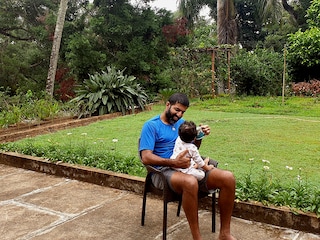
Tennis player Rohan Bopanna’s year-old daughter keeps him on his toes at their family home in CoorgImage: Supriya Bopanna[br]In an alternate non-Covid-19 universe, Rohan Bopanna, the highest-ranked Indian doubles tennis player, would have been revving for the French Open, beginning May 24. Between the Grand Slam and the clutch of tournaments before and after, he would have hoped to qualify for the big-ticket event in July: The Olympics. Instead, Bopanna is at his family home in Coorg, trading his racket for the butter churner, and dishing up chocolate eclairs rather than his booming serves. His year-old daughter is in charge of his daily fitness regime, ensuring the squats, lunges and footwork stay sharp as he chases the young one crawling around the bungalow and outside. The only time he gets a code violation warning is at night, when she is put to bed. “That’s when she needs her mother. I am yet to figure out how to get in there,” says Bopanna.
Like Bopanna, the schedule for wrestler Bajrang Punia, among India’s biggest medal hopefuls in the Olympics, has turned topsy-turvy thanks to the pandemic. If the outbreak hadn’t spread across the globe, Punia would have packed his bags to, first, Russia, then the US, and finally to Japan, where he would have been training hard to peak for his first bout in early August. Now, the former World No 1 in the 65 kg category merely has the ticket to jog around his building compound in Sonepat, which is under the strictest lockdown for being marked a red zone.
With marquee events like the Euro, the Olympics and the T20 World Cups—besides the usual Grand Slams and IPLs—2020 was meant to be a high-octane year for sports. Until it wasn’t. As the likes of the Euro and the Olympics were rescheduled to 2021, IPL “indefinitely postponed” and Wimbledon called off for the first time since World War II, there’s no certainty over whether the year will get to see any high-profile events.Wrestler Bajrang Punia (above) trains at his Sonepat home with the same intensity as beforeImage: JSW Sports[br]If at all it resumes, sport may only continue behind closed doors or in empty stadiums—as the French Open has been planning at a deferred date of September 20—till a definitive treatment or vaccine for the novel coronavirus emerges. This year has turned into a black hole for many athletes looking to make a mark: Commonwealth Games gold-medallist shooter Manu Bhaker who, at 18, had qualified for her first-ever Olympics Yashasvi Jaiswal, the player of the tournament at the recent Under-19 cricket World Cup, who was eyeing a big-bang IPL debut with Rajasthan Royals or footballer Sandesh Jhingan who was raring to hit the ground running after a ligament tear benched him for much of the previous season. Which is why if you ask Bhaker if she’s disappointed at the Games being called off, she says, “Please say postponed, it sounds so much better than saying cancelled.” Shooter Manu Bhaker paints the walls of her house during the lockdownImage: Ram Kishan Bhaker[br]WORK FROM HOMEBhaker, as well as other athletes Forbes India spoke to, though, are unanimous about the need to suspend the 2020 season till the outbreak is tamed. PV Sindhu, the silver medallist from the 2016 Olympics and the reigning badminton world champion, says, “Yes, we were all preparing hard for the Olympics and would now have to carry on the hard work for another year, but rescheduling is a good decision because of the massive surge of the virus. Life comes first.”
But some do feel the postponement has upset their roadmap for the future. Palak Kohli, the para-shuttler whose world rank of 5 in the SL3/SU5 doubles category would have earned her an automatic qualification in the Paralympic Games, rues the bureaucratic conundrum the pandemic has put her in. Kohli had skipped her class 12 board examinations as the dates clashed with the qualification events in Brazil and Peru. “But since the Games and the rest of the qualifying events were postponed, the official announcement hasn’t been made. That’s kept me in limbo,” she says. Para-shuttler Palak Kohli has bought equipment so that she can exercise during the lockdownImage: Nilesh[br]The rescheduling of the Games has also pushed boxer Vikas Krishan Yadav—who put his professional career on hold to turn amateur to represent India at the Olympics—to rethink his plans. A Commonwealth, Asiad and World Championship medallist, Yadav will now have to take up professional boxing once sport restarts, fight a couple of bouts, and come back to the national camp for amateurs around January to prepare for his final unconquered frontier, he says. But till he gets back into the ring, he’ll stay put at his home in Bhiwani, Haryana, and teach his family how to play chess. “My parents were unable to catch on to begin with and I used to get frustrated. Then I realised even I would make mistakes with boxing when I started off and got better only over time. Now both of them have learnt the game and we play a few rounds almost every day,” he says.
While he gets his dose of cardio exercises playing with his three kids, and allows himself a bit of leeway with his sleep—waking up around 8 instead of 5 am at the national camp—Yadav does maintain a daily fitness routine. “The training schedule isn’t clear yet, but I train at least two hours a day—once in the morning and once in the evening. I do strength exercises and those that increase my forearm speed,” he says. “Besides, my city is in the orange zone, which allows me to step outside for a jog.”
Read More
Not only does the schedule help Yadav stay in shape, but it also gives him a semblance of a routine that’s essential to stem a downward spiral through crises. It’s something Bopanna can’t emphasise enough. Every day, at 5 pm, he logs on to Zoom, where over 30 tennis players join him for a session on core exercises. Sindhu hasn’t hit the court in nearly two months, but works out in the corridors and the terrace of her house in Hyderabad, monitored by her father PV Ramana, an Arjuna awardee volleyball player. Bhaker, who holds the junior world record in 10 m air pistol, practises 3 to 4 hours a day at the electronic target range at her home in Haryana’s Charkhi Dadri.Footballer Sandesh Jhingan (left) continues to train at his home gym in MohaliImage: Sandesh Jhingan[br] And Jhingan, who was expected to join the national team in March, has a mix of mental and physical conditioning through meditation, breathing exercises and strength training at a small gym in his Mohali house, apart from playing against the wall, an old-school skill-enhancement technique.
“For athletes, training is everything. If you don’t train, you feel bogged down,” says javelin thrower Neeraj Chopra, an Asiad and Commonwealth gold medallist. The 22-year-old, who qualified for the Olympics in January after struggling with an elbow surgery last year, rushed back from Turkey in mid-March, before the closure of international flights, and was quarantined at the National Institute of Sports (NIS) in Patiala. While the gym and the javelin are still out of bounds, Chopra and his colleagues at NIS are throwing themselves little challenges during the evening training sessions— “like, how far can one go on a handstand”—to keep things interesting. “If you train and sweat every day, you can stay positive,” he says.
“Sportspersons are not used to staying cooped up at home for so long. The thing I’ve missed most is the sound of the ball meeting my bat. And I was most excited to play in the IPL,” says cricketer Jaiswal, who lived in a tent in Mumbai and sold pani puri to make ends meet before being spotted by his coach Jwala Singh. “So, when the lockdown started, I thought it would be tough. But I have managed it well through exercises prescribed by my trainer and conditioning my mind through lessons from the Bhagavad Gita.” It also helped that, just before the lockdown, Jaiswal attended a camp conducted by the Rajasthan Royals in Nagpur. “I realised what I need to work on in terms of my batting skills. I am preparing myself, so that when normalcy resumes, I should be game-ready,” adds Jaiswal.Yashasvi Jaiswal’s (above) IPL debut with Rajasthan Royals will have to wait, but a camp in Nagpur before the lockdown has given the youngster a taste of what’s to comeImage: Faizal Parmar[br] At Lucknow’s Omaxe City, where the Jalandhar girl lives and trains, para-shuttler Kohli and her colleagues have set up outdoor courts at a local park within the colony, and bought gym equipment for their homes to simulate a regular, pre-lockdown training day. “Outdoor badminton is more challenging than indoors because of the wind. If we master our skills outdoors, we should be able to do it easily indoors, when we get back to our training centre,” says Kohli.
Most athletes are trying to sniff out the opportunity in adversity, using the time to focus on their Achilles Heel. Slacking off isn’t an option and some, like wrestler Punia, are going at it as hard as before. The 26-year-old’s world fell in place about two weeks ago, when he set up a mat in his apartment in Sonepat. “Now, I train just like I used to before the rescheduling of the Olympics. For me, nothing has changed and nothing will. I will keep improving my skills in the extra time I’ve got so I stand an even better chance of winning a medal next year,” he says. Boxer Vikas Yadav has taught his family to play chessImage: JSW SportsTAKING A BREAKNot just in his sport, but Punia has taken a leap of faith in life too, picking up a book for the first time during the lockdown. “Kabhi shauk nahi tha [I was never interested before]. In fact, I used to go to the akhada just so that I could bunk school,” he says. “But my coach and doctor told me if one has to achieve something in life, one has to read and gain knowledge.” Between his two practice sessions and cooking, Punia began his reading journey with Devdutt Pattanaik’s Bhartiya Pauranik Kathaein, and is enjoying the ready reckoner on Indian mythology and culture.
Reading is on the agenda for Bhaker as well, but with a far more academic focus. A first-year student of political science at Delhi’s Lady Shri Ram College, the shooter is using this break to brush up her studies for her annual examinations. “I couldn’t study before due to tournaments. We’ve been told that we may have online exams in July. I’m preparing for that,” she says. While Bhaker has reduced her training by a few hours to give her stiff shoulder and arm muscles a break, she’s also picked up the brush, painting parts of the peeled-off walls in her house. “It’s a good time to reboot mentally.”
Footballer Jhingan is an avid reader, with tastes bordering on cerebral. A big fan of novelist Paulo Coelho, Jhingan is now caught up with Marcus Aurelius’s Stoic philosophy. Even through the rigours of a season, Jhingan would read and often sit down to write fiction: He’s already written a few short stories and would love to compile more into a book. “But writing’s an intensive exercise where you take a backseat and turn into the character you are writing about. It can be draining emotionally, so you need to step back at times,” says the defender. “But I still write poems as they help me relax.” On the field, he may be busy sweeping the defence line, but at home, Jhingan can spend hours doing nothing. “I don’t get bored easily.” And then there’s the indulgence of lying down with his head on his mother’s lap, “something that I don’t get to enjoy during my long absences from home”. “Even though I’m 26, at heart I’m like a 10-year-old kid,” he says.
When sport does resume, though, they are all ready to spring back to their feet and look at 2020 as a tiny blip of months in years-long careers. Start off with the domestic circuit maybe, shake off the rustiness and launch into the international tour, when travel picks up with minimal restrictions. As Bhaker says, “I’ve been training for the Olympics for two years. I’m prepared mentally and will keep up the focus. For me, this is not a break.”