What makes Tyeb Mehta the most coveted name in Indian Modernism
Mehta’s works have commanded record prices at auctions and have reshaped the perception of South Asian art abroad
By
Prefer us on GoogleLast Updated: Dec 12, 2025, 17:49 IST7 min
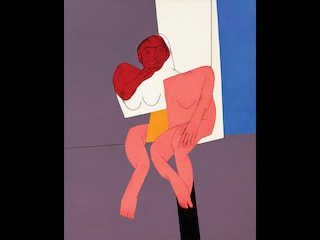
In the long arc of Indian modern art, few figures have carved silence into deeply visceral visual language as Tyeb Mehta. His canvases—severe, distilled, often ruptured by a single diagonal slash—carry the weight of personal history and national trauma, yet they rise above both to become something elemental. To encounter a Tyeb Mehta painting is to stand before a paradox: A work that is sparse but immense, quiet but thunderous, emotionally raw yet architecturally precise. For decades, that paradox is what made him a revered painter among his peers. Today, it is what makes him one of the most sought-after Indian artists on the global market.
Mehta was born in 1925 in the congested lanes of Bombay’s Bhuleshwar, far from the cool white walls of future galleries. He grew up above a video-parlour-to-be, surrounded by the textures of a city still defining itself. Few could have predicted that this boy would one day become a pillar of Indian modernism, a man whose works would command record prices and reshape the perception of South Asian art abroad. Yet even as a young student at Sir JJ School of Art, something set him apart. While others gravitated towards romantic landscapes or decorative traditions, Mehta pared things down. His instinct was not to embellish but to interrogate. He sought clarity through reduction, structure through silence.
This pursuit would place him alongside the Progressive Artists' Group (PAG), that fiery post-Independence collective of FN Souza, SH Raza, HA Gade, S. Bakre and KH Ara, who rejected the antiquated academicism of colonial art schools. Among them, Mehta was the quietest but also the most uncompromising. Souza painted with the aggression of a man slashing through dogma; Raza delved into spiritual geometry and colour. Mehta, in contrast, stripped the canvas to an almost existential minimalism. His work did not shout. It pressed. It held. It confronted without theatrics. Where his peers explored identity and nationhood through exuberance, Mehta addressed the same concerns through tension—an unspoken vibration that seemed to hum beneath every painted surface.
His artistic language arrived fully in its mature form only after 1969, when he discovered the Diagonal, not by design but by accident. A chance stroke across a canvas in his studio in Delhi made him pause. That single line divided the composition so decisively, so brutally, that it became a leitmotif for the rest of his life. It was a metaphor, of course: For rupture, for partition, for the divides that shape the subcontinent and the self. But it was also formal engineering. The diagonal brought structure to his sparseness, a way to hold conflict in equilibrium. It allowed the figures, often distorted, collapsing, or resisting, to appear suspended in an eternal moment of tension.
That tension was rooted in lived experience. In 1947, as a young man, Mehta witnessed a lynching during the Partition riots. He rarely spoke of it publicly, but its shadow stretched across his work. His ‘Falling Figures’ series, which emerged in the 1950s and evolved over decades, embodied the sense of freefall he carried within him. The figures are weightless yet heavy, monumental yet fragile, always caught in the instant before impact. Later came the unforgettable ‘Trussed Bull’, an image of raw force subdued — a metaphor not only for violence but for the cyclical nature of power and oppression. And then, in the 1980s and 90s, the extraordinary ‘Mahishasura’ series, in which Mehta reimagined the ancient myth of the demon vanquished by Durga. In his hands, the myth became neither heroic nor decorative, but psychological. Mahishasura becomes an embodiment of struggle itself, and Durga becomes a force of moral ambiguity rather than triumph. These works, with their sharp planes of colour and archetypal forms, are now among the most iconic images in Indian art.
The austerity of Mehta’s compositions is often mistaken for simplicity. But simplicity requires confidence, and he arrived at it slowly, through decades of experimentation. Early influences from his time in London in the late 1950s can be seen: A brush with Francis Bacon’s brutalist figuration, the shadow of European expressionism, and the loneliness of urban life. Later, his stay in New York in the 1960s brought him face-to-face with Minimalism and Abstract Expressionism. Yet he absorbed these references not as mimicry but as a sharpening stone. The world helped him refine his boundaries, but the voice was entirely his own.
Also Read: Asian collectors spare no expense for Van Gogh's paintings
If his subject matter oscillated between mythic and contemporary, his thought process remained constant: Art must be distilled to its essence. He believed that a painting should reveal just enough to unsettle, but never so much that it resolves itself. That open tension, between narrative and abstraction, emotion and geometry, is the engine of his work. Even the colours carry this weight. Mehta’s palette is famously restrained: Reds that sear, whites that confront, blacks that anchor, earth tones that bruise rather than soothe. Nothing is decorative. Everything is structural, psychological, and symbolic.
As the decades unfolded, the art world caught up. While Mehta had long been revered by curators and artists, the broader public and market began recognising his singularity more clearly in the late 1990s and early 2000s. Important exhibitions such as his retrospectives at Jehangir Art Gallery, The National Gallery of Modern Art, and later presentations in New York, London, and Dubai helped consolidate his legacy. Critics spoke of him with the same reverence reserved for global modernists, Rothko, Bacon, Giacometti, artists who used the human figure as a site of existential inquiry. And collectors, both seasoned and new, gravitated towards his ability to convey so much with so little.
Then came the watershed moment. In 2005, Mehta became one of the first Indian artists to cross the $1 million threshold at auction. It was more than a market milestone but also marked a symbolic yet significant shift in perception—Indian art was no longer a regional curiosity but a formidable category in global collecting. In the years that followed, his prices only climbed, fuelled by scarcity, historical importance, and an unrelenting demand for examples of his mature style.
So, which works by him are so sought after? Mehta’s works sit at the intersection of rarity, intellectual depth, and emotional universality. He did not produce prolifically; each canvas was painstaking, often taking years to resolve. His imagery is instantly recognisable yet endlessly interpretable. And for collectors, owning a Tyeb Mehta is not merely owning a painting; it is owning a piece of modern Indian consciousness—a distilled document of the century’s fractures and resilience.
More profoundly, Mehta matters because he expanded what Indian modernism could be. He rejected ornamentation not out of disdain but because he believed the human condition deserved clarity. In an age of noise, he offered silence. In a culture rich with symbols, he offered the power of the essential form. In a nation divided by history, he drew a line, not to separate, but to expose the fault lines we inherit and the ones we create.
The great irony is that Mehta, a man who avoided self-projection and spectacle, has become emblematic of India’s ascent in the international art world. His canvases now hang in leading private collections, museums, and corporate spaces; his name is shorthand for seriousness, rigour, and artistic integrity. But perhaps his greatest legacy lies in the way his work continues to unsettle. Even today, standing before a Tyeb Mehta painting, one feels the world narrow to a single breath, a single tension point.
Set against this legacy, the work appearing in AstaGuru’s forthcoming Historic Masterpieces auction, scheduled to take place from December 14 to 17, stands as a stunning testament to Mehta at the height of his powers. Painted in 1977, it reveals an artist in full command of his syntax, every plane deliberate, every contour charged with intent. The protagonist, articulated in warm, saturated hues that pulse against a cool, geometric ground, sits suspended between composure and unease. Her limbs seem gently unspooled by the incisive black bar that cleaves the composition, a hallmark of Mehta’s structural tensions. There is an echo of Bacon in the sculptural containment of the figure, yet the emotional pitch is distinctly Mehta’s—quiet, contemplative, and deeply interior. The interlocking planes of cream, blue and mauve compress the space with architectural precision, while the flattened modelling amplifies the psychological resonance.
In its measured economy and profound emotional clarity, this 1977 canvas embodies the maturity of his 1970s period, when Mehta transformed the simplest formal device into a portal of staggering human depth. Its inclusion in the auction is not merely a highlight but a reminder of the artist’s enduring ability to arrest, disturb and illuminate with a single, unforgettable image. Tyeb Mehta gave Indian modernism its sharpest edge, its deepest wound, and its most enduring strength.
The writer is director, client relations, AstaGuru Auction House
First Published: Dec 12, 2025, 18:08
Subscribe Now