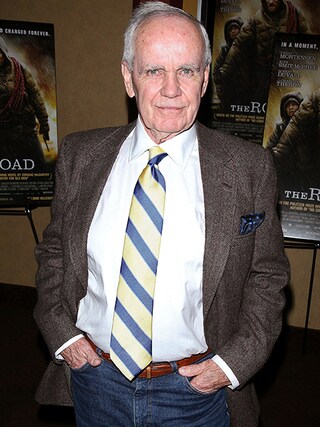
A lone wolf among the last of the literary giants Toni Morrison, John Updike & Philip Roth, Cormac McCarthy’s pared-down melancholic vision provided no solace to humans who passed through its worlds.
Cormac McCarthy’s oeuvre carved a sparse, macabre portrait of the human condition in the American landscape. His early bleak novels, like the savage western Blood Meridian, were set in the Appalachian South, and later, the landscape shifted to the desert Southwest like in his austere, post-apocalyptic Pulitzer winner, The Road.
Javier Bardem as Anton Chigurh in "No Country for Old Men"
There is a scene in the Academy Award-winning film No Country For Old Men—a faithful adaptation of the legendary novel by Cormac McCarthy—when Javier Bardem’s character Anton Chigurh patches his own gunshot-bloodied thigh, bearing the pain, in a motel. The wound that flinches the viewer most in Chigurh isn’t physical it is psychic, arising from an acceptance of the inevitability of violence, a theme that runs like a wild horse through a lot of McCarthy’s oeuvre.
It isn’t surprising that McCarthy had begun No Country... as a screenplay. Although McCarthy focused on his novels without a care for their commercial prospects, he also wrote for film and television, penning the screenplay for Ridley Scott’s crime thriller The Counselor (2013). Another of his unsold screenplays inspired the "Border Trilogy".
Read More
Image: George Rinhart/Corbis via Getty Images
Growing up in Knoxville, McCarthy rebelled against his comfortable upper-middle-class upbringing. He dropped out of Tennessee University, joined the US Air Force and, while stationed in Alaska, began reading obsessively, drawn to the novels of Melville, Dostoevsky and Faulkner. He returned to the University in 1957 but dropped out again three years later to write what became his first novel, The Orchard Keeper (1965).
His first wife, the poet Lee Holleman whom McCarthy had married, filed for divorce, saying he asked her to “get a day job so he could focus on his novel writing".
McCarthy lived on the Spanish island of Ibiza with his second wife, Anne De Lisle, in total poverty until they separated in 1976. McCarthy moved to El Paso, fascinated by the landscape and mythology of the West, crisscrossing the Texas-Mexico border, whose landscapes would become the backdrop for novels such as Blood Meridian and All the Pretty Horses, the first instalment in the "Border Trilogy", which continued with The Crossing (1994) and Cities of the Plain (1998).
Perhaps his most violent book, McCarthy received some of the best reviews of his career for Blood Meridian, which literary critic Harold Bloom called “the ultimate western, not to be surpassed". Famously reclusive, McCarthy gave only a handful of interviews. He has no published letters or memoirs, and no biography has appeared. He did not attend book signings and sent his publisher when he won the National Book Award (for All the Pretty Horses, 1992) and the Pulitzer Prize (for The Road, 2006)
By the early 2000s, McCarthy spent much of his time at the Santa Fe Institute, a multidisciplinary research centre, where he served as a kind of artist-in-residence, preferring the company of scientists there, which influenced his last two books, The Passenger and Stella Maris, intertwined novels that were published together in 2022. The books were about two siblings, a math prodigy and her salvage-diver brother, with an incestuous attachment and a father who helped develop the atomic bomb.
Viggo Mortensen as the man and Kodi Smit-McPhee as the boy in 2009 film adaptation of "The Road"
McCarthy won Pulitzer Prize for The Road (2006), a poignant tale of a father and son trudging across environmental desolation and physical deprivation and human degradation in the wake of a disaster. Here’s a taste of his sparse prose: The hour. There is no later. This is later. All things of grace and beauty such that one holds them to one"s heart have a common provenance in pain. Their birth in grief and ashes.