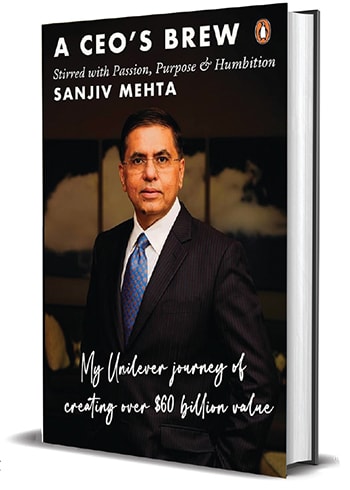
The seed of the book was sown when we were in the Philippines, and we had a famous victory over our arch-rival Procter and Gamble (PNG). When I was leaving the Philippines, my counterpart in PNG invited me to address his leaders. This seldom happens; it’s it is like the BJP inviting a Congress leader to address them. The seed took time to germinate, since I didn’t have time. And then I finished my innings with Unilever.
The first thought behind the book was about sharing knowledge; sharing your thoughts also brings more clarity. The second thought is, I’m a big believer in compassionate capitalism in that business is a force for good. And I wanted to share that you can create immense value while being purposeful and values-lead. The third reason is the concept of ‘humbition’; I needed to share that you need to have a fierce ambition, but it should be tempered and anchored with humility.
I had the privilege and honour for being a CEO for 21 years, and leading different markets and different businesses for Unilever. Over the years, I’ve also been able to codify what it takes to be a high-performing business, and I was keen to share that.
Let me begin with ambition. I am, by nature, really competitive—whether it is in gaining market share, winning or even for my cricket team. And I always set a high bar for myself. We come from a school of thought that says resources should not constrain your ambition. Now, I also believe that if you’re not anchored with humility, ambition and success could lead you to arrogance. And who better than the Greeks to teach us about hubris?
I also believe that if you’re not humble, you won’t be a learner; you won’t be a person who is willing to accept your failures. In today’s world of fast-paced changes, if you’re not a learner, you could get fossilised extremely fast. And accepting that you or your company have limitations, and you need to improve upon them, that’s where humility comes in. When you have the combination of ambition with humility, it becomes a forceful combination.
![]()
Q. You mentioned how you had codified the ways in which to build a high-performance company. What would you say are the most important factors in this process?
High-performance revolves around three axes: The first axis is the mindset, and within that mindset there are two types. First is the growth mindset, which entails hunting for opportunities under any conditions. In the Chinese language, the word crisis is made of two characters, which mean danger and opportunity. So, whatever be the scenario, one needs to look at the opportunities that will be lurking in the corner.
The second important mindset is the owner’s mindset, and this is important for professional organisation. When you believe you’re the owner of the company, you will ensure that every rupee that you spend is being spent for the right purpose. And, when you have an owner’s mindset, you get the same amount of joy as an owner would get when you win. Similarly, you would feel hurt when you lose. But I think the point that I’m trying to make is that the job should not be a 9-to-5 job. You need to be emotionally connected with it to get the best out of you.
The second axis is capabilities, which need to be distinctive and hard to replicate. If they are not hard to replicate, they won’t give you a competitive edge. If everyone can do it, it’s not distinctive. In India, when we were building the moats around us, there were two distinctive capabilities we had built: One was winning in the many Indias, and the second was reimagining HUL by using data and technology.
The third axis is the performance anatomy, which is how you craft a strategy, focus on execution, build a culture that is steeped in performance management and, importantly, talent management. How do you recruit, nurture and retain high-calibre talent? These principles, I believe, apply to every company in any industry. The new ones would be different, because each industry would require a specific set of capabilities to win.
Q. Where does innovation stand in this setup?
You know, one of the things that we lack in the country today is innovation ecosystems. We don’t spend enough money on R&D, but that again is a question of our mindset. If you want to be an innovative company, you will put the resources behind it to ensure that you can come up with products that would be differentiated from your competitors and meet the needs of consumers.
I always used to say, before you win in the marketplace, you have to win the battle in your mind. It’s always mind over matter. The two biggest assets an individual has are self-belief and confidence. Look at a cricketer. No matter how talented you may be, once you lose self-confidence, your bat will dangle outside the off stump. We have seen it with [Virat] Kohli, [Sachin] Tendulkar. When they start losing confidence, despite their immense talent, they struggle.
![]()
Q. You mentioned the owner’s mindset. The nature and structure of new-age companies and startups are different from what old school and old economy companies are. Consequently, the demands made on their CEOs, especially founder-CEOs, are also different from the kind of requirements from CEOs of old economy companies. What is your interpretation of this? How can founders who are also CEOs effectively play both roles and be successful at both?
First, we must understand that societal expectations have also changed. The tenures of CEOs have come down, not just for new-age companies but also legacy companies. And if you’re part of a big, listed company, the shareholders are extremely demanding. And they have also got various options. If you’re not performing, they will take away the money and put somebody else [in your place]. That puts immense pressure on CEOs to perform.
When you look at new-age companies, most of them would be funded by venture capitalists (VC) and private equity (PE); they have put in money to get returns for their investments. So, just like you have shareholders in public markets, the VCs and PEs have invested in new-age companies. They will demand performance; it is legitimate for them to demand that. The important bit that we see the PEs should do is not push the founders to the brink, so, they end up doing wrong things for short-term gains.
We must understand that all the PEs and VCs have got a fund, which has a life cycle. So, they’ve invested the money and they would want to get the returns before the end of the life cycle of the fund. That is where the that pressure that you have to perform within that time frame may not be as acute as it would be otherwise.
As far as performance pressure goes, it is just immense. In fact, in a publicly listed company, you are under constant scrutiny. If you’re a startup, you could still get away with things; if in a couple of quarters, things haven’t gone your way, you’re not in the public glare. Whereas, if you’re a large company, you are constantly under a microscope. So, it is a demanding world for a CEO. It is not an easy world for us.
![]()
Q. You spoke about societal expectations having changed a lot. Societal perceptions have also changed a lot about who owns or runs companies. Do you think the gender of a CEO makes any difference?
I don’t think so. I’m a big believer in diversity. I used to believe that you need to have a certain kind of philosophy, a diversity of counsel and unity of command. And diversity of council doesn’t happen if you have clones sitting across the table. You need people with different backgrounds, different education; gender diversity, background diversity, educational diversity to get the best out of people.
There was a time when the stereotypical image was that of a macho CEO. It is a person who stands on a pedestal, inspires people, leads the team. There’s a lot of myth around the great man. But one man can do nothing. Let’s accept that. I am not belittling the role of a CEO, but we must always remember that it’s the great team. You need a team which has complementary skills, which enjoys each other’s success, a team with a clear articulation of the hierarchy. The company comes first, then comes your own division or the function. That’s when you make it into a great business, into a sustained high-performing business.
Q. The tenures of CEOs are becoming shorter, but nurturing a company’s culture takes time. How can CEOs then nurture cultures within short tenures?
It should not happen that when a new CEO comes in, they radically change the strategy of the company or disown everything of the past. Same goes for the culture. In fact, it’s a relay race. And we must remember that we are the inheritors, and we stand on the shoulders of the people who built the company. We are the custodians during our tenure, and then we will pass on the company’s responsibilities to the next set of leaders.
At HUL, we had a nice practice under which we would get retired directors from all over the country to Mumbai, and the incumbent CEO addressed the company. And the post-dinner speech was given by the most senior retired CEO. Many times, youngsters in the company would ask me, Sanjiv, why do you have this practice and why do you take it so seriously? I used to be clear that if we don’t respect the past, we won’t build the right culture in the country. History should be respected.
The second thing I’ll tell you is an example of our culture. When GST 2.0 was implemented in 2017, we were reviewing its implications for the company. We learnt that we were making unintended gains. The law didn’t say that we couldn’t pocket the money; we could have. But that’s not the spirit of the law. So, we cut the cheque—it was ultimately `120 crore—which went to the government. It took the government six months to frame laws to accept the cheque. Then they, of course, went after all the other companies and got the money from them.
Now, just see the message that would have gone around in the company; that adhering to the law is not about the letter of the law, it’s the spirit of the law. That’s how culture is made. I believe, during my tenure, I would have strengthened it, I am not responsible for building it. It’s been built by successive chairmen: From Prakash Tandon, Rajyaprastha, Thomas, Ganguly, Datta, Banga and so on. That’s how you build a timeless company.
A company like HUL, despite all the new-age companies, is still the employer of choice in the country. It’s able to attract the best possible talent. How many companies will you find like this in history? Which has, over eight to nine decades of its existence, remained the market leader? So, to build a timeless company, culture is extremely important.
![]()
Q. Your book is called A CEO’s Brew. So, how do you like your tea?
My favourite tea is the Lipton Yellow Label, which I get from the Middle East, from Jebel Ali [a port city in Dubai]. The reason is that it is a blend of Kenyan and Sri Lankan teas. And this is a tea… if you look at the colour, it is not muddy brown, it is golden brown. You can relish it with milk and also without milk. In the morning when I get up, I add milk to it. But during the day, I drink many cups of tea without milk.
If you look at a good cup of tea, now that you’ve raised the question, it is about the colour, the aroma, the mouth feel. It is about the lingering taste. Similarly, leadership is made out of various ingredients. You can’t just make a good cup of tea. It has to be heated; it takes time for it to brew. Similarly, leadership muscle can’t be built overnight, it takes time. And just like heat, you have to see the tough times, you have to go through turbulent weather to build your leadership muscle.