Rethinking how we pay farmers for sustainable crops
New research by Professor Can Zhang finds that well-intentioned changes to sustainability certifications may hurt the farmers they’re meant to protect
Last Updated: Apr 02, 2026, 13:10 IST5 min
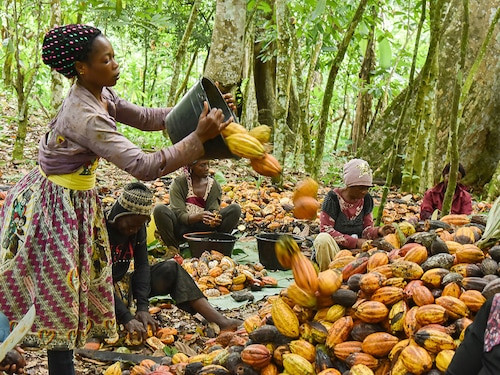
Certified organic, fair trade certified, certified seeds. Foods are reaching new levels of transparency as consumers demand ethical sourcing. With more consumers willing to pay top dollar for certified products, firms need to decide how to support and incentivize small farmers who commit to sustainability processes that make these products possible.
For decades, sustainability labels like Fairtrade and Rainforest Alliance have promoted the idea of the premium—an extra payment companies make to certified farmers on top of market prices. Traditionally, this has been a fixed amount: farmers receive the same bonus regardless of the fluctuating global price of cocoa, coffee, or oranges.
Alternatively, industry watchdogs have recently begun pushing for “flexible premiums”—premiums that rise when market prices fall—with the goal of cushioning farmers from market downturns.
But a new paper forthcoming in Management Science by Can Zhang, an associate professor of operations at Duke University’s Fuqua School of Business—co-authored with Georgetown’s Vishal Agrawal—finds that despite its good intentions, this approach can sometimes hurt farmers and even shrink the overall supply of certified products.
“Premium design is a subtle balancing act,” Zhang said. “The same mechanism that protects farmers from price drops can also discourage firms from buying as much certified crop—so it’s important to understand its full implications.”
To explain how a sustainability market works, Zhang and Agrawal built a model capturing how NGOs, companies, and farmers interact in sustainable agricultural supply chains.
NGOs, like Fairtrade and Rainforest Alliance, often design the certification programs adopted by the food industry.
Several major certification programs use a fixed premium approach—a fixed amount buyers are required to pay on top of the market price. The researchers tested whether proposed flexible premiums may better support farmers and overall sustainable production.
Their model incorporates key factors that determine supply and demand for certified crops. They factored in real-world challenges like weather-driven yield uncertainty and a market price that depends on the aggregate supply of the crop. They also considered quantity risk, noting that farmers’ livelihoods depend not only on price, but also on the volume they can sell as certified.
They found that flexible premiums can sometimes end up reducing farmers’ expected income and sustainable sourcing—exactly the opposite of what that they were supposed to achieve.
“For instance, when supply is plentiful and prices drop, higher premiums can actually dampen demand for certified crops, while in bad years—when supply is tight and prices surge—lower premiums boost companies’ interest in certified crops, but there’s little supply to meet that demand,” Zhang explained. “In other words, flexible premiums can unintentionally exacerbate the mismatch between supply and demand for certified crops.”
But under specific conditions, flexible premiums can deliver a “win-win-win” solution, boosting farmer income, sustainable sourcing—with positive environmental effects—and firm profits.
The researchers found that flexible premiums perform best in settings where the expected supply of certified crops is plentiful—such as when certification is relatively easy for farmers.
Zhang highlights cocoa as one such example. Cocoa production is highly concentrated, with about 70% of the crops produced in West Africa. In such a concentrated region, farmers are organized in cooperatives, with NGOs assisting them in their certification process, making certification less costly. Consequently, the volume of certified crops has been high relative to their demand. In such cases, flexible premiums could unlock value for all sides, Zhang said.
“In the case of cocoa, it is widely known that certified farmers often cannot sell all their production as certified,” he said. “In these cases of abundant certified supply, a flexible premium approach rewards both sustainability and profitability. But if supply is scarce, it can do the opposite.”
The research also examines the growing trend of “self-labeling,” where firms create in-house sustainability programs—like Lindt’s Farming Program and Starbucks’ C.A.F.E. Practices— instead of seeking NGO certifications. While these programs offer companies greater control over branding, the research shows they may favor company profits and sustainable sourcing volume, but not necessarily farmer welfare.
Under self-labeling, firms tend to prefer fixed premiums, which simplify planning and reduce risk. The study found that self-labeling could lead to more sustainable sourcing overall, as companies have greater incentives to source sustainable crops to meet demand and maximize profit.
However, this may not translate into higher farmer income, Zhang said, because firms would optimally set a lower premium than the NGO-certified premiums.
Zhang noted that firms tend to emphasize how much of their crops are sourced sustainably but are often less transparent about the premium paid to farmers.
“It's important for consumers to urge them to actually disclose not only how much they source, but also how much they are paying the farmers,” Zhang said.
Zhang’s model also points to how climate volatility reshapes what works. As crop yields become more unpredictable due to climate change, flexible premiums may become less effective, the research shows. When yield variability is already high, extreme weather can lead to scenarios with constrained certified supply, making flexible premiums less appealing.
“When supply is low and the market price is high, a flexible premium reduces the premium, which increases firms’ interest in sourcing more certified crops,” Zhang said. “But they can’t, because the same weather shocks—a flood or a dry season—that drive prices up also limit how much farmers can produce.”
“In these situations, a flexible premium ends up paying farmers less without increasing the volume they sell as certified,” he added.
For example, disease and weather have pushed orange juice production to its lowest level in 30 years. Under these conditions, “you would like to find more certified products, but they are simply not available,” Zhang said.
The study shows that flexible premiums, while intuitively appealing, are only better in some circumstances, Zhang said. The right model depends on supply dynamics, consumer demand, and farmers’ ability to produce sufficient certified crops.
For companies and NGOs, the research suggests a case-by-case approach to sustainability tools. Certification systems must be tailored to take operational and supply chain characteristics into account, and sometimes the simple, fixed premium approach can still be the right one, Zhang said.
“We all want farmers to earn fair incomes and companies to source sustainably,” Zhang concludes. “The challenge is designing incentives that make those goals compatible, not competing.”
First Published: Apr 02, 2026, 13:15
Subscribe Now