Artemis II lifts off Earth: Why this mission means more than just a moon flyby
The first crewed flight of Nasa’s Space Launch System rocket and the Orion spacecraft is a 10-day quest to validate systems, scout resource-rich lunar real estate and lead the new global space race
People watch as NASA's Artemis II Space Launch System rocket carrying the Orion spacecraft lifts off from Kennedy Space Center on April 1, 2026 in Cape Canaveral, Florida. Photo by Chip Somodevilla/Getty Images
Advertisement
In a Nutshell
Artemis II sends four astronauts on a 10-day moon flyby mission.
Mission tests systems and scouts resource-rich lunar sites
Artemis II ignites a new global race for lunar resources
Nasa’s Artemis II lifted off from Kennedy Space Center on April 1, sending four astronauts toward the moon for the first time in over five decades. The 10-day mission carries Reid Wiseman, Victor Glover, Christina Koch and Canadian astronaut Jeremy Hansen on a free-return trajectory around the moon and back to Earth.
It is the first crewed flight of Nasa’s Space Launch System rocket and the Orion spacecraft. Artemis II is intended as a test flight to verify systems and equipment, laying the groundwork for future missions to land astronauts on the moon in 2028. The Orion features the Environmental Control and Life Support System, the O2O laser-based communication system, and the AVATAR “organ-on-a-chip” technology to monitor radiation effects on human tissue in real time.
The Artemis programme ultimately aims to return humans to the lunar surface and establish a long-term base there, preferably by 2030.
While Nasa frames the 10-day lunar flyby as a systems validation exercise, the mission’s scope is far broader. It marks the definitive start of a new-age space race, signalling an aggressive push to secure strategic lunar real estate and long-term economic dominance.
For the first time since 1972, humans are heading back to the moon, but the mission profile has fundamentally shifted. Unlike the Apollo era missions, Artemis II is the scouting mission for a permanent, industrial presence. At the heart of this scramble is the Lunar South Pole, a region some would say is the most valuable territory in the solar system.
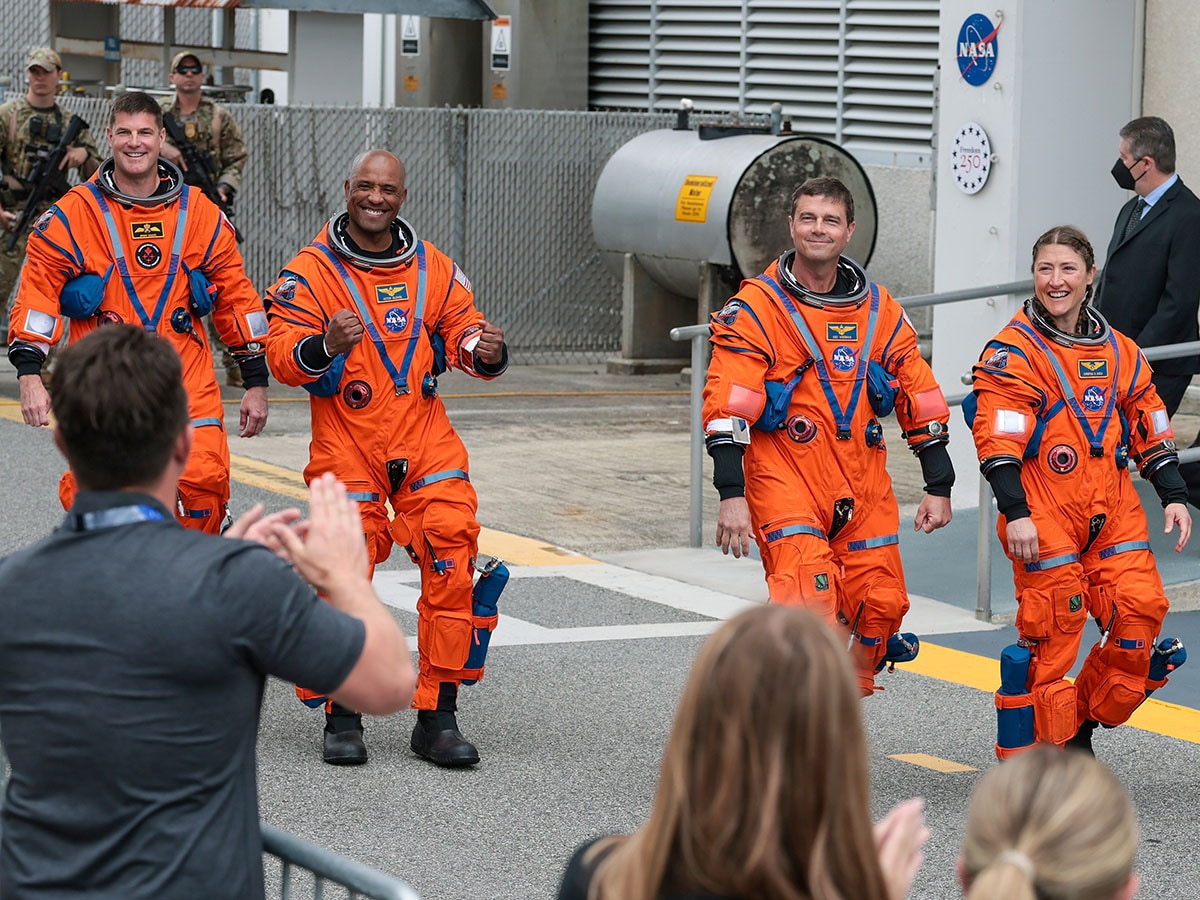
Mission specialist Jeremy Hansen of Canadian Space Agency, pilot Victor Glover, commander Reid Wiseman and mission specialist Christina Koch walk ahead of the launch of the Artemis II at NASA’s Kennedy Space Center on April 01, 2026 in Cape Canaveral, Florida. The 322-foot-tall Artemis II Space Launch System rocket and Orion spacecraft will take the astronauts around the moon and back, 230,000 miles out into space and the farthest any human has ever traveled from Earth. Photo by Joe Raedle/Getty Images
The new gold: Water
The drive to reach the South Pole is driven by volatile resources, specifically water ice hidden in permanently shadowed craters.
By processing ice into liquid hydrogen and oxygen, the moon becomes a deep-space gas station. Harvesting the fuel on the moon slashes the costs for future missions to Mars and beyond.
While water is the immediate logistical priority, the long-term play for lunar dominance also involves various rare earth elements and high-value minerals that are difficult to source on Earth and which are finding increasing usage in advanced technologies.
Deposits of neodymium, lanthanum and yttrium are essential for the high-tech sectors and used in everything from EV motors, smartphone screens and wind turbines to advanced defence systems and AI hardware. Helium-3, a potential fuel for next-generation nuclear fusion, makes moon a source for future clean energy. The moon, apparently, has vast reserves of it.
The race to secure these resources is, therefore, a matter of global economic and technological sovereignty.
The new space race
The urgency of Artemis II is exacerbated by Beijing’s space progress. China’s International Lunar Research Station (ILRS) is a direct rival to the US vision. China is aggressively courting its own bloc of partner nations, offering a competing framework for lunar governance and plans to land its astronauts on moon by 2030.
This geopolitical tension is the driving force behind the Artemis Accords, a US-led diplomatic framework, signed by over 60 nations, including India, to redefine the rules of outer space ownership. While the 1967 Outer Space Treaty forbids ownership of the moon by any one country, the Accords introduce Safety Zones which are exclusive operational areas designed to prevent “harmful interference”.
However, these zones are a double-edged sword. Washington fears a scenario where China establishes de facto squatter’s rights, in a manner of speaking, over strategic peaks with constant solar power. Conversely, Beijing views these US-backed zones as way to bypass international laws and secure the most lucrative and mineral rich craters and regions of the moon.
Future missions
Artemis III (2027) will forgo a lunar landing, instead testing Orion alongside SpaceX and Blue Origin’s commercial landers in low Earth orbit. Artemis IV (early 2028) will be the first crewed moon landing since 1972, targeting the lunar south pole. Artemis V (late 2028) aims for a second landing and the beginning of a permanent lunar base.