Siddharth Pandey, director of Protoplanet and a former Nasa hardware engineer, describes his team’s research in astrobiology and planetary sciences as significantly “ahead of the curve”, providing critical training for deep-space exploration. He feels many non-scientists are unaware of how space exploration benefits their lives and stressed the need to move beyond justifying missions by merely comparing their low cost to Hollywood movie budgets.
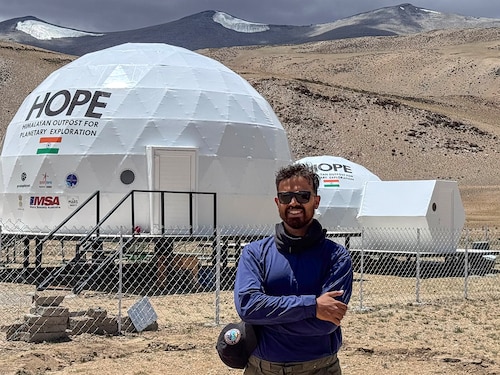
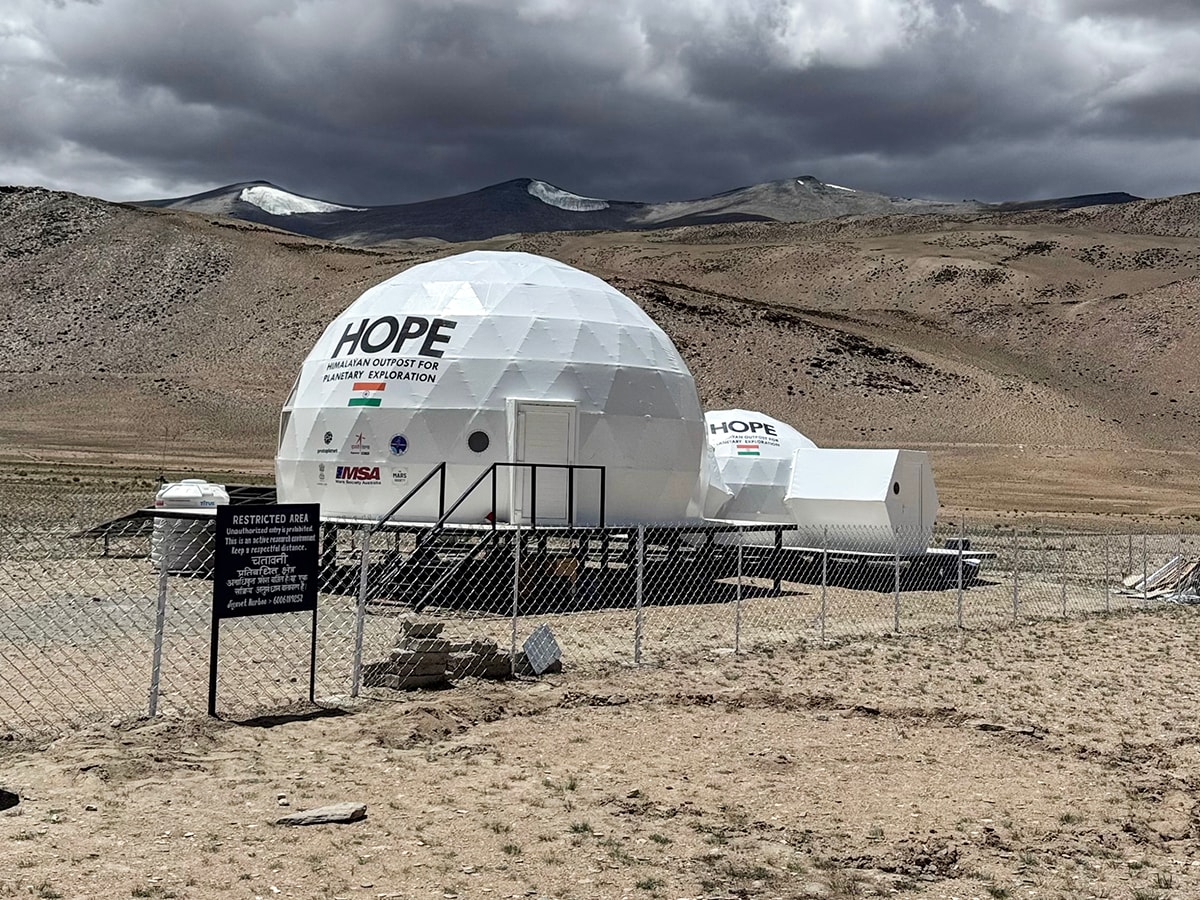
The team just completed its inaugural venture HOPE (Himalayan Outpost for Planetary Exploration) mission at the Tso Kar valley in Ladakh, developed jointly with Isro’s Human Space Flight Centre (HSFC). The mission’s primary goal was to study the effects of extreme environments on the human body—research which could yield critical data for scientists, engineers, astronauts, and students globally.
Protoplanet is a culmination of work that we had been doing in India and for India for the last decade. This was essentially running a lot of training projects in space exploration, particularly in the field of astrobiology and planetary sciences. We were doing things in India even before they were officially part of Isro's (Indian Space Research Organisation) mandate. I'm talking about the 2014-2016 timeframe, when Isro had not yet announced the human space flight programme or Chandrayaan 3. I was in India in 2019 at Amity, I saw the ecosystem is coming together. Isro was opening to startups and research institutions to involve them into flying payloads. So, sometime last year, we realised it was time to set something up because, unless we do it, no one else was going to do it. My focus has always been beyond the low earth orbit—microgravity research or what the astronauts will be doing when they are on the space station. Beyond that, we are also looking at deep space missions—lunar, Venus and Mars. So, as Isro started building these ambitious projects, we saw they don’t have a lot of in-house capability, and at the same time, they're depending on a user base which does not exist. And we also wanted to normalise space exploration for the average Indian—these are the three pillars of Protoplanet. But at the core, we want to remain an R&D-focussed company and work closely with universities and the government.
![]()
Photo Courtesy: Protoplanet
Q. How did Isro come on board?
We had previous relationships with different departments and centres within it (Isro). Protoplanet was new, but the people within the company were familiar names and faces and carried certain reputations. The first thing that we did was register as a space tutor, which is a programme that Isro runs. We applied for that and it helped us get our first formal affiliation with Isro. After that, we reached out to the Human Space Flight Center. We were well received by them. We hold two contracts in two different areas with them. One is focussed on micro gravity applications, the second on analogues, which is essentially environments that mimic Moon and Mars conditions. And Ladakh is one of the places where we have been doing work. Also, internationally, we have been working with a few nonprofit research organisations and some universities in Europe and the US.
Q. Why choose Ladakh for research?
Ladakh is located in a high-altitude dry desert environment. We are in the vicinity of this lake that's glacially fed and that is slowly receding, because of the irregular snow-melting and the precipitation that is taking place now. We have a weather station there that collects data that helps to validate a lot of information being collected from space. From the space angle, there are two ways in which it helps us—the first is that it is of interest to Isro. Currently, the main priority of Isro is to send humans into space and they are interested in seeing the effect of extreme environments on the human body. And because of its high altitude and low oxygen—a hypoxic, hyperbaric environment—it creates both psychological and physiological stresses on the body. It's also a high UV radiation environment. It can cause a lot of spatial disorientation because of how the landscape is.
And second, Ladakh, and particularly the Tso Kar valley, is very similar to the locations that had existed on Mars two billion years ago when it had water on its surface and was very earth-like. And it’s also a place where you can find microbial life surviving in high ultraviolet radiation environments, in very cold, dry and salty conditions. It has access to permafrost— one of the few places on our planet where you can get that. It's got hot springs, which are rich in boron and are very different from the hot springs that exist normally at sea level. So, there is a unique interplay between geochemistry and biology that takes place in these hot spring environments.
Q. Are there other sites in India which are conducive and where we can do these kinds of studies?
There are about 12 to 13 very diverse extreme environments in India that can be utilised for these kinds of studies. The Lonar crater in Maharashtra is important. There is Kutch, the limestone caves in the Northeast, locations in the Western Ghats and all of Deccan Plateau. And that's important, because when you're trying to look at Moon and Mars, it's mostly basalt, so it's the same set of rock. There are a lot of sites in the Deccan that also trap a lot of microbes and preserve them over time. There are impact craters as well—we have four such identified sites in India. The challenge is always making sure it's pristine, not affected by a lot of weather and water activity. There's also the volcanic island in the Andamans, called Barren Island.
Q. What was the mandate with the HOPE mission?
HOPE is something for Earth. It's not what a station on Mars or moon would look like. People get that wrong. There were four research organisations—IIT-Hyderabad, IIT-Bombay, IST-Trivandrum and the University of Malta—that were interested in collecting data from the two crew members who stayed inside HOPE for a period of 10 days. They essentially were placed inside this twin geodesic dome structure. We built an hourly schedule for them for the 240 hours that they had to spend inside and within that they were given different tasks that they had to complete each day. They were collecting a lot of data on themselves while they were doing that. We generate our own electricity through solar, and we manage our own waste. So, we're completely off the grid. We gave them the water reserves for 10 days and the food was astronaut food—freeze-dried food that was specially prepared in Hyderabad. But the main idea was to see what the human body undergoes when in this isolated environment.
Q. Are there specific physiological or psychological traits unique to the Indian population that make localised research essential for our space programme?
Absolutely. At Protoplanet we are informed facilitators. So, if required, we can collaborate on research, but as a company, we are sustaining ourselves as the custodians of infrastructure on which researchers are coming in. From whatever we've seen, I think both physiologically and psychologically, it helps to study the candidates who come from the Indian subcontinent—like studying how the gut performs in space, for example. A lot of the probiotics that come out in the market are based on studies that were conducted on US, Western, or Japanese diets, and not Indian diets. Now, we are finding a lot of companies that are saying that our products are based on research done using Indian gut bacteria.
Q. Analog 2 is slated for next year, what is that going to be about?
There will be a mix of Isro and outside-of-Isro missions that we would be running. So, currently, the station can support two people, we're looking to expand that to about four to six people eventually.
Q. The successful completion of the first exercise must have generated a lot of interest, intellectually and financially?
We have been approached. It’s quite challenging to manage and sustain a station in Ladakh. So, we want to be careful with how much we want to build. It's in a very fragile environment. We are being a bit conscious, because we want to make sure whatever we build is sustainable.