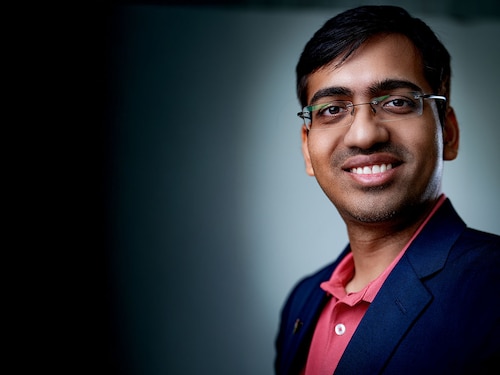
Pawan Kumar Chandana of Skyroot; Photo by Mexy Xavier
Advertisement
Q. When you started Skyroot, there was no ecosystem around it. You had no clue that the government was going to open the sector, and you didn’t exactly have the first-mover advantage. What made you go ahead anyway?
That is exactly what entrepreneurs are about, right? They take bold risks, and that is when you get benefits out of it. Though there were companies at that time, none of them would scale big. So I felt there is an opportunity to build the number one space company in India. And today we are the largest private space tech company in India with a team of almost 1,000 people, and two biggest factories in the country. It is easy to start a company when everything is there—policy, ecosystem and funding. It’s more difficult to start early. When we signed the first ever MoU with Isro, we became the first beneficiary of the space reforms. In that way, we had the early-mover advantage because of taking that risk early on. We put in all [our] energy, brought the best people together, and the best investors to make it big. That was the thought process there, and it worked out.
Q. You are working in the small satellite market. How much of that was influenced by commercial viability versus the desire for technological innovation. Is this an either-or situation?
The main consideration is commercial viability. Because the fundamental fabric of business is revenues and profits. We looked at an opportunity that does not require billion-dollar funding, but something which is lower for a private company to raise venture capital. In the market, we found that satellites were getting smaller. And what used to be like a big bus-sized satellite now has become a shoe-box-sized satellite. And many people require unique orbits—unique destinations in space. So they need to book a small rocket for launching these small satellites, just as we book a cab to go home, which can put it into the lower Earth orbit. Because more than 90 to 95 percent of satellites are below 500 kg… that is where we thought, let us build the smallest commercially viable rocket because it can have less investment, and then it will start getting into business, [make] revenues and profits. So, it’s highly commercially driven.
Q. What role do you prefer—engineer or entrepreneur?
Entrepreneur. I wanted to be one from childhood, because I used to look up to entrepreneurs who built India. It is true nation building. You can generate employment, you can create infrastructure, you can create world-class companies. The impact is much higher as an entrepreneur than being part of a team, for sure. Though being a scientist at Isro was fulfilling, being an entrepreneur is far more fulfilling and challenging.
Q. The whole idea behind Skyroot was reliable and economic access to space. How economical are your services?
So, in a market, there are big rockets and smaller rockets. A big one will cost something like $70 million. So if a customer wants to go to a unique destination in space, instead of booking a $70 million rocket to launch a small payload, they can book a rocket which is just a few million dollars. That is a big transformation we are bringing into the industry. We are targeting to be the lowest cost in the small rocket segment globally.
Q. How many bottlenecks did you have to face while pitching this idea to investors?
Building a rocket is rocket science, but raising capital was an even bigger rocket science, especially because this is a new sector. Investors are new to the sector. So getting them on board and explaining that this is possible, these are the risks that can be taken by VCs, private equity or angel investors and proving to them that this is not an industry for only the government. It has great commercial viability and a great commercial market. It is a strong learning curve. We didn’t have the time for that learning curve as well, because we had to move quickly as a company. So every round we raised was the largest round in the sector at that time. We had to break that glass ceiling at every round. In fact, until GIC led our Series B, 50 percent of our founders’ time went into raising capital. Only four or five investors, maybe 10 investors, ended up investing. Hundreds said ‘no’.
Q. What was your initial pitch to the investors like?
Our pitch has always been that space is the next frontier; it’s going to be a trillion-dollar industry. And then there will be very few companies in the world who can build this tech to this level of scale. So it’s a massive opportunity with high barriers of entry.
Q. Vikram I was initially slated for a 2024 launch, and later in 2025 and now again, it is scheduled for January 2026. Why the delay?
These are all target dates… we never gave a launch date. Even now, January is not the official launch date. It is all speculation so far, but we are getting close.
Q. What after Vikram II?
We have plans to build bigger, reusable vehicles, and we are making good progress.
Q. How far ahead is the reusable launch vehicle in the R&D pipeline?
Our mission at Skyroot is to open up space for all. So the step-by-step process is to build a large reusable vehicle. We knew it from day one. We have not been too public about it, but we have made, I think, good progress. And globally also, I think it will be competitive.
Q. In one of your interviews, you mentioned that talent acquisition and retention is a challenge in this sector. How are you planning to surmount this?
At Skyroot, we were able to acquire good talent. We took, I think, the early cream… and retained most of the talent. It’s not easy. One reason that helped us retain is [that] we grew very fast. People who are part of the growth feel that they are also significantly contributing to the space sector, and their contributions are showing in the form of company growth. Also, we have built fantastic infrastructure and made it a great place to work.
Q. How does unclogging space from debris and space junk fit in with your idea of democratisation of space?
Space sustainability has to be a part of every company. Because there are more things which will go into space. So every company should contribute to sustainability. For example, our rockets go to space, and the final stage of the rocket remains in space. Now we are figuring out technology to enable it to come back and burn down, so that it does not leave junk behind. And there are companies and technologies which see this as a business opportunity. Even space debris removal is a multibillion-dollar business.