Sunita Williams, the most experienced woman spacewalker, retires from Nasa
After a 27-year stint and several achievements, the Indian-origin astronaut calls it a day
By Samidha Jain
Last Updated: Jan 21, 2026, 14:52 IST3 min
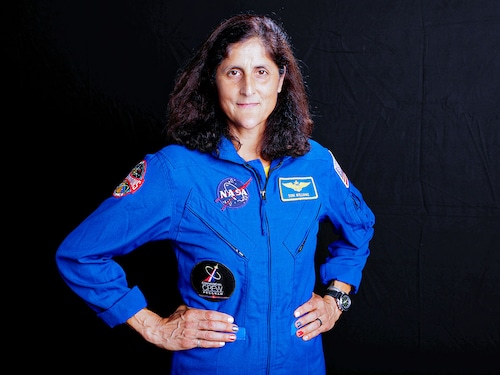
After 27 years at Nasa, the space agency on Wednesday announced the retirement of astronaut Sunita Williams. The retirement, effective from December 27, was months after Williams and her team returned to Earth after a space mission to the International Space Station (ISS)—the mission was initially planned for eight days but got extended to 286 due to a glitch with the spacecraft.
The retirement of Indian‑origin “Suni” Williams marks the close of an extraordinary career defined by record‑setting spacewalks, commanding roles aboard the ISS, and pioneering contributions to Nasa’s transition towards commercial spaceflight. Announcing her retirement, Nasa Administrator Jared Isaacman praised the 60-year-old as “a pioneer in human spaceflight”, noting that her leadership aboard the space station played a key role in advancing future exploration efforts and paving the way for commercial missions in low Earth orbit.
Born on September 19, 1965, in Euclid, Ohio, Williams comes from Indian roots. Daughter of Deepak Pandya, a Gujarati father from Jhulasan village in Mehsana district, and Ursuline Bonnie Pandya, a Slovenian‑American mother, she completed her schooling at Needham High School in 1983. Driven by an early fascination with aviation and engineering, Williams earned a Bachelor of Science in Physical Science from the US Naval Academy in 1987, followed by a Master of Science in Engineering Management from the Florida Institute of Technology in 1995.
Her military journey began in 1987 when she was commissioned as a US Navy ensign, soon advancing to become a Naval Aviator in 1989. She went on to serve in helicopter support squadrons during the Gulf War era, contributing to operations over Kurdish regions and later assisting in humanitarian relief efforts, including the Hurricane Andrew mission in 1992. In 1993, after being considered by the forces for her exceptional technical skill and versatility, she became a US Naval Test Pilot, flying more than 30 different aircraft.
Williams’ journey with Nasa formally began in 1998, when she was selected as part of Group 17, joining a cohort of astronaut candidates undergoing some of the most rigorous training in the world.
A defining component of her early years was the extensive robotics and ISS-systems training she undertook in Moscow, where she collaborated closely with the Russian Federal Space Agency (Roskosmos). This period immersed her in the operational technologies of the ISS, from robotic arm handling to international docking systems, while also preparing her to work seamlessly with multinational crews.
During this formative stage, Williams also trained in a range of mission-critical disciplines at Nasa’s Johnson Space Center, including Extravehicular Activity (EVA) procedures, spacecraft systems engineering, survival training, and advanced physical conditioning.
By the time she completed her candidate training, Williams had established herself not only as a technically exceptional astronaut, but also as a collaborative leader within Nasa’s multicultural astronaut corps, laying the groundwork for her future roles as flight engineer, ISS commander, and long‑duration crew member.
Williams is often referred to as the most experienced female spacewalker in history. In a career that spanned almost three decades, she achieved a whole lot of milestones for Nasa and for the world’s space endeavors. Following are a few significant ones:
First Published: Jan 21, 2026, 14:58
Subscribe Now