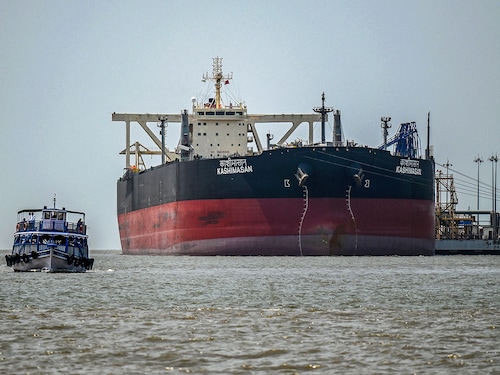
The world’s energy markets were the first to fall when the war erupted in Iran. Now in its second month, the conflict is escalating beyond petrol price hikes, triggering a slew of economic pressures for India, one of the world’s largest crude oil importers. Growth forecasts are being trimmed, inflation risks are flashing red, the import bill is set to rise, and the government is staring at a fiscal burden of nearly Rs 2 lakh crore.
No single indicator captures the scale of the disruption better than the oil price uncertainty index. Through much of 2024, the index fluctuated between 17 and 160, reflecting a market that was nervous but not panicked. By December 2025, it had climbed to 208. Then, in March 2026, it surged to 773.5, nearly four times the December peak and a reading with few historical precedents. The reading signals that markets have rarely, if ever, been this unsure about where crude prices are headed. And because it takes time to restore capacity and there is the constant threat of new disruptions, analysts predict that energy prices will likely remain high even if the conflict eases in early FY27.
Sehul Bhatt, director at Crisil Intelligence, says that “In March, Brent crude increased to $110–120 per barrel, while spot prices of Asian liquefied natural gas nearly doubled to $20–25 per MMBtu,” and suggests that even though there are early signs of “demand moderation”, supply uncertainty and logistics constraints are keeping import costs elevated.
He also warns that normalisation after the conflict ends would not be swift. “A return to normalcy for global gas supply may take longer than for the oil market, considering operational challenges. That will keep prices in check during the first quarter of fiscal 2027.”
Chief Economic Advisor V Anantha Nageswaran echoed this caution in the Finance Ministry’s March economic review, noting that policy planning must account for the physical damage to energy infrastructure.
“The critical question is the extent of damage to energy sites and the effort required to restore normal supplies,” he wrote. “That determines how quickly prices drop, even if the Strait [of Hormuz] reopens promptly.” Nageswaran advised a conservative approach, stating it is “prudent to assume a slow, gradual restoration of ‘business as usual’ in the Gulf rather than an accelerated one.”
Growth forecasts take a hit
The spillover into India’s growth trajectory has been swift. Goldman Sachs has trimmed its FY27 estimate from 6.4 percent to 5.9 percent citing a “terms-of-trade drag” and disruption-driven shortages. Nomura has pulled back from 7.1 percent to 7 percent, and ICRA has revised downward from 7.1 percent to 6.5 percent. The CEA’s own office, which had on February 27 upgraded India’s FY27 growth estimate to a range of 7.0–7.4 percent, is now confronting significant downside to those projections. “Clearly, there is considerable downside to this number,” Nageswaran noted.
ICRA’s scenario analysis lays out the stakes starkly. At $85 per barrel, the baseline, GDP growth in FY27 holds at 6.5 percent, retail inflation stays near 4.3 percent, and the current account deficit remains contained at 1.7 percent of GDP. At $125 per barrel, GDP growth falls to 5 percent, inflation approaches 5 percent, and the current account deficit stretches to 3.1 percent of GDP.
While agencies like Fitch Ratings initially raised India’s FY27 growth forecast to 6.7 percent based on infrastructure and investment-led gains, the tone has shifted to one of “heightened downside risks”. “Large net fossil-fuel importers, including India, would face the sharpest deterioration in external balances and real incomes if energy prices rise and shipping disruptions persist,” warns Jeremy Zook, senior director at Fitch Ratings.
The macro squeeze: Inflation, trade, CAD and the Rupee
Inflation, which appeared contained in early 2026, is perhaps the most consequential risk of the war. Data from Fitch Ratings places India at the top of a grim leaderboard: in an adverse scenario, India faces the steepest inflation shock among 20 major economies—a 2.7 percentage point rise after four quarters. The delayed nature of the shock makes it especially dangerous as by the time it peaks, the damage to growth will already be deeper than headline annual averages reveal. India’s consumption basket, heavily weighted towards food and fuel, makes it structurally more exposed than most peers to an oil shock.
Other countries with a high inflation risk include Turkey at 2.2 points, Poland at 2.1, the United States at 1.4 and China at 1.3 points.
Analysts expect headline inflation to average 4.6 percent for the year, potentially peaking in Q4FY27 as higher manufacturing input costs feed into core goods with a lag. Madan Sabnavis, chief economist at Bank of Baroda, notes that the upper range of 5 percent inflation is likely, especially with the “emerging El Niño weather pattern” threatening food prices.
Nageswaran acknowledged the monetary policy dilemma this creates. If demand moderates in response to higher prices, the RBI would be “more inclined to treat the inflationary impact as a supply shock.” But if demand holds firm, the central bank “may be compelled to watch for second-round effects of higher import costs on inflation and respond accordingly.”
The external sector is also perhaps another casualty. India’s current account deficit (CAD) is forecasted to widen to 2 percent of GDP. Vishrut Rana, senior economist at S&P Global Ratings, points out that while India’s narrow CAD in recent years provides a buffer, the loss of export revenue and a hit to almost 40 percent of remittances coming from West Asia will add severe strain.
The pressure is compounding on the trade front as well. India’s merchandise imports are projected to jump 16.5 percent to $210 billion in Q1FY27, driven by West Asia tensions pushing up prices of crude oil, coal, and other commodities according to a note by CMIE. Freight costs are also expected to double, with higher insurance and rerouting expenses adding further pressure on import bills.
These twin pressures, a widening trade deficit and dwindling remittances, are now spilling into financial markets. “The Indian Rupee is among the most affected currencies,” Rana notes, as foreign portfolio outflows and the energy shock weigh on the exchange rate. Foreign investors pulled a record Rs 1.6 lakh crore from Indian stocks in FY26 due to geopolitical tensions, costly valuations, and a weakening Rupee, even as heavy domestic buying softened the blow.
Meanwhile, data for March shows that the war in West Asia is adding pressure on an already-fragile Indian currency. India’s Rupee fell against every major currency in March—down 3.5 percent against the US dollar and UAE dirham, 2.6 percent against the pound and 1.7 percent against the yen.
The fiscal arithmetic
The war’s impact is not abstract—it is being felt at kitchen counters and auto-rickshaw queues across the country. So, to shield consumers, the government has moved aggressively, reducing excise duties on petrol (from Rs 13 to Rs 3) and diesel (to nil).
On aviation, the government has imposed a 25 percent cap on the monthly increase in Aviation Turbine Fuel prices for domestic operations. For industry, commercial LPG supply is being maintained at over 80 percent of pre-crisis levels, and piped natural gas is being actively promoted as a reliable industrial alternative wherever feasible.
However, this proactive step comes with a steep price tag—a projected revenue loss of Rs 1.3–1.4 lakh crore, which could widen the fiscal deficit by 0.4 percent of GDP, according to Sabnavis.
Meanwhile, CareEdge estimates an additional fiscal burden of Rs 1.9 lakh crore—roughly 0.5 percent of GDP—in FY27, comprising Rs 1.1 trillion in net revenue foregone from excise duty cuts, Rs 0.38 trillion in additional fertiliser subsidies, and Rs 0.4 trillion in revenue lost from lower tax collections. Though cutting excise duties is politically necessary, it narrows the fiscal space available for capital or other developmental expenditure.
This fiscal burden is a shared one. While the duty cuts provide relief, the government has also imposed export duties on diesel (Rs 21.50/litre) and ATF (Rs 29.5/litre) to ensure domestic availability. “The benefit of this reduction will go to the OMCs who have been bearing the higher cost with under-recoveries increasing,” says Sabnavis, noting that retail prices will remain unchanged to prevent a direct inflationary spike.
What of India Inc?
For India’s corporate giants, the story is one of strong balance sheets meeting supply-side challenges. Neel Gopalakrishnan, an analyst at S&P Global Ratings, observes that “Indian corporates, in general, have adequate cushion to withstand higher energy prices... supported by significant deleveraging since the Covid period.” For instance, engineering giant Larsen & Toubro reported no major business disruption last month, with a top official reportedly confirming that nearly 95 percent of its Middle East projects remained operational. However, the firm did flag “logistical and supply-side challenges” and potential revenue risks if the regional instability persists.
But the outlook isn’t universally positive. Despite the overall strength of corporate India, Gopalakrishnan says that the cushion is thinner in energy-intensive fields which are particularly vulnerable to earnings volatility and increased leverage like chemicals, cement, steel, metals, mining, auto and pharmaceuticals.
This divergence is further underscored by Crisil’s sectoral analysis, which noted that domestic production of urea and complex fertilisers could dip by 10–15 percent due to raw material shortages at a crucial time for the kharif season. The government’s subsidy bill is expected to balloon by Rs 20,000–25,000 crore to absorb rising costs.
Nitin Bansal, associate director at Crisil Ratings says that “Factoring in the elevated input costs and imported fertiliser prices for a quarter, the overall subsidy budget is likely to increase by 12-15 percent from initial estimates of Rs 1.71 lakh crore for FY27”.
However, the Finance Ministry has moved quickly to cushion the industrial and investment impact of the war. A full customs duty exemption has been issued on 40 critical petrochemical products until June 30, 2026, and a special one-time relief measure has been announced for eligible SEZ units to sell manufactured goods in the Domestic Tariff Area at concessional customs duty rates, effective April 1, 2026 to March 31, 2027. These steps are designed to reduce cost pressures on downstream sectors including textiles, packaging, and pharmaceuticals.
In a move aimed squarely at investor confidence, a clarification has been issued that the provisions of the General Anti-Avoidance Rule will not be invoked in respect of investments made prior to April 1, 2017.
Four channels of economic pain
The CEA’s framework for understanding the war’s economic impact on India identifies four transmission channels—supply disruptions to oil, gas, fertilisers, and exports, higher import prices, elevated logistics costs including freight and insurance, and a possible decline in remittances from the Indian diaspora in Gulf countries. He noted that the combined impact of these channels on India’s economic fundamentals is “likely to be significant”.