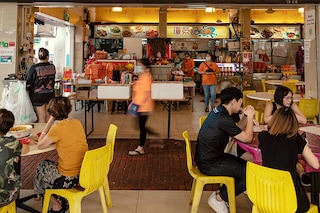
“Our parents never wanted us to join them because the hawker business meant long hours, hard work and little pay. They sent us to university in the hopes that my brother and I would become a doctor or banker. But this is our muscle memory, it’s in our blood," says Liew. The once-tiny hawker stall that started in the 1970s has since grown into one of the island country’s most famous beacons of Singaporean cuisine, recognised on Michelin’s Bib Gourmand list for its “particularly delicious stir-fries" and frequented by everyone—from the late Antony Bourdain to award-winning chefs such as Jose Andreas, Massimo Bottura and others.
The secret to success, Liew says, has been KEK’s ability to retain the soul of their home-style Malay-Chinese cooking, while being cognizant of the tastes and preferences of younger audiences. New updates to the menu include pork ribs caramelised in coffee, deshelled crispy butter prawns served with fried garlic and fluffy steamed and fried mantou bread to mop up their version of the Singaporean sweet-sour-spicy chilli crab.
This sentiment—of reclaiming the past to create new meanings—is personal to Liew and his brother Wayne, but it’s also one that’s sweeping across the Lion City.
A few decades ago, Singapore’s F&B scene comprised old-school hawkers and big-name international chains, leaving a wide open space for businesses that blend local flavours and modern techniques. Thanks to the efforts of local hawkers and food entrepreneurs, next-generation Singaporean cuisine is coming to stand for the evolution of tastes and attitudes the island country is seeing when it comes to all things homegrown.
It helps that official authorities are providing these entrepreneurs with the right jet fuel—resources like capital and business incentives—to take off. In 2020, thanks to the efforts of Singapore’s National Heritage Board, the country’s hawker culture was recognised by Unesco as an Intangible Cultural Heritage of Humanity, to preserve and protect Singapore’s community dining rooms and their cuisine. “The Unesco acknowledgement put a very everyday thing into a frame of reference worth appreciating," says Singapore Tourism’s Renjie Wong, while explaining that, in Singapore, hawker cuisine is Singaporean cuisine to the locals.
Other external forces are at play too. Singapore has been working hard to position itself as a luxury travel destination. In 2018, it inked a multi-year partnership with the 50 Best brand to “spur industry and capability growth and development for F&B enterprises". This year, Singapore played host to the World’s 50 Best Restaurants and World’s 50 Best Bars award ceremonies that helped introduce an international community of chefs, bartenders and media to the country’s local F&B stars, building Singapore’s image as a culinary hotspot.
Debbie Yam in front of her hawker stall. Image: Smitha Menon
Organisations like 50 Best and the Michelin Guide are recognising homegrown dining establishments outside of the white tablecloth and gleaming silverware definition of a restaurant, thus helping create culinary maps for tourists to navigate. Via properties like Michelin’s Bib Gourmand—which describes its recognition as “not a star, but a just-as-esteemed rating that recognises friendly establishments that serve good food at moderate prices"—and 50Best Discovery that puts together a “diverse range of expert-recommended restaurants and bars across the world", businesses such as KEK are enjoying their time in the spotlight. Earlier this year, Michelin’s 79 Bib Gourmand locations in Singapore included 53 hawker centre stalls and five street food establishments.
“For the longest time, our traditional food was seen as static and traditional. What we’re seeing now is innovation that is respectful of the past but also makes sense as an evolution, for the cuisine to move forward. I think this could be the next wave of how we eat in Singapore," says Wong, who helped bring KEK to Mumbai for a pop-up earlier this year, to familiarise urban diners with the institution"s signature dishes.
Playing with fire
While entrepreneurs like KEK have demonstrated commercial success, the hawker business is not without its challenges. For most next-gen owners, Singapore’s rising costs and labour shortages make the experience tough. Debbie Yam, 33, of Tang Kay Kee Fishhead Bee Hoon—located in Singapore’s Central Business District—feels the heat every day. Quite literally.
“I try not to burn myself with all the big fires," jokes Debbie, a wok-wielding fourth-gen hawker who is trying to preserve Singapore"s culinary heritage through more inter-generational dialogue. The stall was founded by her great-grandfather in 1946 as a means to make a living but, by 2016, the family was struggling to keep it afloat. Seeing the business opportunity the stall’s location provided, Debbie, a marketing professional, quit her job and began pivoting the family business to serve suits who came over to dine over lunch. Deprioritising the more labour-intensive dishes on the menu, she has introduced new-age lunch bowls of home-cooked Chinese food, where novel ingredients like creamy sous-vide egg and batter-fried enoki mushrooms jazz up a classic flat noodle dish.
“We have customers who come in and tell me they came here to eat as kids with their grandparents. It’s very heartwarming to hear. It’s this sense of community and coming together over a meal that keeps me going," she says. To pass on her passion for the hawker business, Debbie works with the prestigious National University of Singapore and hosts hawker internships via schools to allow teenagers a chance to sample the hawker life. “We must keep our culture alive, for the sake of our future generations," she says.
Celebrating Tradition
A Singapore pioneer in traditional Cantonese pastries since 1935, Tong Heng faced the familiar challenge of staying relevant in an increasingly fast-paced world. Tong Heng specialises in kueh, bite-sized snacks or desserts native to Southeast Asia and China that comprise all manner of goodies such as egg tarts, barbecued pork buns, mooncakes and lotus salted egg pastry that are fast-disappearing from Singapore’s dining scene, owing to the labour-intensive process of making them.
A few years ago, fourth-generation owner Ana Fong realised the average age of her patrons was over 40 and that, over time, it would hurt the business. Working with a design agency, Tong Heng undertook an extensive multi-phase rebranding exercise to embrace a modern identity via its pastry offerings, redesigned packaging and a revamped store design that connects the brand with a younger generation while staying true to their heritage. The result is a pop-coloured, uniquely designed bakery with 60’s-inspired terrazzo countertops and an intricate mirror sketch of a river valley, with motifs that blend traditional Chinese pastry, Feng Shui and other elements of Tong Heng’s 88-year-old heritage. When I visit, two young girls on the table next to me snap up a few quick selfies with the iconic diamond-shaped egg tarts Tong Heng is known for, before digging into them. Ana’s hunch was right—Tong Heng’s goodies and history are too important to deny.
Inside Tong Heng"s revamped pastry shop.
Across Singapore, approximately 130 brands—including Tong Heng—have been recognised as ‘Made With Passion’ businesses. Jointly led by Singapore Tourism Board and Enterprise Singapore since 2019, Made With Passion is a national marketing initiative to promote consumer awareness and appreciation for homegrown lifestyle brands. The brand mark can be found on select Singaporean brands’ products, packaging and stores and helps Tong Heng wear its heritage badge with pride while attracting new audiences and old fans alike.
Close by, Kelvin Toh Aik Leong, another kueh business owner, is trying to pass on a love for the traditional munchies to the next generation by training new talent to handcraft delicate delights. “Until a few years ago, my dad was still using a fax machine. Vendors would call saying they were running around town trying to find functional fax machines," laughs Kelvin, the second-generation owner of Ji Xiang Aung Ku Kueh.
Kelvin Toh Aik Leong and his mother outside their family shop in Everton.
Traditionally, aung ku kueh, which translates to red tortoise cakes in Hokkien, are celebratory sweetmeats, passed around to loved ones during a celebration. Much like Indian mithai, boxes of aung ku kueh are handed out with wedding invitations or to announce the birth of a child. “Kueh was seen as an old person thing, so we had to reinvent ourselves. We started making them with new fillings like peanut and durian, got on social media and even introduced new products like rainbow-coloured ang ku kueh, which were a hit with the LGBTQ+ community," says Kelvin.
Apart from product innovations, Kelvin has made technical improvements within his industrial kitchen to streamline processes and is now launching a professional training course to help create a new generation of traditional pastry chefs. “So whenever someone tells me my pricing is too expensive, I will invite them for a free course to come and learn how to make it, so they learn to appreciate this skill. Much of our job is education. Only if someone understands the story behind kueh will one buy and appreciate it," he says.
A new way forward
At Amoy Street Food Centre’s A Noodle Story, wanton noodles, a Singapore hawker speciality, gets a modern makeover at the stall run by Gwern Khoo and Ben Tham. Using ramen techniques from Japanese cuisine and the skills they honed at Singapore’s top fine dining establishments, Gwern and Ben layer their Singaporean-style noodles with sous vide marinated pork belly, a soft-boiled egg, plump pork dumplings and rich umami cha-su sauce. Customers line up for a slurp of the good stuff, while fragrant aromas float from the tiny kitchen into the main centre. Since 2016, A Noodle Story has been receiving a Michelin Bib Gourmand nod, the new stamp of approval for many street food hawkers looking to take their businesses to the next level. They’ve since expanded to a spiffy mall outlet and brought on staff to help with marketing, operations and social media. The stall’s name, A Noodle Story, references the “first chapter" in what the founders believe will be the new way forward for local Singaporean cuisine.
A Noodle Story"s stall at Amoy Food Centre. R: The signature Singaporean-style ramen at A Noodle Story.
As tough as Covid was for the F&B sector around the world, for many, it provided an opportunity to experiment with offerings and business plans. According to those in the know, this led to much of the new-age innovation now seen across Singapore’s hawker scene. “Earlier, one would only see traditional food—Indian, Malay, Chinese or Singaporean dishes—at hawker centres. But during the pandemic, many hawkers began testing the market with things like flavoured coffees, hybrid croissants and even Singaporean pizza. We’re now seeing the beginning of a new phase of hawker cuisine and that is very interesting," says KEK’s Paul. “But what will remain the same is our respect for our heritage and our love for coming together around the table to have a good time," he concludes.