Earlier this week, India’s Chief Economic Adviser Dr V Anantha Nageswaran suggested the economy could grow closer to 7.4 percent following the US tariff reduction to 18 percent, but most economists are holding their official forecasts pending clarity on the trade deal’s fine print. Nageswaran told Bloomberg Television on February 3 that growth could approach the government’s earlier 7.4 percent estimate, revising upward from his economic survey forecast of 6.8 to 7.2 percent, released last week. “That could be my first guess, but I need to go back to my spreadsheets,” he said.
Cautious optimism from economists
However, many economists are taking a more measured approach. Madan Sabnavis, chief economist at Bank of Baroda, said the bank would not revise its 7-7.5 percent forecast for FY27, which already encompassed scenarios ranging from no deal to a full agreement. “While we had estimated potential loss of 0.2-0.4 percent when the 50 percent tariff was announced in August, we did see that exports have not really been affected much as there was frontloading as well as re-routing of exports to USA,” he said.
He added that while the upside from lower tariffs may be limited, it could, theoretically add around 0.2 percent to GDP at most. Sabnavis also flagged uncertainty around the US claim that $500 billion of American exports would flow to India. “This can affect local production and hence there can be downward pressure on growth. But this is conjecture right now.”
Sonal Varma, managing director and chief economist at Nomura, maintained her baseline GDP growth forecast of 7.1 percent for FY27. She explained that while the US trade deal offers potential upside, the downside to FY26 GDP growth was already limited due to export diversification by Indian companies. “We see more medium-term benefits for India, as it integrates into both US and EU-centric supply chains,” she said. However, she cautioned that the GDP series rebasing (shifting to a 2022–23 base year) scheduled for February 27, 2026, introduces statistical uncertainty into current growth projections.
Aditi Nayar, chief economist at ICRA, said the ratings agency is waiting for “finer details” of the trade deal to revisit its forecasts. “As of now, we expect it to positively impact India’s FY2027 GDP growth,” she said. CareEdge Ratings offered the most concrete revision. Rajani Sinha, chief economist at CareEdge, said the tariff reduction could add approximately 20 basis points to GDP growth, upgrading the FY27 GDP growth forecast to 7.2 percent from an earlier estimate.
Also Read: How the India-US deal played out through a year of ups and downs
Broader economic implications
Economists noted that easing trade uncertainties could support foreign investment inflows and provide greater stability to the rupee, enabling the Reserve Bank of India (RBI) to support government borrowing and domestic liquidity through increased open market operations. “This could allow the RBI to scale back its forex interventions, which had intensified over the past few months amid heightened volatility,” Sinha added.
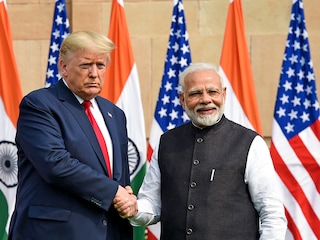
The US and India announced a landmark trade reset late Monday evening slashing tariffs on most Indian goods from 50 percent to 18 percent. This 32 percentage-point drop provides critical relief to India’s labour-intensive sectors like textiles, gems, and leather, which had struggled under punitive duties.
President Trump highlighted a massive $500 billion Indian purchase pledge and a move toward “zero” reciprocal tariffs. He also claimed that New Delhi had committed to halting Russian oil imports in favour of American and Venezuelan fuel. Indian markets rallied on the news, with the rupee posting its biggest gain in more than three years and stocks jumping the most since 2021 on Tuesday.
Read More
Though India has not formally commented on the reduction in Russian oil imports yet, Commerce Minister Piyush Goyal informed Parliament on Wednesday that ensuring energy security remains the government’s “supreme priority”. He clarified that India’s energy strategy focuses on diversifying sources based on market conditions and global shifts.