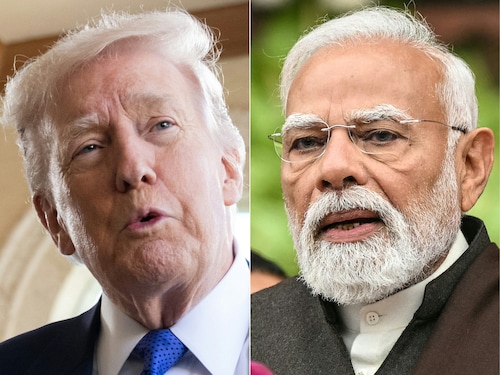
The big-bang announcement came the way many things from US President Donald Trump do: on social media.
Soon after, a post from Prime Minister Narendra Modi confirmed the deal. “Wonderful to speak with my dear friend President Trump today. Delighted that Made in India products will now have a reduced tariff of 18%. Big thanks to President Trump on behalf of the 1.4 billion people of India for this wonderful announcement,” the PM posted on X, the social media platform.
Apart from signalling an easing of tensions between the two major economies, the agreement alters India’s trade position. Once among the most-tariffed, Indian exporters now find themselves a tad better placed than their competitors from Vietnam and Bangladesh, on which the US levy remains near 19 percent. The change eases pressure on Indian manufacturers exporting everything from textiles to gems and jewellery to the US market.
Days earlier, India concluded a trade agreement with the European Union, capping years of negotiations. Taken together, the two deals point in the same direction: India is moving quickly to secure access to its largest export markets even as global trade becomes more fragmented.
Trump, though, framed the deal as a rebalancing of trade in America’s favour, saying India had agreed to expand its purchases of US goods, particularly in energy, agriculture and technology, and agreed to stop buying Russian oil and, instead, to buy much more from the United States and, potentially, Venezuela.
“They (India) will likewise move forward to reduce their tariffs and non-tariff barriers against the United States, to ZERO. The Prime Minister also committed to "BUY AMERICAN," at a much higher level, in addition to over $500 BILLION DOLLARS of US Energy, Technology, Agricultural, Coal, and many other products,” Trump posted.
There was no confirmation from India on the details at the time of writing this copy.
After Monday's announcement, Commerce Minister Piyush Goyal said the deal unlocks the power of two large democracies working together. "Both India and US are natural allies and our partnership will co-create technologies, co-develop solutions, and work together for peace, growth, and a brighter future for India and US," Goyal posted on X.
The agreement, he said, would unlock unprecedented opportunities for farmers, MSMEs, entrepreneurs, and skilled workers to Make in India for the world, Design in India for the world, and Innovate in India for the world. "It will help India get technology from the US. It is not just a trade deal—it is a historic turning point that will reshape India-US relations and accelerate our journey towards Viksit Bharat 2047."
Kumar Mangalam Birla, the Aditya Birla Group Chairman, applauded the announcement. “The reduced tariffs will help strengthen the strategic and economic ties between our two great countries and provide additional opportunity for investment and collaboration,” Birla said in a statement emailed by his team.
The Aditya Birla Group has invested more than $15 billion in the US and is India’s largest investor in the world’s largest economy. “We see this agreement help shape more resilient supply chains, unlock manufacturing opportunities and drive long-term economic competitiveness in both the US and India. We are committed to expanding our presence and investments in the US, where we see substantial opportunities for innovation, growth and enduring partnerships,” Birla said.
The trade agreement lands against a broader push by India to court US investment. Even outside the deal, New Delhi has begun easing taxes in new areas drawing strong interest from US companies.
In the Union Budget presented in Parliament on Sunday, the finance minister announced a 20-year tax holiday for foreign companies providing global cloud services from data centres located in India.
Mother of All Deals
By locking in arrangements with the European Union and Washington in quick succession, India reduces its exposure to trade shocks from any single bloc and strengthens its leverage with all of them.
For Indian exporters, the immediate benefit is certainty. After months of shifting trade policy, predictability itself has value. Lower US tariffs remove a persistent drag on competitiveness, particularly for labour-intensive sectors and manufacturers operating on thin margins.
The gains, however, are unlikely to be uniform. The final impact will depend on sector-specific rules and how quickly tariff changes are implemented. Still, paired with the EU agreement, the deal improves India’s odds of turning export growth into a more meaningful contributor to the economy.
India’s economy has been expanding faster than most major peers, driven largely by domestic demand and public investment.
Diplomatic Push
India’s trade deal with the US comes weeks after Trump ally Sergio Gor assumed his role as the US’ ambassador to India. In his first speech after taking charge, he had said: “Both sides continue to actively engage. In fact, the next call on trade will occur tomorrow. Remember, it is the world's largest nation; So it's not an easy task to get this across the finish line, but we are determined to get there.”
He also said India would be invited to join Pax Silica, a US initiative to build supply chains for artificial intelligence and other advanced technologies to counter China’s dominance in those areas. Gor described the countries’ ties as “the most consequential global partnership of this century.”