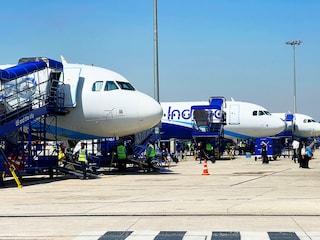
IndiGo’s meltdown this week didn’t just delay flights, it also caught travellers, regulators and the airline off guard. What began as a scheduling hiccup turned into a national talking point.
What happened?
IndiGo cancelled or delayed more than 200 flights on December 3, stranding passengers across major airports. India’s largest airline by market share, which runs around 2,300 flights daily, blamed “unforeseen operational challenges”—from winter congestion and tech glitches to new flight duty time rules that disrupted crew rosters, according to a public statement it made.Government data shows IndiGo’s punctuality collapsed to 35 percent on Tuesday, meaning more than 1,400 flights were late. The disruptions prompted protests at airports and, as reported by Reuters, intervention from the Directorate General of Civil Aviation (DGCA), which has sought an explanation and mitigation plan from the airline.
Passengers Angry
Social media was flooded with videos of passengers shouting at the staff, chanting slogans and demanding answers at terminals in Delhi, Mumbai and Bengaluru. One Delhi flight to Rajkot was delayed by six hours, pushing the 5:40 am departure to 11:30 am, prompting passengers to protest at boarding gates.At Mumbai airport, flyers waited for five to eight hours before being sent back. “IndiGo6E continues to disappoint with delayed/cancelled flights. Not a single top-level representative is at the scene to handle the situation,” posted a Mumbai traveller, adding that people threatened not to let flights depart until the staff gave them clarity.
Another flyer wrote, “My @IndiGo6E flight is delayed for hours and passengers are stuck with no clear communication. I even have a video of people raising concerns. This needs urgent attention.”
At Bengaluru Airport, 62 IndiGo flights were cancelled for a second consecutive day, while Hyderabad saw 31 cancellations and Delhi 37. Airports were overcrowded, with queues snaking through terminals and families stranded for hours.
Read More
Also Read: Airbus software glitch fiasco: Around 6000 flights disrupted globally
The trigger: New flight duty time norms
India’s updated Flight Duty Time Limitations (FDTL) seems to be one of the reasons for the delays and cancellations."A multitude of unforeseen operational challenges, including minor technology glitches, schedule changes linked to the winter season, adverse weather conditions, increased congestion in the aviation system and the implementation of updated crew rostering rules (Flight Duty Time Limitations) had a negative compounding impact on our operations in a way that was not feasible to be anticipated," the airline's official statement read.
Flight Duty Time Limitations
Introduced in phases from July 1 and November 1, the new FDTL require longer rest hours to reduce pilot fatigue. Airlines must now ensure:- A maximum flying limit of eight hours per day, 35 hours per week, 125 hours per month and 1,000 hours annually.
- Rest equalling twice the flying time, with a minimum of 10 hours within any 24-hour cycle.
- Forty-eight consecutive hours of weekly rest.
- No more than two night landings per crew between midnight and 6 am, down from six.
These norms were a result of industry concerns about rising safety risks. A Safety Matters Foundation survey in July found pilots reporting “unsafe flying conditions” arising from fatigue-inducing rosters. Regulators concluded that fatigue was impairing alertness and performance, directing the change.Why IndiGo was affected
IndiGo carries the highest domestic market share and flies the most sectors in India. More flights mean more crew cycles, and, therefore, more exposure when rest rules tighten.The DGCA’s own tally, reported by PTI, shows:
- IndiGo recorded 1,232 cancellations in November.
- 755 were tied to crew or FDTL limits.
- 258 stemmed from airport or airspace restrictions; 92 from ATC failures.
The airline’s on-time performance fell to 67.7 percent in November from 84.1 percent in October, according to the regulator. This plunged to around 35 percent on December 3.Pilots blame IndiGo created its own storm
The Federation of Indian Pilots (FIP), however, rejected the airline’s claims by issuing a statement that IndiGo’s failures “cannot be attributed” to the new regulations. They said:- IndiGo followed a “lean manpower strategy” despite a two-year warning period.
- The airline imposed hiring and pay freezes and non-poaching pacts.
- Pilot leave quotas were reduced after July, and an attempted leave buyback after November “damaged morale”.
- Executives received “record increments approaching or exceeding 100 percent” even as staffing was constrained.
The FIP alleged that IndiGo expanded its winter schedule without hiring or training enough pilots, calling the situation “avoidable” and urging DGCA to approve winter schedules only when airlines prove adequate staffing.The group warned that slot reallocations to rivals such as Air India or Akasa may be warranted if IndiGo “continues to fail in delivering”.
Fatigue versus planning
The DGCA maintains that pilot rest rules are a safety necessity. But IndiGo and other airlines sought delays earlier this year, citing crew availability challenges.The regulator eventually allowed a phased rollout after direction from the High Court, first in July and then November. It is now demanding that IndiGo strengthens its rostering, ATC coordination and disruption handling.
What happens next?
IndiGo says its network stabilisation plan will run at least 48 hours, while the DGCA investigates and monitors corrective actions. The disruptions also affected market sentiment with the parent company, InterGlobe Aviation, shares opening nearly 2 percent lower on December 4.The IndiGo crisis shows how tighter crew-rest rules can collide with tight airline staffing and scheduling. Whether this was unavoidable, or a planning shortfall is unclear. However, it has exposed the need for airlines and regulators to rethink how India scales air travel without compromising on punctuality or safety.