Why we need to redefine corporate performance
The impact of a business needs to be evaluated across all capital—financial, natural, human and social
By
Prefer us on GoogleLast Updated: Jun 18, 2019, 09:08 IST4 min
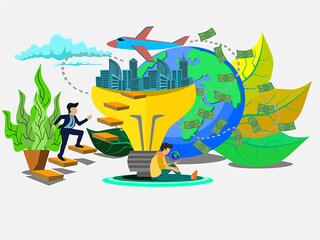
‘Integrated Profit and Loss Reporting’ or IP&L, evolved as a corporate initiative in sustainability leadership in response to the publication of the ‘Integrated Reporting Framework’ by the International Integrated Reporting Council (IIRC) in 2013. It called for the need to take a wider ‘stakeholder’ view of corporate performance.
This approach has been used by many sustainability leaders around the world, including AkzoNobel (a European chemicals giant, in 2014), Amata (a forestry company in Brazil, in 2015), Yarra Valley Water (Melbourne’s water utility, in 2016) and Sveaskog (Sweden’s largest forest owner, in 2018). IIRC’s thinking extends to all capitals the logic of the Natural Capital Protocol, a universal process guideline and framework prepared by the ‘Natural Capital Coalition’, a large community of practice that evolved from the UN-backed The Economics of Ecosystems and Biodiversity (TEEB) project on natural capital to help businesses discover and measure their impacts and dependencies on natural capital.
This framework for the micro-economic level uses only four broad classes of capital, wholly consistent with mainstream literature in environmental economics as well as the ‘inclusive wealth’ approach adopted by UN in their Inclusive Wealth Report (which provides multi-capital analysis of national performance). In the foreword, Partha Dasgupta, a leading economist who pioneered the recognition of non-financial ‘capitals’ in modern economics, explains the four capitals thus:
“Inclusive wealth is the social value of an economy’s capital assets. The assets comprise (i) manufactured capital (roads, buildings, machines, and equipment), (ii) human capital (skills, education, health), and (iii) natural capital (sub-soil resources, ecosystems, the atmosphere).
Such other durable assets as knowledge, institutions, culture, religion—more broadly, social capital—were taken to be enabling assets that is, assets that enable the production and allocation of assets in categories (i)-(iii). The effectiveness of enabling assets in a country gets reflected in the shadow prices of assets in categories (i)-(iii)”
Some commentaries refer to ‘intellectual capital’ as a separate capital class but is in fact always embedded into assets (e.g. software, patents, licences, Wikipedia) which are part of another class of capital (produced or human) so it is not necessary to create a separate ‘capital class’ to capture ‘intellectual capital’.
Community-owned wealth is referred to as ‘club goods’ which has shared ownership rights and the ability to exclude others from accessing or benefiting from their club goods. This is not the case for public goods, which no one can be prevented from using, and use by one party does not prevent use by another. While capital classes are widely considered by corporate managers when evaluating externalities, more attention needs to be paid to ownership categories because there is no ethical basis to “set off” the impacts on the health or wealth of one community or owner with that of another owner or community.
A leader in sustainable business, Yarra Valley Water, which published its Integrated Profit and Loss in 2016, has since moved ahead with using these metrics to target a doubling of its social capital creation. Furthermore, their capital impacts are also expressed in terms of the impact of their programmes and business model features on the Sustainable Development Goals. The company thus is able to see its impacts across shareholder and stakeholder value not only in terms of the four capitals, but also in terms of social value delivered towards various SDGs. This is truly the future of performance reporting and sets a model that will help make companies future-fit, ready for tomorrow’s VUCA (volatility, uncertainty, complexity, and ambiguity) world.
First Published: Jun 18, 2019, 09:08
Subscribe Now