EV industry has crossed early adoption level, but infra remain problematic
Auto industry experts at Global Electrification Mobility Summit discussed infrastructure gaps, policy coordination, and grid readiness as next steps to scale EV adoption in India
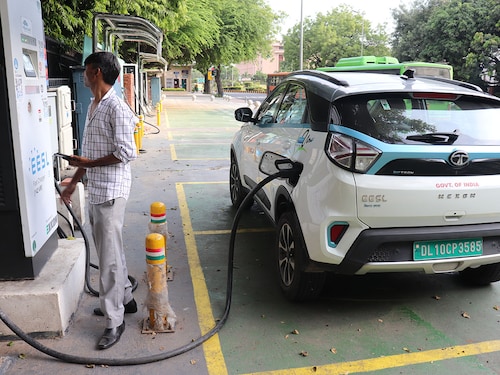
Expansion of charging networks will require planning beyond vehicle deployment, particularly around electricity distribution capacity and load management. Photo by Kain Kaushik/Shutterstock
Advertisement
India’s electric vehicle (EV) transition is moving beyond early adoption, but expanding charging infrastructure, strengthening domestic manufacturing and ensuring policy coordination across sectors remain key challenges, said industry leaders and policymakers at the fifth Global Electrification Mobility Summit (GEMS) on Tuesday.
The discussion has shifted from whether EV adoption will occur to how quickly the ecosystem can scale sustainably. “What began as a focus on adoption and ecosystem creation has now evolved into broader national aspirations to position India as a globally competitive manufacturing and export hub for electric vehicles, components and associated technologies,” said Rajesh Menon, director general, Society of Indian Automobile Manufacturers (Siam).
Speakers said EV uptake has moved beyond pilot and niche phases toward wider deployment. “Electric mobility is not just a change in the power trend, it represents a shift in how societies move, breathe and grow sustainably,” said Sushant Naik, chairman of Siam’s Electric Mobility Group and global head of government and corporate affairs at Tata Motors. He added that the next phase requires mainstream adoption across vehicle categories and geographies, and that scale will be critical to reduce costs and improve affordability.
Shailesh Chandra, president of Siam and managing director and CEO of Tata Motors Passenger Vehicles, said electrification is reshaping the entire mobility ecosystem. Electrification is not just about a shift in propulsion technology, it “represents a fundamental reorientation of mobility systems,” he said, pointing to changes across manufacturing, energy integration and digital connectivity.
The Union Minister for Heavy Industries HD Kumaraswamy emphasised that electrification sits at the centre of India’s industrial and climate strategy: “India’s vision is clear, to move from adoption to leadership, from participation to influence and from scale to strategic depth.”
A report released by Niti Aayog in August 2025 had framed electrification as a system-wide transition, projecting EVs to account for 80 percent of two- and three-wheeler sales, 70 percent of commercial cars, 40 percent of buses and 30 percent of private cars by 2030. The report said such adoption could reduce oil imports, strengthen domestic manufacturing and reshape mobility through new energy integration and service models.
Policy predictability was highlighted as important for investment planning in electrification. In a separate panel discussion, Naik said industry requires confidence in policy continuity for investments linked to localisation, safety standards and incentives. In the same discussion, Dr Hanif Qureshi, additional secretary at the Ministry of Heavy Industries, said, “Stable policy frameworks matter more than short-term incentives,” adding that “India’s focus is continuity”. Qureshi also referred to government initiatives related to charging infrastructure, domestic manufacturing and supply chains, describing them as part of broader efforts to strengthen the ecosystem beyond early-stage demand incentives.
Infrastructure, energy and grid challenges
Expansion of charging networks will require planning beyond vehicle deployment, particularly around electricity distribution capacity and load management, speakers said. Ghanshyam Prasad, chairperson of the Central Electricity Authority, said utilities must be prepared for the additional demand created by EV charging. “Please give your projections to the distribution utilities well in advance, so that they are prepared to take that kind of a load,” he said, referring to the need for industry and planners to share demand forecasts with power distributors.
Prasad also pointed to longer-term system integration issues, noting that “vehicle-to-grid integration offers potential future value. Standardisation is necessary, but innovation must not be stifled,” highlighting the need to balance interoperability with technological flexibility as charging ecosystems evolve.
Padma Jaiswal, secretary of the National Capital Territory of Delhi, cautioned that the environmental gains from electrification depend on the energy mix used to power vehicles. “There is very little value which is derived out of the electrification when the electrification is coming out of coal… the electrification should come out of renewable sources of energy like solar and wind," Jaiswal said, added that integrating renewable generation, storage capacity and distribution networks remains critical as charging infrastructure expands.
On the technology side, Reji Mathai, director of the Automotive Research Association of India (ARAI), pointed out that domestic control over battery management systems is key for charging interoperability, noting that unless manufacturers “own it, control it, or can change it”, optimisation remains difficult. Mathai said localisation of such systems would support performance improvements and reduce import dependence.
Despite challenges, speakers agreed that adoption trends indicate growing market acceptance. “Over the past six years, India’s electric vehicle market has recorded a compound annual growth rate exceeding 60 percent,” said Kumaraswamy. He noted EV registrations neared 2 million units in financial year 2024-25, led by two-wheelers, while passenger EVs crossed 1 lakh units. The government, he said, is supporting manufacturing through incentive schemes, including the Rs 25,938-crore Production Linked Incentive (PLI) programme for auto and components and the Rs 18,000-crore PLI scheme aimed at creating 50 GW domestic battery capacity.