Urban labour participation dips despite lower jobless rate
Urban female participation slips to 25.5 percent while unemployment declines to 6.7 percent amid rise in self-employment
By Samreen Wani
Last Updated: Feb 10, 2026, 18:55 IST1 min

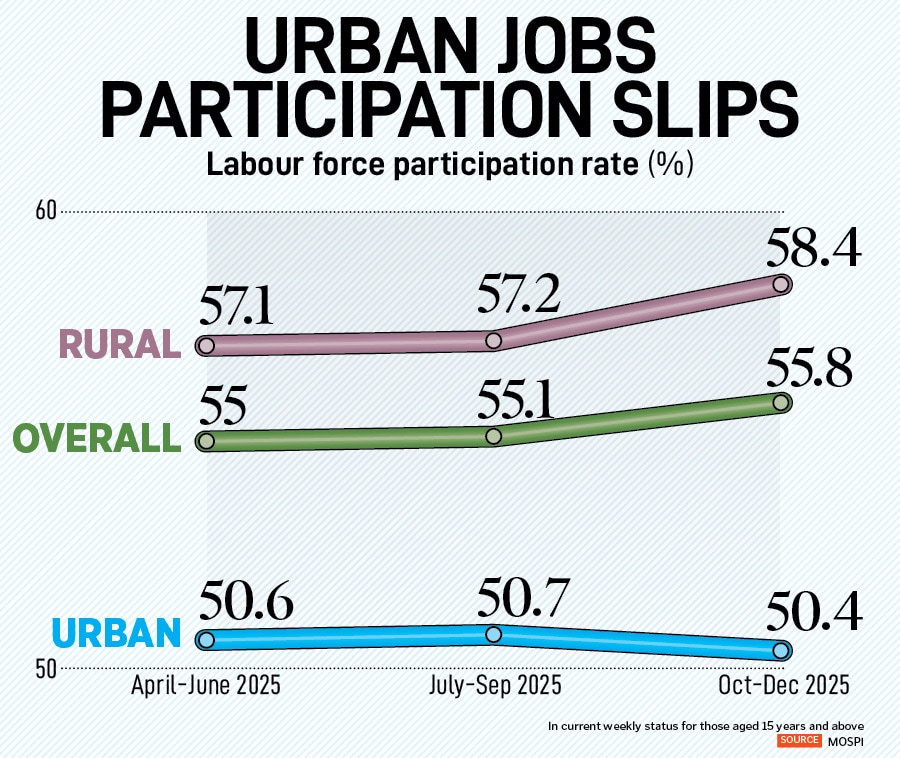
Urban labour force participation slipped marginally to 50.4 percent in the October-December 2025 quarter, from 50.7 percent in the previous quarter, even as unemployment rates declined across both urban and rural areas, according to government data released on Tuesday.
The urban dip contrasts with rural areas, where labour force participation rose to 58.4 percent from 57.2 percent, driving overall participation higher to 55.8 percent from 55.1 percent. This highlights persistent structural differences between urban and rural employment dynamics.
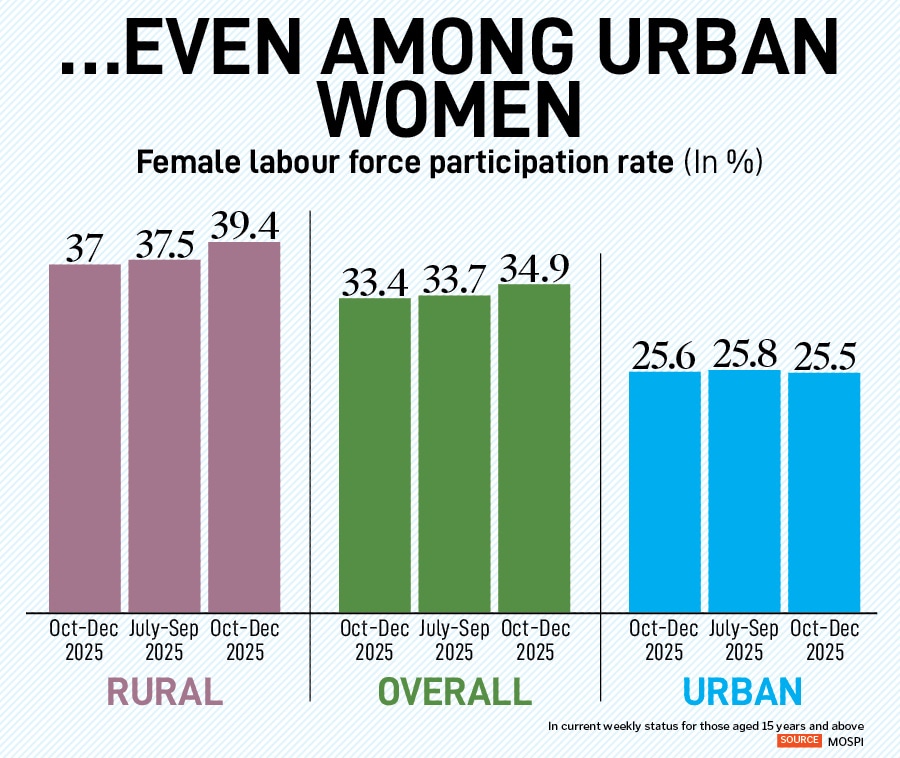
Female labour force participation in urban areas showed particular weakness, declining to 25.5 percent from 25.8 percent in the July-September quarter—also its lowest figure in three quarters. However, rural women demonstrated stronger workforce engagement, with participation rising to 39.4 percent from 37.5 percent. Overall female labour force participation increased to 34.9 percent from 33.7 percent, driven primarily by rural gains. The persistent gap between urban and rural female participation rates underscores the continuing barriers women face in accessing urban employment opportunities.
Despite the marginal decline in urban participation, employment rates improved across the board. Urban unemployment for persons aged 15 years and above decreased to 6.7 percent from 6.9 percent in the previous quarter, driven by a decline in male unemployment from 6.2 percent to 5.9 percent. Rural unemployment fell more sharply to 4.0 percent from 4.4 percent, with reductions reported for both men and women.
Self-employment emerged as a growing employment category in both geographies. In rural areas, self-employed persons increased to 63.2 percent from 62.8 percent, while urban self-employment rose to 39.7 percent from 39.3 percent. The rise in self-employment, particularly in urban areas where it coincided with declining labour force participation, suggests workers may be opting for informal or gig-based work arrangements.
Sectoral patterns remained largely stable. Agriculture continued to dominate rural employment, accounting for 58.5 percent of workers in October-December, up from 57.7 percent in the previous quarter. Urban areas maintained their service-sector orientation, with the tertiary sector engaging 61.9 percent of workers.
The data indicates that while unemployment is declining, urban labour markets face challenges in drawing more people into the workforce, particularly women. The decrease in urban participation alongside an uptick in self-employment indicates a shift in the composition of the workforce, potentially reflecting a move away from formal employment.
Rural areas, by contrast, show stronger workforce engagement trends, though the concentration in agriculture and the rise in self-employment suggest limited structural transformation in employment patterns.
First Published: Feb 10, 2026, 19:03
Subscribe Now