From daily earnings to long-term security: Platforms drive financial protection ...
Bridging daily earnings to long-term security through innovation and collaboration
By
Prefer us on GoogleLast Updated: Mar 31, 2026, 18:32 IST6 min
India’s platform economy is no longer a peripheral source of flexible work. It is a rapidly evolving ecosystem that engages approximately 1.2 crore people, according to the Economic Survey 2025–26. As the sector matures, industry players have been proactively investing in initiatives that address a critical question: how can daily earnings translate into long-term financial security?
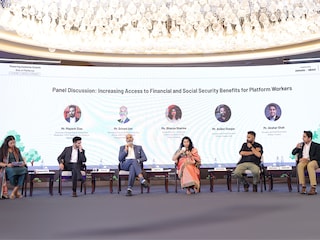
This conversation took centre-stage during a panel discussion on ‘Increasing Access to Financial Inclusion and Social Security Benefits for Platform Workers’ at the third edition of the Powering Inclusive Growth: Role of Platforms conference, organised by Zomato and Blinkit in collaboration with Startup India, DPIIT in New Delhi. The panel featured Mayank Dias, Advocate, Michael Dias & Associates and Moderator, FICCI Taskforce for Platform Aggregators; Sriram Iyer, Managing Director and Chief Executive Officer, HDFC Pension Fund Management Limited; Bhavya Sharma, Senior Director – Corporate Communications and ESG, Urban Company; Aniket Doegar, Founder, Haqdarshak and Akshar Shah, Founder and Chief Executive Officer, Fixerra. They shared insights on how platforms, policy and technology can work together to strengthen financial security for gig workers.
Under this framework, gig workers are eligible for social protection benefits across areas such as life and disability cover, accident insurance, health and maternity benefits, childcare support and old-age protection.
Zomato and Blinkit’s active delivery partners are covered under health insurance with coverage of ₹1 lakh for hospitalization and day care, along with personal accident insurance providing accidental death cover of ₹10 lakh, with premiums fully borne by the platforms. The plans also include ICU expenses, and OPD coverage of up to ₹5,000 over and above the health insurance. In 2025 alone, Zomato and Blinkit spent over ₹100 crore on insurance coverage.
Financial literacy initiatives complement these efforts. In collaboration with the National Stock Exchange, Zomato conducted over 100 financial literacy camps in a matter of just 10 months. In addition, Zomato’s delivery partner app offers in-app learning modules, explaining savings and investments via a dedicated feature of ‘Finance Guru’.
Acknowledging platform workers’ need for liquidity, Zomato also partnered with Clear Tax helping delivery partners engaged with them file their income tax returns. In AY2025-26 alone, nearly 1.2 lakh returns were filed and refunds amounting to over Rs 18 crore were received by delivery partners. Beyond these refunds, filing returns gave them access to institutional loans from the formal financial system.
Other platforms in the ecosystem, like Urban Company, have also been rolling out such initiatives. Service professionals engaged with their platform have been given access to insurance, credit and retirement planning tools through platform partnerships. “Once basic earnings are met, the next set of needs—critical to ensuring dignity of work and a secure livelihood—include retirement planning, emergency funds, and savings and investments,” noted Bhavya Sharma. “If they were not associated with the platform, they would probably not have access to the formal banking system or even NBFCs. That’s the value that platforms have unlocked.”
In partnership with the Pension Fund Regulatory and Development Authority (PFRDA) and HDFC Pension Fund Management, Zomato piloted the NPS Platform Workers Model, which allows delivery partners to contribute small, voluntary amounts towards retirement savings. The system leverages digital onboarding and simplified KYC processes, allowing contributions to be made seamlessly through the platform ecosystem.
Sriram Iyer pointed out, “The Platform Workers Model was successful because it was adapted to the platform workers’ needs rather than the other way around. There was exceptional flexibility offered in the NPS model for them. They were able to contribute as per their schedule and amounts that they were comfortable with. In addition, the platform facilitated execution; they simply had to opt for the amount they wanted to contribute and it would be automatically deducted from their earnings and transferred to their NPS account. All this built trust and led to a growth in contributions.”
Aniket Doegar of Haqdarshak, an organization that has been helping citizens access government schemes for over a decade, emphasized that India already has an extensive architecture of welfare mechanisms, from health insurance and pensions to cash transfers and accident coverage, that gig and platform workers can access. “While the architecture exists,” he explained, “the next phase is about improving access and making sure platform workers can navigate these programmes effectively. Technology and continuous engagement will play a crucial role in connecting workers to these entitlements more efficiently.”
“Digital public infrastructure allows both discovery and access,” recounted Akshar Shah. “Workers can view multiple financial options directly within the apps they already trust, without having to navigate different banks or physical branches.”
In partnership with Fixerra, Zomato has enabled customized financial products, such as fixed deposits and recurring deposits with low-entry amounts. Delivery partners can explore the savings instruments directly from their platform interface, investing as low as ₹100 in recurring deposits, allowing them to build savings gradually. These efforts resulted in delivery partners engaged with Zomato to invest over ₹2.5 crore, within a period of one year.
The pages slugged ‘Brand Connect’ are equivalent to advertisements and are not written and produced by Forbes India journalists.
First Published: Mar 31, 2026, 18:34
Subscribe Now